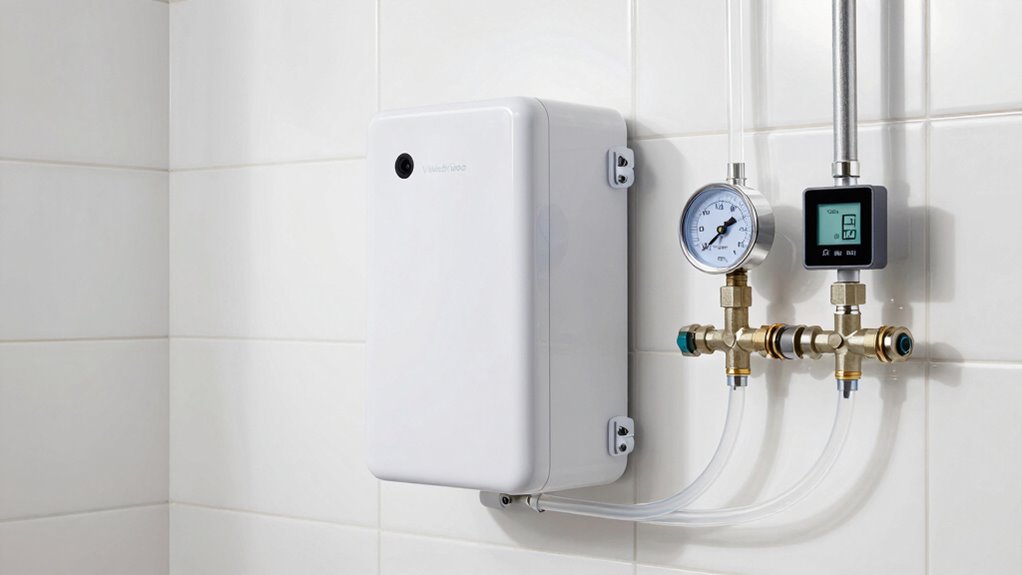

When choosing a whole-house RO system, it’s important to match the GPD rating to your household’s actual water use. Calculate daily needs for drinking, laundry, and other activities to determine a realistic demand. Overestimating slightly provides a buffer for peak times and future growth, while avoiding unnecessarily large, costly units. Remember, the system’s rated capacity is maximum, so understanding your real-world usage helps select the most efficient size—more details will guide you to the best fit.
Key Takeaways
- GPD ratings indicate maximum system capacity; actual household use is often lower.
- Match RO system size to daily household consumption to avoid overspending and unnecessary energy use.
- Overestimating GPD provides a buffer for peak demands and future household growth.
- Proper sizing ensures efficient operation, reduces maintenance needs, and extends system lifespan.
- Consider household water needs variability and source quality when selecting a GPD rating.

Are you wondering how to determine the right size of a whole-house reverse osmosis (RO) system? Choosing the appropriate capacity is essential to guarantee your water filtration needs are met without overspending or underperforming. When sizing your system, you should start by estimating your daily water consumption. This means calculating how many gallons of water your household uses on a typical day, including everything from drinking water to laundry and dishwashing. Knowing this helps you select a system with the right gallons per day (GPD) rating, which indicates its maximum production capacity. Keep in mind that the system’s GPD rating is a theoretical maximum; in real-world usage, your actual consumption may be lower, so overestimating slightly can provide a buffer for peak times.
Estimating your household’s daily water use helps in choosing the right-sized whole-house RO system.
It’s tempting to simply choose a system rated for the highest GPD you see on the market, but that can lead to unnecessary expense and energy use. Instead, consider your household’s actual needs. For example, if your household consumes around 75 gallons daily, selecting a 100 GPD system might be more than enough, providing room for future growth or unexpected water demands. Remember, water filtration isn’t just about capacity; system maintenance also plays an essential role. A larger system requires more upkeep, such as filter replacements and membrane checks, so balancing capacity with ease of maintenance ensures your system remains efficient and reliable over its lifespan.
Additionally, understanding the difference between peak and average usage helps in sizing your system accurately. If you host guests regularly or have family members with varying water needs, you might experience days where your consumption exceeds normal levels. In such cases, opting for a system with a higher GPD rating can prevent shortages and maintain consistent water quality. Furthermore, consider your water source quality; if your feed water has high levels of contaminants, a larger or more robust system may be necessary to handle filtration demands effectively. Also, exploring deep‑sky imaging techniques can inspire your water management practices, just as precision in imaging requires proper equipment sizing.
Finally, keep in mind that a properly sized whole-house RO system not only supplies clean water but also reduces the frequency of system maintenance. Smaller systems might need more frequent filter changes, which can become cumbersome. Conversely, a well-sized unit designed for your household’s demand will run more efficiently and require less frequent upkeep, saving you time and money in the long run. Proper sizing, based on realistic usage and maintenance considerations, ensures your water filtration system performs at its best, providing safe, great-tasting water for your entire home.
Frequently Asked Questions
How Often Should I Replace the RO Membrane?
You should replace your RO membrane roughly every 2 to 3 years, depending on your water quality and usage. Follow the replacement schedule recommended by the manufacturer to guarantee peak performance. The membrane lifespan can vary, but regular maintenance and monitoring your system’s output will help you identify when it’s time for a replacement. Staying proactive prevents reduced water quality and system damage.
Can a Whole-House RO System Remove Chemicals and Heavy Metals?
Did you know that RO systems can remove up to 99% of contaminants? A whole-house RO system effectively handles chemical removal and heavy metal filtration, making your water safer. It’s designed to reduce pollutants like lead, arsenic, and pesticides, providing cleaner, healthier water for your entire home. Keep in mind, regular maintenance guarantees the best removal, so check your membranes and filters periodically for consistent, reliable protection.
What Is the Maintenance Cost for a Whole-House RO System?
Your maintenance expenses for a whole-house RO system typically range from $100 to $300 annually, depending on usage and water quality. You’ll need to follow a regular replacement schedule for filters and membranes, usually every 6 to 12 months. Regular maintenance helps prevent clogs and guarantees peak performance, saving you money over time. Keep an eye on system performance and replace parts promptly to avoid costly repairs.
How Does Water Temperature Affect RO System Efficiency?
Imagine water flowing smoothly through your system like a gentle stream; when water temperature drops, your RO system’s efficiency dips, like a stream freezing in winter. Cooler water causes increased viscosity, slowing filtration, while warmer water boosts system efficiency by reducing resistance. So, temperature effects are vital—maintaining ideal warmth helps your system run smoothly, maximizing filtration and protecting your investment in clean, fresh water.
Is a Booster Pump Necessary for Optimal RO Performance?
A booster pump is often necessary for ideal RO system performance, especially if your water pressure is low. It increases water flow and pressure, ensuring the membrane functions efficiently and produces better-quality water. Without a booster pump, your system might struggle to reach its full capacity, leading to slower production rates and potential membrane damage. Adding a booster pump helps maintain consistent pressure, maximizing your entire RO system’s performance.
Conclusion
When sizing your whole-house RO system, don’t rely solely on gallons per day estimates. Instead, observe your actual water usage to get a clear picture. Think of it like measuring a container—visualize your daily needs to avoid over- or under-sizing. By understanding real-world consumption, you make certain your system meets your household’s demands efficiently. Accurate sizing saves you money and guarantees clean, reliable water, making your home’s water system both effective and sustainable.