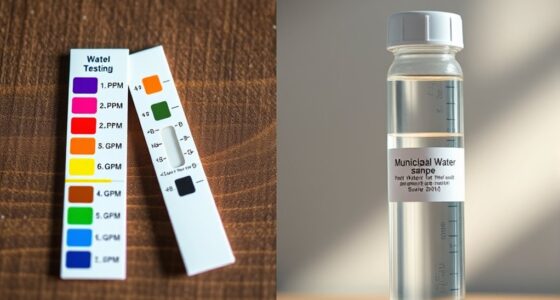
To guarantee your UV sterilizer works effectively, you need to match it precisely to your flow rate in GPM. An undersized unit won’t deliver enough UV dose, letting bacteria or viruses slip through. Conversely, an oversized sterilizer can waste energy and cost more. Proper sizing guarantees pathogen elimination and system efficiency. If you want to avoid these issues, understanding how to select the right size is key—more details are just a step away.
Listen free for 30 days with Audible
Thousands of audiobooks and originals — cancel anytime.
As an affiliate, we earn on qualifying purchases.
Key Takeaways
- Accurate flow rate calculation ensures the UV sterilizer delivers the required UV dose for effective sterilization.
- Match the sterilizer’s capacity to your system’s maximum GPM to prevent under- or over-exposure.
- Oversized units with inadequate flow can cause insufficient pathogen contact, reducing sterilization effectiveness.
- Undersized sterilizers may not handle peak flow rates, leading to decreased UV intensity and compromised safety.
- Consider future system expansion when sizing to maintain performance and avoid mismatched flow and sterilizer capacity.

Choosing the right UV sterilizer size is essential to effectively eliminate bacteria and viruses from your water or air. If you pick a unit that’s too small, it won’t deliver the necessary UV dose to neutralize harmful pathogens, risking compromised safety. Conversely, selecting a sterilizer that’s too large can be inefficient, wasting energy and increasing costs without providing additional benefits. To ensure your sterilizer performs optimally, you need to understand two key factors: the UV lamp lifespan and flow rate calculation. These elements directly influence the effectiveness and longevity of your sterilizer.
The UV lamp’s lifespan is a critical consideration because it determines how often you’ll need to replace the bulb to maintain sterilization efficiency. Most UV lamps last between 9,000 and 12,000 hours of use, but this can vary based on the model and operating conditions. Overestimating the lamp lifespan might lead you to neglect timely replacements, resulting in decreased UV intensity and compromised sterilization. Regularly checking the lamp’s condition and adhering to manufacturer recommendations ensures continuous protection. When sizing your sterilizer, keep in mind that a lamp nearing the end of its life produces less UV light, which can lower the sterilizer’s effectiveness, especially if flow rates are not adjusted accordingly.
Flow rate calculation is your next crucial step. This involves determining how much water or air passes through the sterilizer per minute (GPM—gallons per minute). Your goal is to match the sterilizer’s flow rate with your application’s volume. If your flow rate exceeds the unit’s capacity, the water or air may not receive enough UV exposure to inactivate pathogens completely. This mismatch can lead to insufficient sterilization and potential health risks. To accurately perform the flow rate calculation, measure your total volume and consider the desired contact time—the duration the water or air spends under UV exposure. A larger flow rate requires a more powerful or larger sterilizer to ensure each molecule receives the necessary UV dose. Additionally, understanding the navigation and mapping of your sterilization system can help optimize flow paths and improve overall effectiveness.
Failing to match the UV sterilizer size to your flow rate can result in underperformance, regardless of the lamp’s quality. It’s vital to select a sterilizer that can handle your maximum flow rate comfortably, preferably with some margin for future expansion or fluctuations. By carefully calculating your flow rate and choosing a UV sterilizer with an appropriate lamp lifespan in mind, you’ll optimize both the safety and efficiency of your sterilization system. Remember, a well-sized UV sterilizer not only guarantees pathogen elimination but also extends the lifespan of your equipment and reduces maintenance costs over time.
Frequently Asked Questions
Can I Use a Larger UV Sterilizer for My Smaller System?
You shouldn’t use a larger UV sterilizer for your smaller system, as it can cause system compatibility issues and size limitations. A bigger sterilizer may not fit properly and could lead to inefficient sterilization or damage. To guarantee peak performance, match the UV sterilizer size to your system’s flow rate. Using the right size ensures effective sterilization without risking system issues or unnecessary energy use.
How Does Water Temperature Affect UV Sterilizer Efficiency?
Water temperature crucially impacts UV sterilizer efficiency. Warmer water increases the sterilization efficiency because UV light penetrates better and kills microbes more effectively. Conversely, colder water reduces UV effectiveness, making sterilization less reliable. To guarantee ideal results, you should monitor water temperature and, if necessary, adjust your system or preheat the water. Keeping water at the recommended temperature range maximizes UV sterilizer performance and ensures safer, cleaner water.
What Maintenance Is Required for Optimal UV Sterilizer Performance?
Think of your UV sterilizer as a vigilant guard; to keep it sharp, you must perform regular system cleaning and replace the UV bulb when it dims. You’ll want to check the bulb every 12 months and clean the quartz sleeve to prevent buildup. This routine keeps the UV light shining brightly, ensuring your water stays safe and pure, just like a well-armed sentinel protecting its domain.
Are There Specific UV Wavelengths That Work Best for Sterilization?
You should look for UV sterilizers that use a wavelength around 254 nanometers, as this UV wavelength is most effective for sterilization. It targets DNA and RNA, disrupting microorganisms’ reproductive abilities and increasing sterilization effectiveness. Using a device with the right UV wavelength ensures you get the best germ-killing results, providing safer water or surfaces. Always check the product specifications to confirm it emits at this suitable wavelength for sterilization.
How Long Does a UV Sterilizer Bulb Typically Last?
Your UV sterilizer bulb typically lasts about 9 to 12 months, depending on usage and water quality. You should plan for replacement frequency around once a year to maintain ideal sterilization performance. Keep an eye on the bulb’s lifespan, as over time it loses effectiveness, reducing UV output. Regularly check your bulb and replace it when it reaches the end of its lifespan to guarantee your sterilizer works efficiently.
Conclusion
To guarantee your UV sterilizer works perfectly, you must match its size to your flow rate, not just guess or overlook the GPM. Measure accurately, select wisely, and avoid under- or over-sizing. Keep your water clean, keep your system efficient, and keep your confidence high. Remember, proper sizing is the key to effective sterilization. When you align your UV sterilizer with your GPM, you guarantee ideal performance and peace of mind.
NFL season / tailgating Picks
team gear
As an affiliate, we earn on qualifying purchases.