To size your water softener correctly, consider your household’s daily water use and water hardness level. Typically, a softener with a capacity of 32,000 grains suits a family of four, while larger households or high-demand situations need 40,000 grains or more. Proper sizing reduces regeneration frequency, saves salt, and improves efficiency. If you want to make sure you choose the right capacity for your needs, there’s more to explore on how to make the best selection.
Key Takeaways
- Determine household water usage and water hardness to calculate required softener capacity in grains.
- Match softener grain capacity with household demand to prevent frequent regenerations or oversizing.
- Use the formula: daily water consumption (gallons) x water hardness (gpg) to estimate needed grains.
- Larger families or high-demand households need softeners with 40,000+ grain capacity for efficiency.
- Consider additional features like iron removal if your water contains iron to maintain system performance.
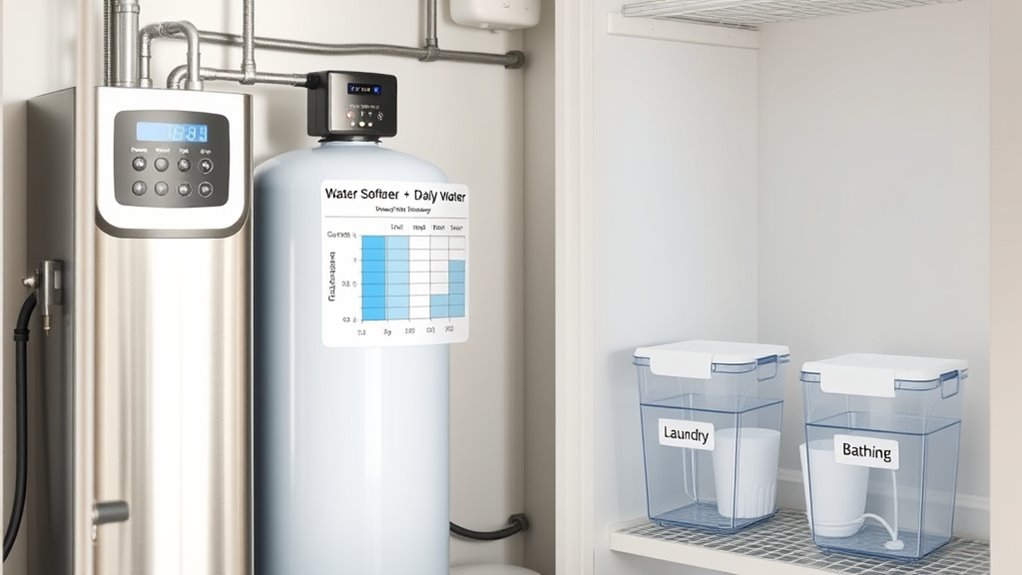
Have you ever wondered how to choose the right size water softener for your home? It’s a critical step to guarantee your water treatment system works effectively without wasting resources. Sizing a water softener isn’t just about fitting it into your space; it’s about matching its capacity to your household’s water usage and water quality. One key factor is understanding grain capacity, which determines how much hardness the unit can handle before needing regeneration. If you select a softener that’s too small, it’ll run out of softening ability quickly, leading to more frequent regenerations and increased salt consumption. Conversely, choosing a unit that’s too large might be unnecessary and more expensive than you need, wasting space and energy.
When it comes to grain capacity, you’ll want to take into account your family’s water usage patterns. For example, a household of four with moderate water use might need a softener with a capacity of around 32,000 grains. Larger families or homes with high water demand might require units with capacities of 40,000 grains or more. To determine the right size, estimate your household’s daily water consumption and multiply it by the hardness level of your water, which is measured in grains per gallon (gpg). This calculation helps you find a softener that can meet your needs without frequent regeneration, saving you money on salt and water. Efficient salt use is essential; a properly sized softener minimizes salt waste and maximizes salt efficiency, which is better for your wallet and the environment. Understanding bank swiftifs codes can be helpful if you need to transfer funds for installation or maintenance services.
Another essential aspect to consider is iron removal. If your water contains iron, you’ll need a softener capable of handling iron levels efficiently. Iron can stain fixtures and laundry and also clog the resin bed, reducing efficiency. Choosing a softener with a higher capacity or one equipped with specialized iron removal media ensures your system manages iron effectively. This not only improves water quality but also prevents the need for frequent maintenance. Proper sizing combined with iron removal features guarantees your softener operates smoothly, maintains salt efficiency, and keeps your water clear and clean.
Frequently Asked Questions
How Often Should I Regenerate My Water Softener?
You should regenerate your water softener when the salt recharge level gets low, usually every 7 to 14 days, depending on your water usage. Regular regeneration ensures peak efficiency and prevents mineral buildup. Keep an eye on the salt level and schedule recharges accordingly. Doing so helps maintain your softener’s performance, prolongs its lifespan, and keeps your water consistently soft. Adjust frequency based on your household’s water consumption for best results.
Can I Upgrade My Water Softener Capacity Later?
Yes, you can upgrade your water softener capacity later. A softener upgrade is possible if your household water needs grow or you notice reduced efficiency. Look for models that allow capacity expansion or consider replacing your unit with a larger one. Just make certain the new softener is compatible with your plumbing and that professional installation is done if necessary. Upgrading ensures you maintain soft water without sacrificing performance.
Does Water Hardness Vary Seasonally Affecting Softener Need?
Yes, water hardness can vary seasonally due to mineral fluctuations, impacting your softener’s effectiveness. During certain times of the year, increased mineral content from runoff or changes in water source may require you to adjust your softener’s settings or regenerate more frequently. Monitoring your water quality regularly helps you stay ahead of seasonal variations, ensuring your softener continues to work efficiently and keeps your water soft.
Are There Health Concerns With Softened Water?
Don’t worry, softened water is generally safe to drink, but it’s worth keeping an eye on your health safety. Softening removes minerals like calcium and magnesium, which are crucial for mineral intake. Some people worry about sodium levels increasing in softened water, but for most, it’s not a concern. If you have health issues or are on a low-sodium diet, consult your doctor to guarantee softened water suits your needs.
How Does Well Water Affect Softener Sizing?
Well water’s mineral content considerably impacts softener sizing, as it often contains higher levels of calcium and magnesium compared to city water. You need a larger grain capacity softener to effectively remove these minerals and prevent scale buildup. By understanding your well water’s mineral levels, you can choose a softener that efficiently handles the mineral load, ensuring your water stays soft and your system operates reliably.
Conclusion
Now that you know how to size your water softener based on grain capacity and family water usage, you’re ready to tame the rough waters ahead. Think of your softener as a trusty ship, steering smoothly through the rough seas of hard water. By choosing the right size, you’ll guarantee your household runs like a well-oiled machine, sparkling and protected. With this knowledge, you’ve got the power to keep your water soft and your home happy.