For buyers comparing the best water heaters, I’d put the Ranein 8.5 GPM indoor natural gas model first for its high stated flow rate and output, with the GE 18-gallon electric heater standing out for smaller hot-water needs and the portable propane model for off-grid use. The main choice is between a storage tank that holds a limited supply and tankless models that heat water on demand, with fuel type and installation requirements narrowing the field further. A larger flow rating can help serve multiple fixtures, but it does not replace checking your climate, gas supply, venting, and household demand. Read on for how these seven options compare and which tradeoffs matter for your setup.

Get home appliances delivered free — and shop member deals
- Fast, free delivery on millions of items
- Access to Prime Big Deal Days deals on October 6–7
- Prime Video, Amazon Music and more included
Complete the kit


![[Genuine] Waterdrop PF-01A Water Filter Replacement for W...](https://m.media-amazon.com/images/I/41+5tl9EiKL._SX342_SY445_QL70_FMwebp_.jpg)
Key Takeaways
- Ranein leads on stated capacity: Its 8.5 GPM and 190,000 BTU ratings are the highest listed among the indoor gas models here, which may suit heavier simultaneous demand when the home’s supply and installation support it.
- The GE serves a different need: Its 18-gallon tank stores a limited reserve, making it a better fit for modest demand or a point-of-use role than a whole-home tankless replacement.
- Portable propane models trade convenience for scope: The 18L unit is suited to temporary or off-grid hot water, while fixed indoor gas heaters are designed around a permanent installation.
- Electrical compatibility can rule out compact tankless units: The 110V, 3000W heater has a modest electrical specification, so buyers should check whether its output fits the intended fixture and local conditions.
- Flow ratings are not directly interchangeable: The listed 7.6 to 8.5 GPM figures on gas models do not account for incoming water temperature, plumbing, or installation; buyers should compare usable output for their own climate and demand.
| CAMPLUX Indoor Natural Gas Tankless Water Heater, Up to 7.6 GPM |  | Best Overall for High-Flow Indoor Use | Fuel type: Natural gas | Flow rate: 6.86 GPM listed; up to 7.6 GPM advertised | Maximum input: 199,000 BTU | VIEW LATEST PRICE | See Our Full Breakdown |
| 110V 3000W Electric Tankless Water Heater with Digital Display | 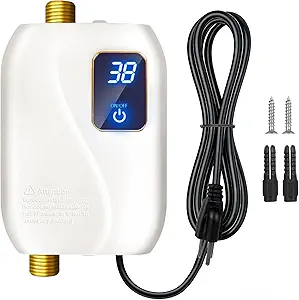 | Best for a Single Sink | Voltage and power: 110 V; 3,000 W | Temperature rise: 82°F at 0.3 GPM; 131°F at 0.5 GPM | Display: LED digital display | VIEW LATEST PRICE | See Our Full Breakdown |
| GE Appliances 18-Gallon Electric Water Heater with Adjustable Thermostat |  | Best Compact Tank Heater | Capacity: 18 gallons | Power supply: 120 V | Water connections: 3/4-inch NPT | VIEW LATEST PRICE | See Our Full Breakdown |
| 18L Portable Propane Tankless Water Heater with Digital Display |  | Best for Camping and Outdoor Washing | Fuel type: Propane | Capacity: 18 L | Maximum heating output: 115,425 BTU/hour | VIEW LATEST PRICE | See Our Full Breakdown |
| APUS Natural Gas Tankless Water Heater, 140,000 BTU, 6.8 GPM, Indoor |  | Best for App Control | Power source: Natural gas | Heat output: 140,000 BTU | Maximum flow rate: 6.8 GPM | VIEW LATEST PRICE | See Our Full Breakdown |
| Ranein Indoor Natural Gas Tankless Water Heater, 8.5 GPM, 190,000 BTU |  | Best for Higher Hot-Water Demand | Fuel: Natural gas | Maximum flow rate: 8.5 GPM | Heat output: 190,000 BTU | VIEW LATEST PRICE | See Our Full Breakdown |
| Westinghouse Indoor Natural Gas Tankless Water Heater, 7.9 GPM, 180,000 BTU |  | Best for Connected Temperature Control | Fuel and installation: Natural gas; indoor | Maximum flow rate: 7.9 GPM | Heating capacity: 180,000 BTU | VIEW LATEST PRICE | See Our Full Breakdown |
| water heater | Maximum flow rate |
|---|---|
| CAMPLUX Indoor Natural Gas Tan | — |
| 110V 3000W Electric Tankless W | — |
| GE Appliances 18-Gallon Electr | — |
| 18L Portable Propane Tankless | 4.76 GPM |
| APUS Natural Gas Tankless Wate | 6.8 GPM |
| Ranein Indoor Natural Gas Tank | 8.5 GPM |
| Westinghouse Indoor Natural Ga | 7.9 GPM |
More Details on Our Top Picks
CAMPLUX Indoor Natural Gas Tankless Water Heater, Up to 7.6 GPM
I’d put the CAMPLUX near the top for households seeking a high-flow indoor tankless heater. Its listed flow rate is 6.86 GPM, while the advertised maximum is 7.6 GPM, so I’d size a home around the listed figure and confirm capacity for simultaneous showers and taps. Its 199,000 BTU maximum input is higher than the APUS’s 140,000 BTU, giving this model more burner capacity on paper; the APUS counters with Wi-Fi control and a built-in booster pump. The CAMPLUX’s wall-mounted form saves floor space, and freeze protection adds a layer of cold-weather defense. That protection does not remove winter care: the unit needs annual descaling and winterization below 20°F. I’d choose it for flow potential, provided its gas and venting requirements fit the home.
Pros:- Tankless operation supplies hot water on demand without tank preheating.
- High advertised flow capacity and 199,000 BTU maximum input suit heavier household demand.
- Wall-mounted design frees floor space.
- CSA certification and multiple safety protections.
Cons:- Listed 6.86 GPM flow rate differs from the advertised maximum of 7.6 GPM.
- Annual descaling adds routine upkeep.
- Winterization is required below 20°F despite built-in freeze protection.
Best for: Households replacing an indoor natural gas heater that want strong flow potential for several hot-water outlets.
Not ideal for: Buyers who want verified flow figures without a discrepancy or minimal cold-weather maintenance.
- Fuel type:Natural gas
- Flow rate:6.86 GPM listed; up to 7.6 GPM advertised
- Maximum input:199,000 BTU
- Heat output:170,000 BTU/hour
- Power:120 V, 58 W
- Maximum temperature:149°F
- Connections:3/4-inch NPT
- Mounting and weight:Wall-mounted; 37.5 lb
- Certification and maintenance:CSA certified; annual descaling
Our verdict“Choose the CAMPLUX for an indoor natural gas installation where high flow potential matters and seasonal maintenance is manageable.”
110V 3000W Electric Tankless Water Heater with Digital Display
I see this 3,000W electric unit as a point-of-use heater for a sink, kitchenette, or similar fixture, rather than a whole-home solution. Its small wall-mounted body and LED display make it easier to place near a single tap and check operating status. The temperature-rise figures clarify its limits: it lists an 82°F rise at 0.3 GPM and 131°F at 0.5 GPM, while showers typically need at least 1.8 GPM. Compared with the GE 18-gallon tank heater, this model avoids storing a small batch of hot water, but it can’t serve as a shower heater. Installation also needs vertical mounting and a circuit over 32A, which may call for electrical work. I’d pick it for one low-flow outlet when compact, on-demand service matters.
Pros:- Compact wall-mounted format fits near a single point of use.
- On-demand heating avoids keeping stored water hot.
- LED display shows operating status and supports Fahrenheit or Celsius.
- Includes leakage, dry-boil, and overheating protections.
Cons:- Not suitable for showers or typical whole-home demand.
- Requires vertical installation and a circuit over 32A.
- Its low-flow output limits use to a single fixture.
Best for: Owners adding hot water to a remote utility sink, kitchenette, or RV fixture with low flow needs.
Not ideal for: Households seeking a shower heater or a multi-fixture whole-home unit; its output is specified for low flow.
- Voltage and power:110 V; 3,000 W
- Temperature rise:82°F at 0.3 GPM; 131°F at 0.5 GPM
- Display:LED digital display
- Thermal efficiency:Up to 98%
- Connections:1/2-inch NPT
- Installation:Vertical, wall-mounted
- Recommended circuit:Over 32A
- Warranty:24 months
Our verdict“Choose this unit for a low-flow sink where compact on-demand heating is useful and the electrical circuit can support it.”
GE Appliances 18-Gallon Electric Water Heater with Adjustable Thermostat
The GE 18-gallon electric heater is the tank option I’d favor for a small home, condo, or single hookup where a modest reserve of hot water is more useful than high continuous flow. Its adjustable thermostat lets the owner set the desired temperature, and the stainless steel heating element is designed to resist rust and corrosion. Unlike the CAMPLUX tankless unit, this GE stores heated water, so it can supply a brief draw without depending on burner output at that moment; once its limited reserve is depleted, recovery takes time. It can also work as an inline booster, giving it flexibility that the compact 3,000W sink heater lacks. The tradeoff is capacity: 18 gallons can feel restrictive for larger households or overlapping showers. I’d choose it where compact storage and simple 120-volt power suit the installation.
Pros:- 18-gallon stored supply suits modest hot-water needs.
- Can operate as a standalone heater or inline booster.
- Adjustable thermostat gives control over set temperature.
- Stainless steel heating element resists rust and corrosion.
Cons:- Limited capacity can run short during larger or overlapping draws.
- Requires compatible 120-volt power and 3/4-inch NPT plumbing.
Best for: Condo residents, small households, or owners adding a modest hot-water reserve to one hookup.
Not ideal for: Larger families or homes with frequent simultaneous draws that can exceed an 18-gallon reserve.
- Capacity:18 gallons
- Power supply:120 V
- Water connections:3/4-inch NPT
- Thermostat:Adjustable
- Heating element:Stainless steel
- Anode rod:Included
Our verdict“Choose the GE for a small household or single hookup that benefits from a compact stored-water reserve.”
18L Portable Propane Tankless Water Heater with Digital Display
For outdoor washing at a campsite or RV setup, this portable propane heater serves a different purpose from the indoor CAMPLUX and APUS units. Its stated maximum flow is 4.76 GPM, with up to 115,425 BTU/hour of heating output, and the included one-button shower head offers a ready-made way to use that hot water outdoors. The digital display and six listed safety protections add useful controls for a portable setup. The temperature range tops out at 113°F, which may suit washing but offers less headroom than the CAMPLUX’s 149°F maximum. Its role is also tied to location: it is designed for outdoor use, so I would not treat it as a permanent indoor household heater. I’d choose it for portable hot-water access where propane is available and outdoor installation fits the plan.
Pros:- Portable format suits camping and RV use.
- Maximum listed flow is 4.76 GPM.
- One-button shower head is included.
- Six listed safety protections cover several operating conditions.
Cons:- Requires a propane supply.
- Outdoor-use design limits installation options.
- Maximum temperature of 113°F is below the CAMPLUX’s stated 149°F maximum.
Best for: Campers, RV owners, and outdoor users who want portable hot water for washing.
Not ideal for: Buyers seeking a permanent indoor heater or a unit that does not depend on a propane supply.
- Fuel type:Propane
- Capacity:18 L
- Maximum heating output:115,425 BTU/hour
- Maximum flow rate:4.76 GPM
- Temperature range:17°F–113°F
- Display:Digital
- Safety protections:Overheat, dry combustion, antifreeze, low-flow ignition lockout, flame failure, and high-pressure relief
Our verdict“Choose this portable heater for outdoor washing when you have propane and need hot water away from a fixed household system.”
APUS Natural Gas Tankless Water Heater, 140,000 BTU, 6.8 GPM, Indoor
The APUS indoor tankless heater makes the most sense for buyers who value remote temperature control and a built-in booster pump. Its Tuya app connectivity lets owners adjust and monitor the unit remotely, while the stated range of 95°F to 140°F gives a clear setpoint window. The claimed maximum flow of 6.8 GPM is close to the CAMPLUX’s listed 6.86 GPM, though CAMPLUX advertises up to 7.6 GPM and has a higher 199,000 BTU maximum input. APUS uses a 140,000 BTU burner, so I’d compare household demand carefully instead of choosing on the pump’s maximum figure alone. The copper heat exchanger and freeze and overheat protections add practical features, but the unit must be fully drained during extended freezing conditions or non-use. Its energy and wait-time claims are manufacturer claims.
Pros:- Tuya app provides remote temperature control and monitoring.
- Built-in booster pump supports a stated maximum flow of 6.8 GPM.
- Compact wall-mounted design weighs 26.9 lb.
- Includes freeze and overheat protection.
Cons:- 140,000 BTU output is lower than the CAMPLUX’s 199,000 BTU maximum input.
- Must be fully drained during extended freezing conditions or non-use.
- Energy-saving and reduced wait-time statements are manufacturer claims.
Best for: Natural gas households that want app-based temperature control and a compact indoor wall-mounted heater.
Not ideal for: Buyers in freezing climates who cannot drain the system during prolonged cold or non-use.
- Power source:Natural gas
- Heat output:140,000 BTU
- Maximum flow rate:6.8 GPM
- Power:120 V, 44 W
- Temperature range:95°F–140°F
- Energy factor:UEF 0.81
- Heat exchanger:Oxygen-free copper
- Connectivity:Wi-Fi; Tuya app
- Dimensions and weight:7.09 × 21.26 × 13.58 in; 26.9 lb
Our verdict“Choose the APUS for app control and a built-in pump when its 140,000 BTU output matches your household’s hot-water demand.”
Ranein Indoor Natural Gas Tankless Water Heater, 8.5 GPM, 190,000 BTU
The Ranein leads this pair on listed capacity: up to 8.5 GPM and 190,000 BTU, compared with the Westinghouse’s 7.9 GPM and 180,000 BTU. That extra headroom may suit a home where several outlets draw hot water at once, while its wall-mounted design avoids taking up floor space for a storage tank. An LED display and adjustable-speed blower add useful operating controls. The tradeoff is a narrower installation fit: the manufacturer says it is not recommended above 2,000 feet, and the listed two-year warranty is shorter than the Westinghouse heat exchanger’s five-year coverage. In cold weather, the remaining water also needs draining through the pressure relief valve during extended non-use. I’d shortlist it for capacity only after checking the elevation guidance and installation requirements.
Pros:- Up to 8.5 GPM and 190,000 BTU for higher simultaneous hot-water demand
- On-demand heating avoids keeping a storage tank hot
- Wall-mounted form saves floor space
- LED display and adjustable-speed blower provide operating controls
Cons:- Manufacturer does not recommend installation above 2,000 feet
- Remaining water must be drained through the pressure relief valve during extended cold-weather non-use
- Listed warranty is two years
Best for: Households at or below 2,000 feet that regularly use several hot-water outlets and have compatible natural-gas plumbing.
Not ideal for: Homes above 2,000 feet, or owners who want longer listed heat-exchanger warranty coverage or minimal cold-weather upkeep.
- Fuel:Natural gas
- Maximum flow rate:8.5 GPM
- Heat output:190,000 BTU
- Maximum temperature:155 °F
- Maximum pressure:116 psi
- Power:120 V AC
- Dimensions:15.08 × 24.25 × 8.07 in
- Mounting:Wall mount
- Elevation guidance:Not recommended above 2,000 ft
Our verdict“Choose the Ranein if you need the higher listed flow capacity and your home meets its elevation and installation requirements.”
Westinghouse Indoor Natural Gas Tankless Water Heater, 7.9 GPM, 180,000 BTU
The Westinghouse gives up some listed capacity to the Ranein—7.9 GPM and 180,000 BTU versus 8.5 GPM and 190,000 BTU—but adds controls and operating details that may matter more in a connected home. Its Wi-Fi app and voice control offer remote access and fault alerts, while temperature stability within ±1°F targets fewer swings during use. A 0.53 GPM activation threshold and 15 PSI minimum pressure also support operation in lower-flow conditions. The product description says it can handle up to three simultaneous showers, though actual performance depends on the home’s incoming water conditions and demand. Installation requires natural gas, 120V AC, and 3/4-inch NPT plumbing. Warranty coverage is split: two years for the unit and five for the heat exchanger, so the longer term does not cover every component.
Pros:- Wi-Fi app and voice controls include fault alerts
- Listed temperature stability is within ±1°F
- 0.53 GPM minimum activation flow supports lower-flow draws
- Heat exchanger has a listed five-year warranty
Cons:- Lower listed flow and heat output than the Ranein
- Requires natural gas, 120V AC power, and 3/4-inch NPT plumbing
- Warranty terms vary between the unit and heat exchanger
Best for: Connected-home owners who want remote status and temperature control, with plumbing and gas service suited to an indoor natural-gas unit.
Not ideal for: Households prioritizing the highest listed flow in this pair, or buyers seeking one uniform warranty term for the whole unit.
- Fuel and installation:Natural gas; indoor
- Maximum flow rate:7.9 GPM
- Heating capacity:180,000 BTU
- Temperature stability:±1°F
- Minimum activation flow:0.53 GPM
- Minimum water pressure:15 PSI
- Connectivity:Built-in Wi-Fi; app and voice control
- Plumbing and power:3/4-inch NPT; 120V AC
- Warranty:2 years for unit; 5 years for heat exchanger
Our verdict“Pick the Westinghouse if app control, low-flow activation, and tighter stated temperature stability matter more than the Ranein’s higher capacity.”
How We Picked
I compared the seven models by fuel type, stated capacity, and intended setting, then considered how each specification might translate to household or portable use. For the indoor gas units, listed flow rate and BTU output helped distinguish their stated capacity, while the GE’s tank volume and the electric tankless unit’s voltage and wattage signaled narrower use cases. I also weighed usability clues, such as an adjustable thermostat or digital display, alongside the maintenance and installation demands implied by tank, indoor gas, and portable designs.
The ranking favors the best fit for a clearly defined buyer over a single specification in isolation. Ranein ranks first for its top listed flow and BTU figures among the indoor gas models; Westinghouse and CAMPLUX follow as other higher-capacity gas choices, with APUS offering a lower listed flow rate. The GE, portable propane, and 110V electric options rank for more specific needs, since their form factors or stated electrical capacity make them less direct whole-home contenders. I treat manufacturer ratings as comparison points, not guarantees of performance in every home.
Factors to Consider When Choosing Best Water Heaters
Before choosing a water heater, match the unit to your home’s hot-water demand, utilities, and installation conditions. A headline flow rate or tank size does not tell the whole story: incoming water temperature, plumbing layout, electrical capacity, venting, and local codes all shape what will work. These checks can help prevent buying a unit that is powerful on paper but mismatched to the space or supply available.
Estimate Peak Demand, Not Just Household Size
Count the fixtures likely to run at the same time, such as a shower and kitchen tap, rather than choosing by the number of people alone. A home with staggered schedules may need less simultaneous capacity than a smaller household with overlapping routines. Tankless ratings describe flow under specified conditions, and delivered hot-water flow can fall when incoming water is cold or several fixtures draw at once. Storage tanks instead provide a finite reserve that can run low during a long or repeated series of uses. Think through your busiest hour and the fixtures involved before comparing model ratings. If demand varies widely, a qualified installer can help size the system against actual fixture flow and local conditions.
Check Fuel, Power, Venting, and Codes Before Buying
A heater must match the services already available at its installation point, or the cost and scope of upgrades can change the decision. Gas models need a compatible fuel line, correct venting, and appropriate combustion air; indoor placement makes those details especially important. Electric units require a circuit capable of serving their specified voltage and wattage, and a small 110V model should not be assumed to supply a whole home. Portable propane models also need safe outdoor use and proper handling of the fuel cylinder. Check local permitting and code rules before purchase, since requirements vary by location. Getting an installer’s assessment early can identify constraints that product listings cannot show.
Choose Between Stored Hot Water and On-Demand Heating
A tank stores heated water, so it can cover a short burst of demand without heating at the exact moment of use, but its reserve is limited. Tankless systems heat water as it flows, which avoids relying on a fixed stored volume, but they need enough fuel or electrical capacity to meet the draw. The label “tankless” does not mean unlimited simultaneous hot water: capacity still depends on flow, temperature rise, and system sizing. Consider whether your priority is a compact footprint, a reserve for occasional use, or sustained demand across multiple fixtures. A small tank can also suit a secondary location where whole-home capacity is unnecessary. Choose the operating style that matches your routines, not just the technology label.
Account for Climate and Incoming Water Temperature
Water entering the heater is colder in some regions and seasons, so the unit must raise its temperature farther to deliver the same usable hot water. That temperature rise can reduce the flow a tankless heater can supply, even when its listed maximum looks generous. Buyers in colder climates should use performance tables for their local incoming water temperature rather than relying on a headline GPM figure. Storage heaters face their own practical limits: a cooler setting may stretch the supply but can affect comfort and sanitation choices. Ask the installer to size against the coldest expected inlet conditions and the desired delivery temperature. This check can matter more than small differences between advertised flow ratings.
Compare Installation and Long-Term Maintenance Needs
The purchase decision includes the space and work needed to install and maintain the unit. Indoor gas heaters require suitable venting and periodic checks; tankless equipment may also need flushing where mineral buildup is a concern. A storage tank takes up room and has a finite volume, while a portable heater needs a suitable setup each time it is used. Ask what routine service the manufacturer recommends, whether parts and service are available locally, and what warranty conditions apply. Existing plumbing or venting may reduce installation complexity, while a retrofit can call for more substantial work. A higher-capacity model is only a sound choice if its installation and upkeep are practical for the home.
Frequently Asked Questions
Can I use a portable propane water heater indoors?
Do not assume a portable propane model is safe for indoor use because it produces hot water or has a digital display. Portable units may require outdoor placement and can create combustion hazards if operated in an enclosed space. Check the manufacturer’s instructions for approved locations, ventilation, and exhaust handling before use. If you need hot water inside a home, choose equipment specifically rated for indoor installation and have its venting assessed. Local rules may add requirements for both the appliance and fuel storage.
Will a 110V, 3000W tankless heater run a whole house?
A unit with those electrical specifications is generally a limited-output option, so buyers should not assume it can serve several household fixtures at once. Its practical hot-water delivery depends on how much the incoming water needs to be heated and the flow through the fixture. It may suit a small point-of-use application if its instructions and local electrical setup support that use. Compare the required temperature rise and desired flow with the manufacturer’s performance data. Have an electrician confirm the circuit is appropriate before installation.
Is a high GPM rating enough to choose an indoor gas tankless heater?
No; a listed maximum flow rate is only useful when considered alongside the temperature rise, gas supply, and installation conditions. Colder incoming water can reduce how much hot water the unit delivers at a comfortable temperature. The home’s simultaneous fixture demand also matters, as does whether the gas line and venting meet the unit’s requirements. Compare performance charts at the inlet temperature expected in your area rather than ranking models by GPM alone. An installer can check the gas supply and size the heater for your actual fixtures.
When does an 18-gallon tank make more sense than a tankless model?
A compact tank can make sense when hot-water demand is modest, intermittent, or limited to one area, and a stored reserve is more useful than high continuous flow. It may also suit locations where a suitable gas supply or tankless installation is impractical, provided the electrical setup works. Its limitation is the finite amount of stored hot water, which can be depleted by long draws or back-to-back use. Consider recovery time as well as tank volume if usage is concentrated. For whole-home demand, compare its capacity with the household’s busiest periods before treating it as a replacement for a larger system.
What should I verify before replacing an existing heater with a tankless model?
Start with the available fuel or electrical service, venting route, installation location, and the maximum demand expected at once. A tankless replacement can require changes to a gas line, vent, circuit, or plumbing, even when the new unit appears compact. Check local permit requirements and the manufacturer’s approved installation instructions before removing the existing heater. Ask the installer to account for incoming water temperature and the flow needed at your fixtures. Confirm maintenance access and service availability too, since a difficult-to-reach unit can make routine care less convenient.
Conclusion
For a higher-demand home with compatible gas service, I’d choose the Ranein as the best overall based on its highest listed flow and BTU ratings in this group, after confirming the figures suit local conditions. The GE is my best value for modest, localized demand because its small tank serves a narrower job without pretending to be a whole-home solution. For beginners who want a straightforward storage format, the GE is also the easiest concept to size and understand, though installation still needs a proper electrical check. The Westinghouse is my premium-leaning alternative for buyers prioritizing a high-capacity indoor gas design, while the portable propane unit is the pick for temporary or off-grid use. Choose CAMPLUX or APUS when their stated capacity better matches your gas setup and demand; consider the 110V electric model only for a suitably small application.
NFL season / tailgating Picks
team gear
As an affiliate, we earn on qualifying purchases.