
TL;DR

Get home appliances delivered free with Prime
- Fast, free delivery on millions of items
- Prime Video, Amazon Music and more included
- Member-only deals all year
A dehumidifier size calculator ensures you pick a unit that matches your room’s moisture needs. Correct sizing prevents waste and ineffective moisture control, saving you money and stress.
Ever bought a dehumidifier only to find it doesn’t quite do the job? Or maybe you got one that’s way too big, running constantly and wasting energy. The secret to a perfect fit? A dehumidifier size calculator. It’s like a GPS for moisture — guiding you to the right capacity so your space stays comfortable without unnecessary cost or noise.
In this article, you’ll learn how to interpret the results of a dehumidifier size calculator, what factors influence the right choice, and how to avoid common sizing mistakes. Think of it as a simple tool that makes the complex world of moisture control clear and manageable.
Use a dehumidifier size calculator to match capacity with your room’s size, humidity, and moisture sources.
Room temperature and airflow significantly impact actual performance, so choose models rated for your conditions.
Slight oversizing can improve moisture control and reduce cycling, but avoid excessive capacity that wastes energy.
Features like automatic defrost and continuous drainage extend dehumidifier efficiency, especially in cooler, damp spaces.
Always interpret capacity recommendations with your real room conditions—avoid relying solely on manufacturer coverage claims.
What a dehumidifier size calculator actually does for you
A dehumidifier size calculator estimates the ideal pint-per-day capacity based on your room’s unique conditions. It asks for details like square footage, ceiling height, humidity level, and moisture sources. The goal? Find a unit that removes enough water without being oversized or undersized.
Understanding this is crucial because selecting a unit that’s too small means your space will stay damp, promoting mold growth and unpleasant odors. Conversely, choosing a unit that’s too large can lead to rapid cycling, which wastes energy, causes unnecessary wear, and can even dry out the air too much, leading to discomfort. The calculator helps you find that sweet spot—balancing capacity with efficiency and comfort.
For example, if you have a 1,200 sq. ft. basement with persistent dampness and a current humidity of 70%, the calculator might suggest a 35–45 pint model. This range indicates the unit’s ability to handle your specific moisture load, ensuring mold prevention and air quality without overspending on unnecessary capacity.
As an affiliate, we earn on qualifying purchases.
How to accurately input your room details
- Measure the room’s floor area in square feet. For example, a 15×20 ft. room equals 300 sq. ft.
- Note the ceiling height. Standard is 8 ft., but higher ceilings—say, 10 or 12 ft.—mean more volume and moisture potential.
- Assess your current humidity level. Use a hygrometer to find out if it’s around 50%, 70%, or higher.
- Identify moisture sources like bathrooms, laundry areas, or open sump pits. These increase the needed capacity.
- Decide if the space communicates freely with other rooms or if doors are usually closed. Closed rooms may need separate sizing.
For instance, a basement with 9-ft ceilings, 65% humidity, and a laundry area will require a slightly larger unit than a small bedroom with minimal moisture sources. This is because higher ceilings increase the volume of air that needs dehumidification, and additional moisture sources like laundry or bathrooms significantly raise the moisture load, demanding a higher capacity to maintain optimal humidity levels.
Accurately inputting these details ensures the calculator provides a realistic recommendation. Overestimating can lead to unnecessary expense and energy use, while underestimating risks persistent dampness and mold. The key is understanding how each factor influences the moisture load and capacity needed.
As an affiliate, we earn on qualifying purchases.
Matching calculator results to real-world room sizes
Once you get a pint range from the calculator, compare it to your space. For example, if your calculator suggests a 30–40 pint unit for a 900 sq. ft. living room, that’s a good fit. But if your basement is damp and suggests 50 pints, consider a slightly larger model.
Understanding the implications of these recommendations is essential because real-world spaces often vary from theoretical estimates. Factors like insulation quality, water intrusion, and ventilation can all influence the actual moisture load. For instance, an uninsulated garage or a basement with water intrusion might require an extra capacity beyond the calculator’s estimate to effectively control humidity. Use the sizing chart below to interpret your results, but always consider these environmental factors to ensure your dehumidifier is appropriately matched to your space’s needs.
Matching the calculator’s output with your actual room conditions helps prevent issues like persistent dampness or excessive energy consumption. When in doubt, opting for a slightly higher capacity can provide a buffer, especially in spaces prone to fluctuating moisture levels.
As an affiliate, we earn on qualifying purchases.
The importance of factors like temperature and airflow
Temperature affects how much moisture a dehumidifier can remove because colder air holds less moisture, which can lead to reduced efficiency. In cooler spaces—like basements or crawlspaces—dehumidifiers rated for low temperatures and equipped with automatic defrost features are vital. These features prevent the coils from freezing, ensuring continuous operation even in winter conditions. Proper airflow is equally critical; poor placement—such as blocking vents or placing the unit too close to walls—can hinder circulation, reducing performance regardless of the unit’s size.
For example, a 50-pint unit placed in a 55°F crawlspace without adequate clearance may only operate at half its rated capacity, failing to control humidity effectively. Ensuring proper placement—away from walls, with unobstructed vents—and choosing models designed for low-temperature operation can significantly improve performance. Recognizing these factors helps you make informed decisions about your dehumidifier’s placement and features, ultimately ensuring your space remains dry and comfortable.
Understanding how temperature and airflow influence dehumidifier efficiency emphasizes that selecting the right size isn’t enough. Proper installation and choosing models suited for your environment are equally important to achieve optimal moisture control.
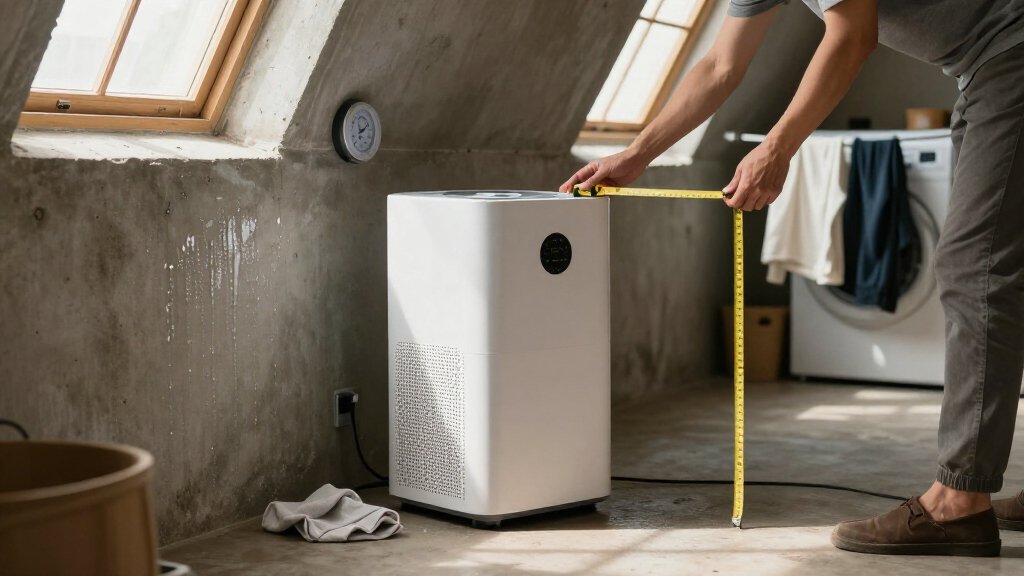
large room dehumidifier with high capacity
As an affiliate, we earn on qualifying purchases.
As an affiliate, we earn on qualifying purchases.
Frequently Asked Questions
How do I know if my room needs a 30, 40, or 50 pint dehumidifier?
Use a hygrometer to measure your room’s humidity level and consider its size and moisture sources. The calculator will give you a recommended range, helping you pick the right pint capacity for your space’s needs.Can I use a larger dehumidifier than recommended?
Yes, slightly larger units can reach target humidity faster and run less often. However, avoid overly oversized models, as they can waste energy, create noise, and short cycle. Stick close to the calculator’s range for best results.Does room temperature affect dehumidifier performance?
Absolutely. Cooler spaces—like basements—lower a dehumidifier’s efficiency. Choose models rated for low temperatures and with features like automatic defrost to maintain performance.Should I size my dehumidifier by square footage or cubic volume?
Square footage works well for standard 8-ft ceilings. For higher ceilings, calculate cubic volume. Larger spaces or rooms with high moisture loads may need a bigger capacity than simple square footage suggests.What features matter most beyond capacity?
Look for a built-in humidistat, continuous drain option, automatic defrost, and energy efficiency ratings. These features ensure your dehumidifier runs smoothly and lasts longer in demanding environments.Conclusion
Choosing the right dehumidifier isn’t about picking the biggest or smallest model. It’s about matching the unit’s capacity to your space’s true moisture load. A good size ensures your indoor air stays fresh, mold-free, and comfortable — without wasting energy or noise.
Next time you shop, use a dehumidifier size calculator as your guide. It’s a simple step that saves you money and frustration — and keeps your home dry and cozy all year round.
Dehumidifier Size Calculator
Estimate daily pint capacity from room size and how damp the space feels.
Your room likely starts in the 20 to 30 pint range. Compare compact dehumidifiers for smaller spaces.
See compact dehumidifier matchesYour room points to a 35 to 40 pint unit. Compare mid-size dehumidifiers and check drainage options.
See mid-size dehumidifier matchesYour conditions call for a 50 pint or larger unit. Compare larger dehumidifiers and confirm room moisture sources.
See larger dehumidifier matchesEstimate only. Check product specs, local rates, and site conditions before buying or planning around these numbers.
Cold & flu season Picks
humidifiers
As an affiliate, we earn on qualifying purchases.