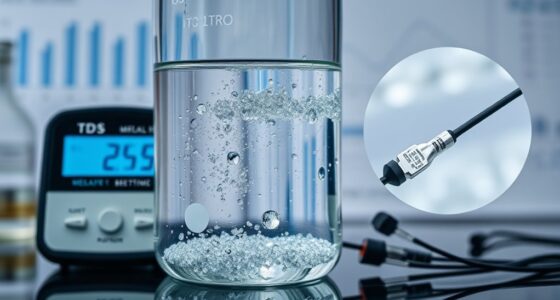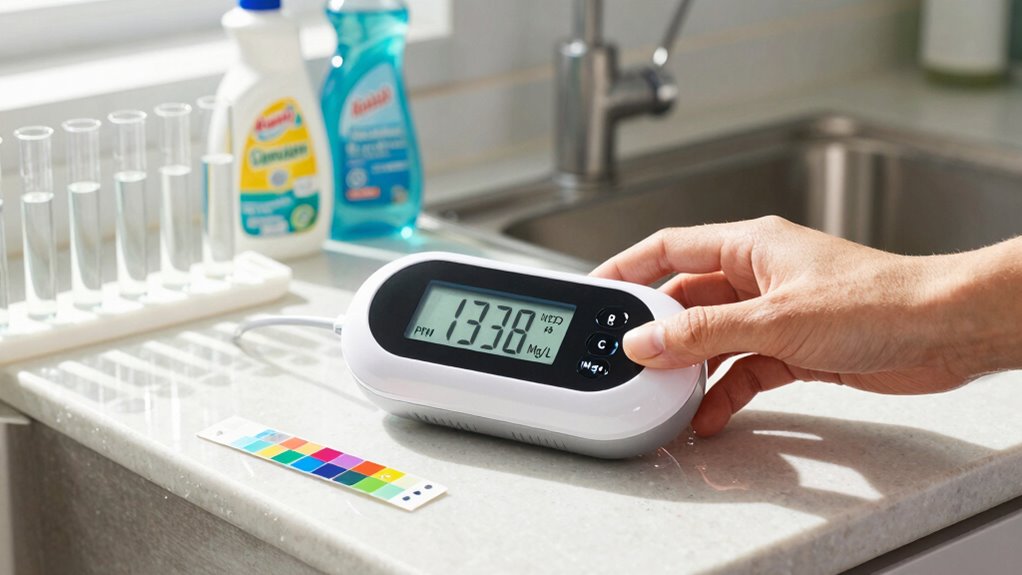
Understanding water units like ppm, ppb, and mg/L helps you interpret your water test results accurately. Ppm and mg/L are equivalent, showing the amount of a substance in one million parts of water, while ppb measures even smaller traces—one billionth. Knowing these differences helps you assess contaminant levels and safety standards. If you want to confidently identify if your water is safe, exploring these concepts further will empower you to make informed decisions about your water quality.
Key Takeaways
- Ppm (mg/L) and ppb are units measuring water contaminants, with ppm indicating milligrams per liter and ppb parts per billion.
- Converting ppm to ppb involves multiplying by 1,000; converting ppb to ppm involves dividing by 1,000.
- Trace contaminants like lead or arsenic are often measured in ppb, highlighting their presence at very low levels.
- Understanding these units helps homeowners interpret water test results and assess water safety accurately.
- Knowing the differences ensures informed decisions about water treatment and compliance with safety standards.
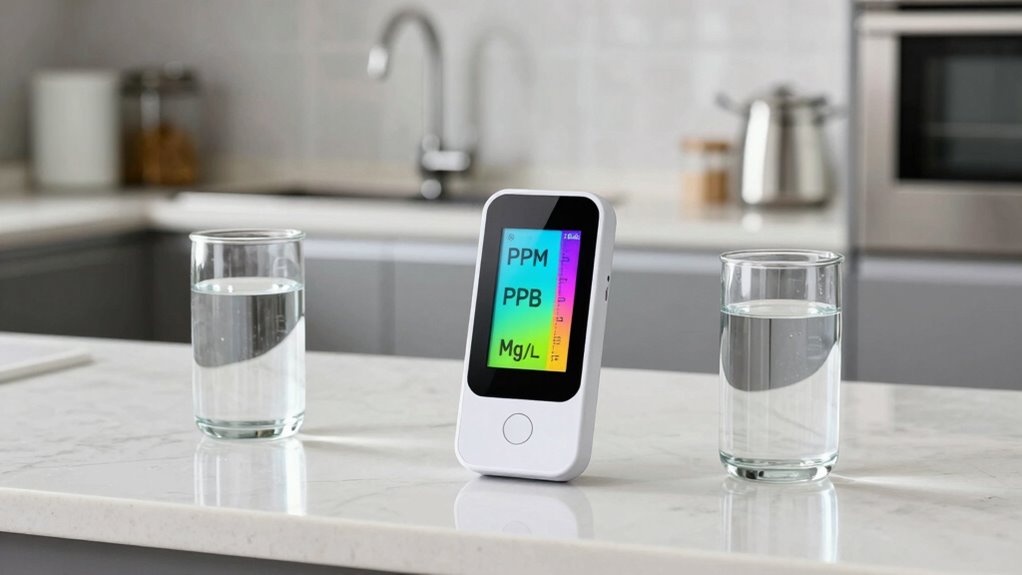
Water testing methods often involve taking samples and analyzing them with specialized equipment. These tests measure contaminants, minerals, or pollutants, and the results are expressed in various units. Ppm (parts per million) and mg/L (milligrams per liter) are fundamentally equivalent, representing the same concentration in water. For example, 1 mg/L of a substance equals 1 ppm because it indicates one milligram of that substance dissolved in one liter of water. Ppb (parts per billion) is a smaller unit, representing one billionth of a part in the water. It’s used for detecting trace amounts, such as contaminants in the parts per billion range, which is crucial for substances that are harmful even at low concentrations. Understanding unit conversions makes it easier for you to compare and interpret results from different tests or labs. Converting ppm to ppb involves multiplying by 1,000 because 1 ppm equals 1,000 ppb. Conversely, converting ppb to ppm requires dividing by 1,000. This simple relationship helps you switch between units depending on the level of detail you need or the units specified in your water testing reports. Mastering these basics allows you to quickly grasp what the numbers mean in real-world terms, whether you’re checking for lead, arsenic, or other contaminants. Knowing how these units work isn’t just about numbers; it’s about ensuring your water is safe. When you review water test reports, recognizing that 10 ppm is different from 10 ppb clarifies the severity or safety of the levels present. It also empowers you to communicate effectively with water testing professionals or health authorities. Whether you’re installing a home filtration system or just monitoring your well water, understanding water testing methods and unit conversion basics helps you take control of your water quality. It’s a simple yet indispensable part of being a proactive homeowner concerned about your health and safety.

Bestprod All-New 21 in 1 Drinking Water Testing Kit Strips, Home Tap and Well Water Test Kit for Hardness, Lead, Iron, Copper, Chlorine, Fluoride
- Clear, Easy-to-Read Results: Provides clear results for all substances
- Simple to Use: Add water, set timer, read results
- User-Friendly Guide: Includes clear instructions for interpretation
As an affiliate, we earn on qualifying purchases.
As an affiliate, we earn on qualifying purchases.
Frequently Asked Questions
How Do Water Units Affect Drinking Water Safety?
Water units directly impact your understanding of safety because they measure contamination levels. If the units show high contamination, it indicates potential health risks, making your water unsafe to drink. Monitoring water units helps you detect water contamination early, so you can take action. Staying aware of these measurements protects your health, preventing possible health implications from contaminated water, and ensures your drinking water remains safe for your family.
Can Water Units Vary Between Different Industries?
Think of water units like a universal language, but even dialects vary by industry. You’ll find industry-specific units, such as ppm or mg/L, used differently across sectors. Regional measurement standards also influence these variations, ensuring measurements align with local regulations. This means your water quality readings might change depending on the industry’s precise measurement system, making it essential to understand the context to interpret results accurately.
Are There International Standards for Measuring Water Units?
Yes, there are international standards for measuring water units to guarantee measurement consistency worldwide. Organizations like the ISO and EPA establish conversion standards to align units like ppm, ppb, and mg/L. These standards help you accurately compare water quality data across industries and countries, making sure your measurements are reliable and standardized regardless of where or how you test your water. Always check for these standards to maintain consistency.
How Often Should I Test My Water for Ppm or Ppb?
You should test your water for ppm or ppb at least once every six months to guarantee contamination detection remains current. If you notice changes in taste, odor, or color, increase testing frequency to monthly. Regular testing helps catch pollutants early, protecting your health and maintaining water quality. Keep a record of results to identify trends over time, and consider professional testing if you suspect serious contamination.
What Equipment Is Needed to Measure Water Units Accurately?
To measure water units accurately, you need testing methods like digital TDS meters or spectrophotometers. Calibration equipment is essential to guarantee precise readings, so keep calibration solutions handy and regularly calibrate your devices. Choose reliable, user-friendly tools designed for your specific testing needs. Properly maintained equipment helps you get consistent results for ppm, ppb, or mg/L, giving you confidence in your water quality assessments.

Varify 17in1 Complete Drinking Water Test Kit – 100 Strips + 2 Bacteria Tester Kits – Well, Tap, Home, City Water Testing Strip for Lead, Alkaline, Chlorine, Hardness, Iron, Fluoride, Copper & More
- Number of Parameters Tested: 17 essential water quality parameters
- Comprehensive Water Analysis: Detects contaminants and imbalances
- Premium Quality Strips: Professional-grade, reliable test strips
As an affiliate, we earn on qualifying purchases.
As an affiliate, we earn on qualifying purchases.
Conclusion
Understanding water units like ppm, ppb, and mg/L helps you make informed decisions about your home’s water quality. Imagine testing your well and discovering high lead levels in ppb — knowing what that means prompts you to take action before health issues arise. By mastering these units, you’re empowered to ensure safe, clean water for your family. Don’t wait—be proactive about your water quality, and safeguard what matters most.
Varify 17in1 Complete Drinking Water Test Kit – 100 Strips + 2 Bacteria Tester Kits – Well, Tap, Home, City Water Testing Strip for Lead, Alkaline, Chlorine, Hardness, Iron, Fluoride, Copper & More
- Number of Parameters Tested: 17 essential water quality parameters
- Comprehensive Water Analysis: Detects contaminants and imbalances
- Premium Quality Strips: Professional-grade, reliable test strips
As an affiliate, we earn on qualifying purchases.
As an affiliate, we earn on qualifying purchases.

iSpring RCC7AK-BN NSF Certified, 75 GPD, Alkaline 6-Stage Reverse Osmosis System, pH+ Remineralization RO Water Filter System Under Sink Patented Top-Mounted Faucet Design for Easy Installation
- Patented Top-Mounted Faucet Design: Easy above-sink installation
- Mineral Boost Stage: Adds essential minerals and balanced pH
- Transparent Filter Housing: Monitor contaminant buildup easily
As an affiliate, we earn on qualifying purchases.
As an affiliate, we earn on qualifying purchases.