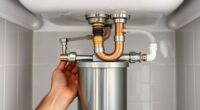
If your softener isn’t regenerating, check your water pressure—too low or high can prevent proper cycles. Make sure there’s enough salt in the brine tank and that salt isn’t crusted over, as this affects regeneration. Inspect the control valve for clogs or damage, and verify that electrical components and timers are functioning correctly. Regular maintenance can prevent many issues, so stay tuned to discover more ways to fix your softener hassles.
Key Takeaways
- Check water pressure to ensure it’s within the recommended 40-80 psi range for proper regeneration.
- Ensure the salt level in the brine tank is sufficient and free of salt bridges or crusts.
- Inspect and clean the control valve to remove debris or mineral buildup that may block operation.
- Verify that the system’s timer and electrical components are functioning correctly and reset if needed.
- Conduct routine maintenance and address any system issues promptly to prevent regeneration failures.
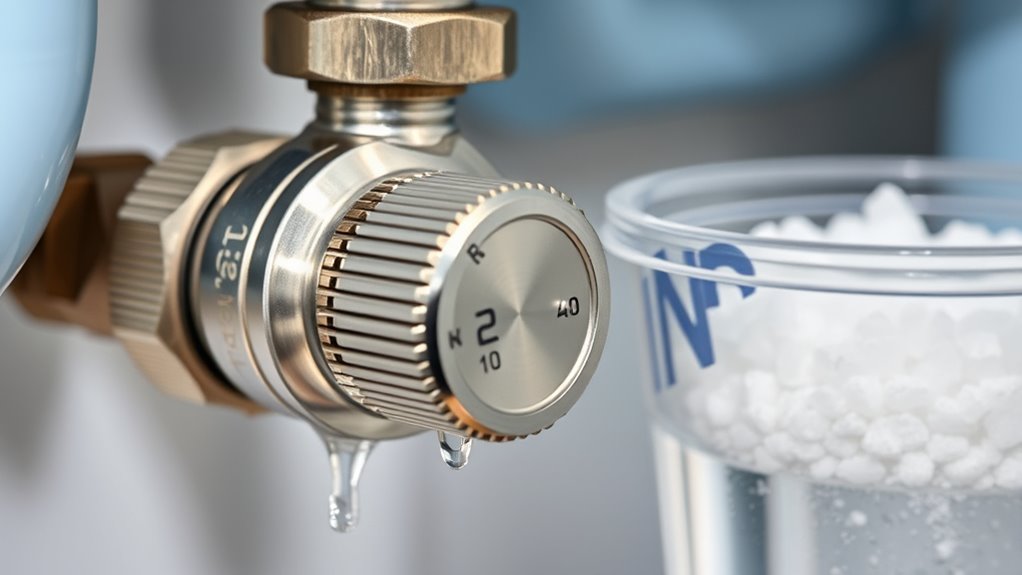
If your water softener isn’t regenerating properly, it can lead to hard water problems and reduced appliance efficiency. One common cause is issues with water pressure. Softeners rely on a steady flow of water to trigger regeneration cycles. If your water pressure is too low, the softener might not detect enough flow to start the process. Conversely, excessively high pressure can damage internal components or cause the system to malfunction. You should check your home’s water pressure and ensure it falls within the manufacturer’s recommended range, usually between 40 and 80 psi. If it’s outside this range, installing a pressure regulator or adjusting the existing one can help maintain proper operation.
Check your home’s water pressure, ideally between 40 and 80 psi, to ensure proper softener regeneration.
Another critical factor that affects regeneration is the salt level in the brine tank. If the salt is too low, the system won’t have enough brine to effectively regenerate the resin beads that soften your water. Regularly inspecting and maintaining the salt level is essential. You want the salt bridge to be broken, ensuring the salt is dissolved properly and accessible for the regeneration cycle. If you notice salt buildup or a crusty layer on top of the salt, it’s time to remove the salt bridge and replenish with fresh salt. Using the right type of salt recommended by your softener’s manufacturer—such as pellet or block salt—is equally important for peak performance.
Sometimes, the problem lies with the control valve. A malfunctioning valve may not open or close properly, preventing the regeneration cycle from initiating. If you’ve confirmed that water pressure and salt levels are correct, you might need to inspect or replace the control valve. Also, debris or mineral buildup can clog the valve, so cleaning it thoroughly can restore proper function.
Electrical issues can also interfere with regeneration. Check the timer and control board for any faults or error codes. If your softener’s timer isn’t working correctly, it won’t trigger the regeneration cycle at the scheduled times. Resetting the system or replacing faulty components might be necessary.
Proper maintenance and awareness of lifestyle factors, such as regular system checks, can help ensure your softener functions optimally and prevents costly repairs or replacements.

Morton Clean and Protect Water Softener Salt Pellets, 40 LB (Pack of 2)
- Package Includes: Two 40 lb bags of salt pellets
- Extended Use: Total of 80 lbs of salt pellets
- Buildup Prevention: Patented system to prevent buildup
As an affiliate, we earn on qualifying purchases.
As an affiliate, we earn on qualifying purchases.
Frequently Asked Questions
Can Hard Water Damage My Softener’s Regeneration Process?
Hard water can damage your softener’s regeneration process, especially if the water pH is off. High pH levels can cause scale buildup, reducing efficiency and shortening your softener’s lifespan. Over time, this damage may prevent proper regeneration. To protect your softener, monitor water pH levels and perform regular maintenance. Addressing these issues helps guarantee your softener works effectively, prolonging its lifespan and maintaining soft water quality.
How Does Water Temperature Affect Softener Regeneration?
Water temperature substantially impacts your softener’s efficiency. When water is too cold, the regeneration process slows down, reducing the softener’s ability to remove minerals effectively. Conversely, warm water speeds up the process, improving efficiency and ensuring better softening. Maintaining ideal water temperature, around 45-85°F, helps your softener regenerate properly, prolonging its lifespan and ensuring you get consistently soft water throughout your home.
Is It Necessary to Manually Initiate Regeneration Often?
You probably think your softener will always handle itself, but sometimes manual activation is necessary, especially if automatic scheduling fails. Ironically, relying solely on automatic regeneration can leave you with hard water if the system skips a cycle. So, yes, you should occasionally initiate manual regeneration to guarantee your softener stays in top shape. Don’t just wait for it—take control and keep the water soft and smooth.
Can a Clogged Valve Prevent the Softener From Regenerating?
A clogged valve can definitely prevent your softener from regenerating properly. When the valve is blocked, water flow stops, hindering the regeneration process. Check for debris or buildup that might cause a clog. Also, guarantee the water temperature is within the recommended range, as cold water can make valves stick or clog more easily. Clearing the clog and maintaining proper water temperature usually restores your softener’s regeneration function.
What Role Does the Control Valve Play in the Regeneration Cycle?
Did you know that a control valve manages about 90% of your water softener’s efficiency? It plays a vital role in the regeneration cycle by directing water flow, initiating resin cleaning, and regenerating the system. If the control valve malfunctions, the entire process stalls, making system maintenance necessary. Without proper operation, your softener can’t regenerate correctly, leading to hard water issues. Regular checks guarantee smooth water flow and peak performance.

110V 5600 Water Softener 12 Day Control Timer Valve for Water Filter Softener Resin Tanks 9''-11' Diameter Timed Water Softener Control Valve
- Durable Construction: Made from high-quality ABS and plastic
- Long Service Life: Suitable for whole house and small boiler systems
- 12-Day Timing Function: Automatically regenerates resin at scheduled intervals
As an affiliate, we earn on qualifying purchases.
As an affiliate, we earn on qualifying purchases.
Conclusion
If your softener isn’t regenerating, don’t let it drain your patience. Think of it like a car needing a tune-up—you just need to identify the hiccup and fix it. Whether it’s a valve issue, salt problem, or clogged injector, addressing these common issues can get your softener back on track. With a little troubleshooting, you’ll have your water soft and smooth as silk again, turning this hiccup into a breeze.

Zurn Wilkins 34-NR3XLDU 3/4" NR3XL Pressure Reducing Valve with Double Union FNPT Connection
- Compact design for tight spaces: Short lay length and compact design
- Easy repairs with cartridge design: Cartridge-loaded for simple repairs
- Versatile tailpiece options: Threaded, PEX, copper sweat, CPVC
As an affiliate, we earn on qualifying purchases.
As an affiliate, we earn on qualifying purchases.

GSLWLKJ 5600 Timer Water Softener Valve 110V for 9"-11" Tanks
- Material: Made from durable ABS and plastic
- Ease of Installation: Simple to install with user-friendly design
- Timing Function: Automates regeneration every 12 days
As an affiliate, we earn on qualifying purchases.
As an affiliate, we earn on qualifying purchases.