For water damage pros, choosing the right moisture meter is critical for accurate assessment and efficient remediation. The FLIR MR160 stands out as the best overall choice thanks to its thermal imaging and versatile detection modes. The Protimeter Aquant offers non-invasive readings ideal for quick scans, while the Extech MO290 combines pinless and pin-type measurements with infrared temperature. Each of these options balances accuracy, usability, and durability, but they also come with tradeoffs like cost or complexity. Keep reading to see how these models compare and which is best suited for your specific needs.

Get home appliances delivered free with Prime
- Fast, free delivery on millions of items
- Prime Video, Amazon Music and more included
- Member-only deals all year
Complete the kit


Key Takeaways
- High-end models like the FLIR MR160 excel in thermal imaging and multi-functionality, making them ideal for detailed inspections.
- Non-invasive meters such as the Protimeter Aquant provide quick scans without damaging surfaces, suited for sensitive materials.
- Pinless meters tend to be more user-friendly and faster but may sacrifice some measurement precision compared to pin-type devices.
- Durability and battery life vary significantly; professionals should prioritize models with long-lasting power for job sites.
- Price often correlates with features; investing in a higher-end model can save time and improve accuracy in complex water damage scenarios.
| FLIR MR160 Imaging Moisture Meter with IGM Technology: Thermal Imaging, Pin & Pinless Detection, 80×60 Resolution, METERLiNK App, Rechargeable Battery for Home Inspection & Mold Remediation |  | Best Overall | Thermal Sensor Resolution: 80×60 | Sensor Type: Lepton thermal imager | Detection Methods: Pinless and pin probe | VIEW ON AMAZON | See Our Full Breakdown |
| Protimeter Aquant Non-Invasive Moisture Meter |  | Best Value | Moisture Detection Depth: ¾ inch (20mm) | Connectivity: Bluetooth with app | Battery Life: Extended | VIEW ON AMAZON | See Our Full Breakdown |
| Extech MO290 Pinless Moisture Psychrometer with IR Thermometer |  | Best for Versatility | Measurement Depth: 0.75 inch | Distance to Spot Ratio: 8:1 | Emissivity: 0.95 | VIEW ON AMAZON | See Our Full Breakdown |
| General Tools Moisture Meter MMD950 – Humidity Sensor – Pin Type / Pinless Device | 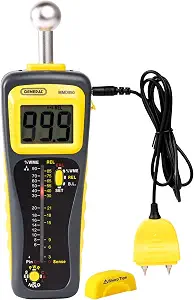 | Best for Dual-Mode Flexibility | Measurement Modes: Pin and Pinless | Sensor Type: Spherical | Power: 9V battery | VIEW ON AMAZON | See Our Full Breakdown |
| General Tools MMD4E Moisture Meter for Wood, Walls & Water Leak Detection |  | Best for Basic Water Leak Detection | Measurement Range: 5 – 50% for wood, 1.5 – 33% for concrete and drywall | Display: Backlit LCD | Power: 9V battery | VIEW ON AMAZON | See Our Full Breakdown |
| Rechargeable Pinless Moisture Meter for Wood, Drywall & Masonry |  | Best Overall for Versatility and Ease of Use | Measuring Depth: 0.79 in (20 mm) | Display: Color LCD | Battery: Rechargeable USB Type-C | VIEW ON AMAZON | See Our Full Breakdown |
| Protimeter BLD9800-C-R MMS3 Restoration Kit Moisture Meter with Hard Case |  | Best for Comprehensive, Professional-Grade Assessment | Package Dimensions: 20 x 15.5 x 7 inches | Item Weight: 7.68 pounds | Batteries: 2 AA (included) | VIEW ON AMAZON | See Our Full Breakdown |
| Klein Tools ET140 Pinless Moisture Meter for Non-Destructive Detection in Drywall, Wood, and Masonry |  | Best for Quick, On-the-Spot Material Checks | Detection Depth: up to 3/4 inch | Battery: 9V | Operating Humidity: 30-70% | VIEW ON AMAZON | See Our Full Breakdown |
| Protimeter BLD9800-C MMS3 Standard Kit Moisture Meter with Hard Case |  | Best for In-Depth, Multi-Mode Analysis | Package Dimensions: 20.5 x 15.5 x 6.5 inches | Item Weight: 6.98 pounds | Batteries: 2 AA (included) | VIEW ON AMAZON | See Our Full Breakdown |
| Tramex Moisture Encounter MEX5 |  | Best for Advanced Moisture Mapping and Data Sharing | Measurement Range: 0-30% in wood | Depth Penetration: up to 1.25 inch | Features: Bluetooth, hygrometer, infrared thermometer | VIEW ON AMAZON | See Our Full Breakdown |
| Proster Rechargeable Moisture Meter – 5 Modes Pinless 40mm Depth |  | Best for Versatile, Non-Invasive Material Detection | Measurement Modes: Index, Concrete, Cement, Plaster, Wood | Detection Depth: 40mm | Material Modes: Wood (0.5-1.4 g/cm³), Gypsum (1.2-1.5 g/cm³), Cement (1.8-2.5 g/cm³), Concrete (2.4-3.0 g/cm³), Index | VIEW ON AMAZON | See Our Full Breakdown |
| Tramex Moisture Encounter ME5 |  | Best for Detailed Mapping and Multi-Depth Readings | Measurement Range (Wood): 5-30% | Measurement Range (Other materials): 0-100% | Depth Penetration: up to 0.4″ (9 mm) shallow, up to 1.25″ (30 mm) deep | VIEW ON AMAZON | See Our Full Breakdown |
| Protimeter SurveyMaster Dual-Function Moisture Meter |  | Best for Versatile, Dual-Mode Measurement with App Integration | Measurement Modes: Pin and non-invasive | Display: Large, easy-to-read | Battery Life: Three times longer than previous models | VIEW ON AMAZON | See Our Full Breakdown |
| Proster Pinless Moisture Meter 3/4″ Depth Color Alarm Non-Destructive |  | Best for Deep, Non-Invasive Moisture Checks in Wood and Masonry | Measurement Depth: 3/4 inch (19 mm) | Material Range: 5-70% for wall and masonry, 5-75% for wood | Power: 9V battery included | VIEW ON AMAZON | See Our Full Breakdown |
| Protimeter BLD5777 Reachmaster Pro |  | Best for Extended Reach and Wireless Inspection | Handle Length: 27 to 48 inches | Depth of Measurement: Up to 5 inches | Wireless Communication: Yes | VIEW ON AMAZON | See Our Full Breakdown |
More Details on Our Top Picks
FLIR MR160 Imaging Moisture Meter with IGM Technology: Thermal Imaging, Pin & Pinless Detection, 80×60 Resolution, METERLiNK App, Rechargeable Battery for Home Inspection & Mold Remediation
This pick stands out for combining thermal imaging with moisture detection, offering a comprehensive diagnostic tool that can identify hidden water issues more effectively than traditional moisture meters like the Protimeter Aquant. Its thermal sensor resolution of 80×60 provides clearer images, helping inspectors locate moisture behind walls without invasive testing. Wireless data transfer and a durable, shock-resistant housing add to its professional appeal. However, the high price may be a barrier for some, and the thermal resolution might miss subtle temperature differences in complex scenarios. This model is ideal for seasoned water damage professionals needing multi-faceted diagnostics, but it might be overkill for occasional or DIY inspections.
- Combines thermal imaging with moisture detection
- Wireless data transfer via METERLiNK
- Rugged, portable design
Relatively expensive and requires some familiarity with thermal imaging technology, plus thermal resolution may limit detection of very small temperature differences.
Pros:- Combines thermal imaging with moisture detection for comprehensive diagnostics
- Wireless data transfer and professional reporting features
- Durable, portable design suitable for tough job sites
Cons:- Relatively high cost for a moisture meter
- Requires familiarity with thermal imaging technology
- Limited thermal resolution may miss small temperature differences
Best for: Experienced water damage inspectors and mold remediation specialists needing detailed diagnostics
Not ideal for: Beginners or budget-conscious inspectors who prefer simple, manual moisture meters
- Thermal Sensor Resolution:80×60
- Sensor Type:Lepton thermal imager
- Detection Methods:Pinless and pin probe
- Connectivity:METERLiNK app
- Display:2.3-inch color display
- Battery Life:Up to 18 hours
Our verdict“This device is perfect for professionals seeking a versatile, high-tech moisture detection solution with thermal imaging capabilities.”
Protimeter Aquant Non-Invasive Moisture Meter
The Protimeter Aquant excels in non-invasive moisture detection, offering a quick and damage-free way to survey walls and floors—especially when compared to the General Tools MMD950, which combines pin and pinless modes but lacks Bluetooth connectivity. Its ability to detect moisture up to ¾ inch deep makes it suitable for building surveys and moisture mapping. The Bluetooth integration allows for easy data logging, but this feature adds to its cost and complexity. For simple surface inspections, this model provides a reliable balance of features and affordability. This is best suited for building inspectors and restoration professionals who prioritize non-destructive testing, but it may fall short for those needing deep or invasive measurements.
- Non-invasive detection up to ¾ inch deep
- Bluetooth connectivity for app integration
- Durable, backlit LCD display
Limited to ¾ inch detection depth and requires Bluetooth app for full functionality, which could complicate simple inspections.
Pros:- Non-invasive moisture detection without surface damage
- Bluetooth connectivity for seamless data logging
- Durable construction with a clear backlit display
Cons:- Limited to moisture detection up to ¾ inch depth
- Requires Bluetooth app for full functionality
- Potentially higher cost due to advanced features
Best for: Building inspectors and restoration professionals seeking non-invasive, quick moisture assessments
Not ideal for: Users needing deep moisture detection beyond ¾ inch or detailed invasive testing
- Moisture Detection Depth:¾ inch (20mm)
- Connectivity:Bluetooth with app
- Battery Life:Extended
- Display:Backlit LCD
- Materials Compatible:Wood, drywall, concrete, fiberglass
Our verdict“Ideal for professionals needing quick, non-destructive moisture surveys with easy data management at a reasonable price.”
Extech MO290 Pinless Moisture Psychrometer with IR Thermometer
The Extech MO290 offers a flexible testing approach, combining pinless moisture measurement with an infrared thermometer, making it a versatile choice for various inspection needs. Its pinless method allows non-destructive scans up to 0.75 inches, comparable to the Protimeter Aquant, but adds infrared temperature readings for more detailed analysis. This feature is valuable for identifying condensation points or temperature-related moisture issues. However, its measurement depth is limited, and remote probe contact readings require additional setup. Unlike dedicated moisture meters, this device balances multiple functions but might lack the precision of specialized tools. This pick makes the most sense for inspectors who need multi-purpose testing in one device, but it may be less ideal for those requiring deep moisture detection or extensive data logging.
- Pinless moisture measurement up to 0.75 inches
- Infrared thermometer with large display
- Automatic temperature differential calculations
Limited depth and lack of advanced connectivity options mean it’s best for versatile field use rather than detailed, long-term data analysis.
Pros:- Pinless moisture measurement for non-destructive testing
- Infrared thermometer for temperature analysis
- Large, easy-to-read display with programmable alarms
Cons:- Limited measurement depth of 0.75 inches
- Requires remote probe for contact readings
- No mention of long battery life or advanced data features
Best for: Building inspectors and remediation specialists needing quick, multi-function testing
Not ideal for: Inspectors requiring in-depth moisture analysis or extensive data storage capabilities
- Measurement Depth:0.75 inch
- Distance to Spot Ratio:8:1
- Emissivity:0.95
- Cable Length:3 feet
Our verdict“A versatile, multi-purpose moisture meter ideal for inspectors who need both moisture and temperature insights on-site.”
General Tools Moisture Meter MMD950 – Humidity Sensor – Pin Type / Pinless Device
The General Tools MMD950 combines pin and pinless modes, offering flexibility for various inspection scenarios, similar to the Protimeter BLD9800. Its dual sensors allow detection behind surfaces like drywall or wood, making it suitable for detailed inspections where surface access is limited. The large LCD and tri-color LED bar graph improve readability, but the manual calibration process can slow down workflow. While its 9V battery can be a minor inconvenience, the device’s broad measurement range and remote probe add to its versatility. Compared to single-mode meters, this model provides a balanced approach for different inspection needs, but its slightly complex calibration may be a hurdle for occasional users. This device is best for professionals needing both pin and pinless testing options in one tool, but it may be less suitable for quick, one-off checks.
- Dual measurement modes for versatility
- Large LCD with color indicators
- Remote probe with 46-inch cable
Some users might find calibration manual and battery replacement slightly inconvenient, especially during intensive work sessions.
Pros:- Dual measurement modes for comprehensive testing
- Large, easy-to-read display with visual alerts
- Remote probe for hard-to-reach areas
Cons:- Requires manual calibration and 9V battery replacement
- Somewhat complex operation for simple tasks
- Limited to specific moisture ranges
Best for: Restoration technicians and building inspectors requiring flexible moisture testing options
Not ideal for: DIYers or inspectors who prefer simple, single-mode meters for quick scans
- Measurement Modes:Pin and Pinless
- Sensor Type:Spherical
- Power:9V battery
- Display:Jumbo LCD and tri-color LED
- Auto Power-Off:Yes
Our verdict“Best suited for professionals who need adaptable moisture detection with both pin and pinless modes in a single device.”
General Tools MMD4E Moisture Meter for Wood, Walls & Water Leak Detection
The General Tools MMD4E offers a straightforward solution for detecting moisture in common building materials like wood and drywall, similar to the Protimeter SurveyMaster. Its backlit LCD provides clear readings, and stainless steel pins ensure accurate contact measurements. While it is easy to operate and includes calibration tools, the reliance on pin probes can cause surface damage and limit repeated testing on delicate surfaces. Its broad measurement range makes it suitable for quick water leak detection, but it doesn’t offer advanced features like Bluetooth or thermal imaging. This model is a reliable choice for basic moisture assessments, especially when surface damage is acceptable. This is best for contractors and homeowners who need simple, effective moisture detection at an accessible price, but not for detailed moisture mapping or invasive testing.
- Easy-to-read backlit LCD display
- Accurate detection in various materials
- Includes calibration tools and stainless steel pins
Limited to specific moisture ranges and surface testing, making it less versatile for complex water damage scenarios.
Pros:- Easy-to-read backlit LCD display
- Accurate moisture detection in various materials
- Includes calibration tools and stainless steel pins
Cons:- Requires 9V battery replacement
- Limited to specific moisture ranges
- Pin probes can cause surface damage
Best for: Homeowners and contractors needing quick, reliable detection of water leaks and surface moisture
Not ideal for: Inspectors requiring non-destructive testing or deep moisture analysis
- Measurement Range:5 – 50% for wood, 1.5 – 33% for concrete and drywall
- Display:Backlit LCD
- Power:9V battery
- Pins:8mm stainless steel
- Includes:Protective cap, calibration checker
Our verdict“A practical, budget-friendly option for basic moisture detection where surface damage is not a concern.”
Rechargeable Pinless Moisture Meter for Wood, Drywall & Masonry
This pinless moisture meter excels in providing fast, non-invasive readings across a variety of materials, thanks to its color display, data storage, and adjustable alarms. Unlike the Protimeter BLD9800-C-R MMS3, which offers more advanced features like ambient humidity measurement and infrared thermometry, this model prioritizes simplicity and portability for quick inspections. The rechargeable USB-C battery ensures ongoing convenience, but its limited measuring depth of 0.79 inches can miss deeper moisture pockets in thicker materials. Calibration issues reported by some users highlight the need for occasional checks. Compared to other pinless models like the Klein ET140, it offers a more comprehensive display and data options, though it sacrifices some depth and advanced features.
Pros:- Non-destructive, fast moisture detection across multiple materials
- Rechargeable USB-C battery reduces ongoing costs and hassle
- Clear color LCD display with data storage and adjustable alarms
Cons:- Limited measuring depth of only 0.79 inches may miss deeper moisture
- Requires some familiarity to correctly set alarms and interpret readings
- Occasional calibration issues reported by users
Best for: Home inspectors and leak detection professionals needing a quick, non-destructive tool for various materials
Not ideal for: Heavy-duty restoration projects requiring deep moisture assessment or detailed environmental data
- Measuring Depth:0.79 in (20 mm)
- Display:Color LCD
- Battery:Rechargeable USB Type-C
- Weight:12 ounces
- Package Dimensions:7.36 x 5.16 x 1.85 inches
- Warranty:36 months
Our verdict“This pick is best suited for professionals who need quick, portable moisture assessments without deep material penetration.”
Protimeter BLD9800-C-R MMS3 Restoration Kit Moisture Meter with Hard Case
The Protimeter MMS3 stands out for its multi-functionality, combining surface, pin, non-invasive, and humidity measurements with an infrared thermometer, making it a versatile choice for detailed moisture analysis. Compared with the Tramex MEX5, which offers Bluetooth connectivity and dual-depth readings, the MMS3 provides a more integrated kit that suits professionals conducting complex restoration or renovation projects. Its weight of nearly 7 pounds indicates it’s built for durability rather than portability, and its features might overwhelm casual users unfamiliar with advanced moisture diagnostics. Nonetheless, this model offers a deeper feature set for those needing detailed, multi-angle data in a single device.
Pros:- Versatile 4-in-1 measurement capabilities for thorough analysis
- Includes infrared thermometer for dew point and surface temperature
- Ergonomic, one-handed operation with a comprehensive kit
Cons:- Heavy weight may reduce handheld ease during extended use
- Complex features can demand a learning curve for new users
- Higher price point compared to simpler models
Best for: Restoration specialists and contractors requiring a comprehensive, all-in-one moisture assessment tool
Not ideal for: DIYers or small-scale inspectors seeking a lightweight, straightforward device
- Package Dimensions:20 x 15.5 x 7 inches
- Item Weight:7.68 pounds
- Batteries:2 AA (included)
- Warranty:2 years
Our verdict“Ideal for professionals needing detailed, multi-faceted moisture data in demanding restoration projects.”
Klein Tools ET140 Pinless Moisture Meter for Non-Destructive Detection in Drywall, Wood, and Masonry
The Klein Tools ET140 offers straightforward, non-invasive moisture detection up to 3/4 inch deep, making it perfect for quick inspections of drywall, masonry, and wood. Its bright reverse-contrast display and LED indicators make readings easy to interpret on-site, especially for professionals who need rapid results. Comparing it to the Protimeter MMS3, which provides a broader array of measurement modes, the ET140 is more focused on simplicity and speed, but it lacks the advanced environmental parameters. Its reliance on a 9V battery and limited material compatibility means it’s less suited for detailed or multi-material assessments.
Pros:- Non-destructive detection up to 3/4 inch deep
- Easy-to-read reverse-contrast display and LED indicator
- Lightweight and simple to operate for quick assessments
Cons:- Limited to drywall, masonry, and wood without calibration for other materials
- Requires 9V battery replacement over time
- No advanced environmental or moisture mapping features
Best for: Building inspectors and contractors who need rapid, non-destructive moisture checks in common building materials
Not ideal for: Restoration projects or detailed moisture profiling requiring environmental data or deeper measurements
- Detection Depth:up to 3/4 inch
- Battery:9V
- Operating Humidity:30-70%
- Temperature Range:40°C
Our verdict“Best suited for professionals needing rapid, non-invasive checks on standard building materials without extra complexity.”
Protimeter BLD9800-C MMS3 Standard Kit Moisture Meter with Hard Case
The Protimeter MMS3 Standard Kit offers a detailed, multi-measurement approach, combining surface, pin, non-invasive, and humidity readings with an infrared thermometer. Its ergonomic design and included accessories make it suitable for professionals who need thorough moisture analysis across different materials and conditions. Compared with the Tramex MEX5 for simplicity and Bluetooth features, the MMS3 emphasizes versatility and depth, though at a weight nearing 7 pounds, it’s less suited for prolonged handheld use. Its comprehensive kit, including calibration and software, makes it a powerful tool for complex projects but might be more than needed for casual inspections.
Pros:- Multi-mode measurement for surface, pin, non-invasive, and humidity
- Infrared thermometer for dew point and surface temperature
- Complete kit with probes, calibration check, and software
Cons:- Heavy weight may reduce ease of handling
- Features may overwhelm users unfamiliar with advanced moisture testing
- Higher price and complexity limit accessibility for casual users
Best for: Construction inspectors and restoration experts requiring detailed, multi-mode moisture diagnostics
Not ideal for: DIYers or inspectors seeking a lightweight, single-function device
- Package Dimensions:20.5 x 15.5 x 6.5 inches
- Item Weight:6.98 pounds
- Batteries:2 AA (included)
- Warranty:2 years
Our verdict“Best for professionals who need a versatile, all-in-one moisture testing solution for complex building assessments.”
Tramex Moisture Encounter MEX5
The Tramex MEX5 is distinguished by its dual-depth measurement and Bluetooth capabilities, allowing users to quickly assess moisture content in wood, drywall, and other materials while creating detailed moisture maps. This model is better suited for those who need to generate reports and share data easily, especially in larger restoration or forensic projects. Its external probes for deeper measurements add flexibility but also introduce extra steps, making it less straightforward for casual or quick inspections. Price is not specified, but its advanced features suggest a premium investment.
Pros:- Dual-depth measurement distinguishes surface from core moisture
- Bluetooth connectivity for easy data transfer and reporting
- Flexible with external probes and adjustable specific gravity
Cons:- Requires external probes for some measurements, adding complexity
- Multiple features may be overwhelming for casual users
- Price not specified, likely a higher-end device
Best for: Restoration professionals and building surveyors needing detailed moisture maps and remote data sharing
Not ideal for: Small-scale inspectors or DIY users who prefer simple, handheld devices without Bluetooth or multiple measurement modes
- Measurement Range:0-30% in wood
- Depth Penetration:up to 1.25 inch
- Features:Bluetooth, hygrometer, infrared thermometer
Our verdict“Ideal for professionals who prioritize detailed moisture mapping and seamless data sharing over simplicity.”
Proster Rechargeable Moisture Meter – 5 Modes Pinless 40mm Depth
The Proster Rechargeable Moisture Meter stands out for its ability to detect moisture non-invasively across multiple building materials like wood, concrete, and drywall, making it highly adaptable for various water damage inspections. Unlike the Protimeter SurveyMaster, which offers dual modes but at a higher cost, the Proster provides a rechargeable power source and a color backlight for easy readability in all lighting conditions. However, interference from metal objects within its sensing depth can sometimes skew readings, requiring careful calibration. This model is best suited for water damage professionals who need quick, damage-free assessments across different surfaces without breaking the bank. It involves tradeoffs such as potential false positives from metal interference and the need for calibration before each use. Overall, it offers a solid balance of portability, versatility, and ease of use for inspectors who prioritize non-invasive testing.
Pros:- Non-invasive, damage-free moisture detection across various materials
- Multiple material-specific modes for tailored accuracy
- Rechargeable lithium-ion battery for convenience
- Color backlight display with audible alerts for easy operation
Cons:- Interference possible from nearby metal objects within sensing depth
- Requires calibration before each use for optimal accuracy
Best for: Water damage restoration specialists needing quick, multi-material detection without invasive probes.
Not ideal for: Heavy-duty structural engineers requiring deep core moisture measurements or diagnostics beyond surface detection.
- Measurement Modes:Index, Concrete, Cement, Plaster, Wood
- Detection Depth:40mm
- Material Modes:Wood (0.5-1.4 g/cm³), Gypsum (1.2-1.5 g/cm³), Cement (1.8-2.5 g/cm³), Concrete (2.4-3.0 g/cm³), Index
- Calibration:Quick calibration before each use
- Battery:Lithium-Ion rechargeable
- Temperature Range:Up to 55°C
Our verdict“This moisture meter is ideal for water damage pros who need versatile, non-invasive detection on different building surfaces with quick setup.”
Tramex Moisture Encounter ME5
The Tramex Moisture Encounter ME5 excels in providing dual-depth measurement and Bluetooth connectivity, making it ideal for creating detailed moisture maps and reports. Compared with the Protimeter SurveyMaster, which offers dual modes but relies more on app-based calibration, the ME5 provides a large analogue display for quick on-site readings without needing a smartphone. Its Bluetooth feature allows for seamless data transfer, but this requires pairing with a device, which might be a hassle in some field environments. This pick makes the most sense for professionals who need comprehensive moisture profiling and documentation, especially in larger or more complex structures. The main tradeoff is that it only detects moisture and doesn’t offer diagnostic features like mold detection or temperature measurement. Overall, it’s tailored for detailed assessments rather than quick spot checks.
Pros:- Non-destructive, pinless moisture detection
- Dual-depth measurement for surface and core moisture
- Bluetooth connectivity for mapping and reporting
- Pre-calibrated for multiple building materials
Cons:- Limited to moisture detection, no additional diagnostics
- Requires Bluetooth device for full report features
Best for: Restoration specialists and building inspectors needing moisture mapping and detailed material analysis.
Not ideal for: DIYers or contractors seeking a simple, single-depth moisture check or a more affordable, straightforward device.
- Measurement Range (Wood):5-30%
- Measurement Range (Other materials):0-100%
- Depth Penetration:up to 0.4″ (9 mm) shallow, up to 1.25″ (30 mm) deep
- Calibration:Pre-calibrated for various materials
- Display:Large analogue
- Connectivity:Bluetooth
Our verdict“This model is perfect for professionals requiring detailed moisture mapping and multi-depth analysis in complex structures.”
Protimeter SurveyMaster Dual-Function Moisture Meter
The Protimeter SurveyMaster offers both pin and non-invasive modes, making it highly adaptable for different inspection scenarios. Its larger display and automatic calibration provide quick, reliable readings, surpassing the Proster Rechargeable Moisture Meter in ease of use and durability. The inclusion of Bluetooth with the Protimeter Connect app allows for detailed report generation and data management, but the device’s higher price and need for a smartphone can be limiting for some users. This tool is well-suited for professionals who prefer a hybrid approach—using pins for deep moisture assessment and non-invasive modes for quick scans. The main tradeoff involves the device’s cost and dependency on external devices for full functionality. It’s a robust choice for those who need comprehensive measurement options combined with data logging.
Pros:- Dual measurement modes for comprehensive testing
- Extended battery life and large, clear display
- Bluetooth connectivity for app integration and reporting
- Automatic calibration ensures consistent accuracy
Cons:- Higher price point may deter casual users
- Requires smartphone app for full feature set
Best for: Water damage and restoration professionals who want versatile measurement modes with easy data management.
Not ideal for: Budget-conscious inspectors or DIY users who do not require Bluetooth connectivity or dual modes.
- Measurement Modes:Pin and non-invasive
- Display:Large, easy-to-read
- Battery Life:Three times longer than previous models
- Connectivity:Bluetooth with Protimeter Connect app
- Calibration:Automatic check every 50 cycles
- Auto Shut-off:Yes
Our verdict“This meter is suited for professionals who need versatile, dual-mode moisture measurement combined with digital data management.”
Proster Pinless Moisture Meter 3/4″ Depth Color Alarm Non-Destructive
The Proster Pinless Moisture Meter provides a non-destructive method for detecting moisture up to 3/4 inch below the surface, making it suitable for carpentry, leak detection, and masonry work. Compared with the Protimeter BLD5777 Reachmaster Pro, which offers telescopic reach for hard-to-access areas, the Proster is more compact and easier to handle in tight spaces. However, its depth measurement is limited to 3/4 inch, which might be insufficient for thicker materials or extensive moisture intrusion. The color LED alerts and backlit LCD enhance usability in different lighting conditions, but calibration may be needed for different materials to maintain accuracy. This pick makes most sense for those focused on quick, non-invasive assessments in residential or small commercial projects.
Pros:- Non-invasive, pinless detection up to 3/4 inch depth
- Easy-to-read display with LED alerts
- Suitable for various building materials
- Compact and user-friendly design
Cons:- Limited to 3/4 inch depth, less effective for thicker materials
- Requires battery replacement and occasional calibration
Best for: Carpenters, leak repair technicians, and inspectors needing deep but non-invasive moisture checks.
Not ideal for: Structural engineers requiring measurements beyond 3/4 inch or detailed diagnostic features.
- Measurement Depth:3/4 inch (19 mm)
- Material Range:5-70% for wall and masonry, 5-75% for wood
- Power:9V battery included
Our verdict“This device is best for professionals who need reliable, non-invasive moisture detection at shallow depths in residential work.”
Protimeter BLD5777 Reachmaster Pro
The Protimeter Reachmaster Pro features a telescopic handle extending from 27 to 48 inches, enabling moisture measurement in hard-to-reach areas without climbing ladders. Compared with the Proster Rechargeable Moisture Meter, which offers portability but limited reach, the Reachmaster excels in large-scale inspections and detailed assessments. Wireless communication and adjustable sensitivity add to its versatility, but the device’s reliance on batteries for wireless features introduces ongoing costs and maintenance. This model is suited for water damage pros who need to perform inspections on ceilings, beams, or extended wall sections efficiently. The main tradeoff involves its limited depth measurement (up to 5 inches) and higher price point. Overall, it’s a powerful tool for comprehensive inspections where reach and non-invasiveness are priorities.
Pros:- Telescopic handle for extended, hands-free measurements
- Wireless communication for easy data transfer
- Adjustable sensitivity for different materials
- Non-invasive moisture detection
Cons:- Limited to moisture measurement up to 5 inches depth
- Requires batteries for wireless operation
Best for: Inspectors working on large structures requiring extended reach in hard-to-access areas.
Not ideal for: Small-scale projects or users who only need basic moisture detection without extended reach.
- Handle Length:27 to 48 inches
- Depth of Measurement:Up to 5 inches
- Wireless Communication:Yes
- Auto Shut-off:Yes
- Adjustable Sensitivity:Yes
Our verdict“This moisture meter is ideal for large-scale inspections needing extended reach and wireless data capabilities in complex structures.”

How We Picked
In selecting these moisture meters, I prioritized models that deliver reliable accuracy, user-friendly operation, and durability under professional conditions. Devices with features tailored to water damage assessment, such as deep measurement depths or non-invasive scanning, were favored. I compared their performance in typical water damage scenarios, considering ease of use, build quality, and value for the investment. The ranking reflects a balance between advanced features and practical usability, making sure each pick serves a specific professional need while avoiding overly complex or fragile options.Factors to Consider When Choosing Moisture Meter For Water Damage Pros
Choosing the right moisture meter for water damage work involves understanding several key factors. Beyond basic accuracy, professionals need tools that are durable, easy to operate in tight spaces, and capable of differentiating between surface and deep moisture. Knowing what features are truly essential can prevent overspending on unnecessary tech or missing critical measurements during remediation. Here’s what to consider before making your purchase.Measurement Depth and Range
Moisture meters vary in how deep they can detect moisture, ranging from a few millimeters to several centimeters. For water damage pros, a device with a deeper measurement range helps identify hidden pockets of moisture behind walls or under floors. However, deeper measurement often comes with increased cost and complexity. Choosing a model with adjustable depth settings allows for more precise assessments across different materials and damage levels.
Type of Detection: Pin vs. Pinless
Pin-type meters measure moisture via pins inserted into materials, offering high accuracy and specificity but risking surface damage. Pinless models use electromagnetic sensors to scan surfaces non-invasively, ideal for delicate surfaces like drywall or wood veneer. Pros often prefer pinless for quick scans, but in some cases, the accuracy of pin sensors is necessary to confirm moisture levels deep within materials. Combining both in one device can be a significant advantage but may increase the price.
Ease of Use and Ergonomics
In fast-paced water damage projects, simplicity can be a game-changer. Look for models with intuitive controls, clear displays, and ergonomic designs that reduce fatigue during extended use. Features like backlit screens or single-hand operation facilitate working in low-light or tight spaces. However, more user-friendly models might sacrifice some advanced measurement options, so consider your typical workflow when selecting.
Durability and Battery Life
Worksite conditions demand robust devices that withstand drops, dust, and moisture. A sturdy outer shell and water-resistant features extend a meter’s lifespan. Battery life is equally critical; models with long-lasting rechargeable batteries or easy-to-replace batteries help avoid interruptions during assessments. Investing in a rugged device may cost more upfront but reduces the risk of costly replacements or downtime.
Price and Value
Moisture meters range from budget-friendly options to high-end professional tools. While lower-cost models can be sufficient for basic assessments, they might lack features like deep measurement, temperature compensation, or data logging. Higher-priced devices often include these extras, which can improve accuracy and efficiency. Evaluate your typical project requirements and choose a model that balances needed features with your budget, avoiding overpaying for capabilities you won’t use.
Frequently Asked Questions
How do I know if a moisture meter is accurate enough for water damage assessment?
Accuracy in water damage work depends on the device’s measurement technology and calibration. Professional-grade meters typically specify their measurement range and accuracy ratings, which should be within ±1-2% for moisture content. To ensure reliability, select a model from reputable brands with positive reviews and consider devices that include calibration features or come with a calibration certificate. Regular calibration and proper usage are essential for maintaining measurement accuracy over time.
Should I choose a pinless or pin-type moisture meter for water damage restoration?
Pinless meters offer quick, non-destructive scans, making them ideal for preliminary assessments or working on sensitive surfaces. Pin-type meters provide more precise readings at greater depths, which is valuable when diagnosing hidden moisture pockets. In most cases, professionals benefit from having both functions available, as pinless tools speed up initial surveys, while pin sensors confirm and detail moisture levels in specific areas. Consider your typical workflow and surface sensitivity before committing to one type.
What measurement depth should I look for in a professional moisture meter?
For water damage remediation, a depth of at least 1-2 inches is advisable to detect moisture behind walls and within structural components. Some high-end models can measure up to 4 inches or more, providing a comprehensive picture of hidden damage. The deeper the measurement capability, the better equipped you are to locate moisture in complex damage scenarios, but keep in mind that increased depth often comes with higher costs and more complex operation.
Are advanced features like thermal imaging necessary for water damage pros?
Thermal imaging can significantly enhance water damage inspections by revealing temperature differences caused by moisture presence. For large-scale or complex restorations, a moisture meter with thermal imaging capabilities helps identify hidden leaks and moisture pockets quickly. However, these models tend to be more expensive and may require additional training. If your work frequently involves detailed diagnostics, investing in such a device can improve accuracy and efficiency, but for routine inspections, standard meters often suffice.
How important is durability and battery life in choosing a professional moisture meter?
Durability ensures your device withstands the rough conditions of water damage sites, reducing replacement costs. Look for models with ruggedized cases, water resistance, and shockproof features. Battery life is equally important; long-lasting rechargeable batteries or easy-to-replace batteries prevent interruptions during inspections. A device that fails mid-job can delay remediation and affect your workflow, so investing in a durable, high-capacity model pays off in the long run.
Conclusion
For water damage professionals, the choice of moisture meter hinges on specific needs and budget. The FLIR MR160 makes an excellent overall pick for its advanced imaging and multi-functionality, suited to detailed diagnostics. The Protimeter Aquant offers a non-invasive, quick solution perfect for rapid surveys, while the Extech MO290 balances pinless and pin measurements for comprehensive assessments. Beginners or those with lighter workloads might prioritize simpler, more affordable options, whereas large restoration firms should consider high-end models with deeper measurement capabilities. Ultimately, selecting the right tool depends on your typical projects, required precision, and working conditions.