
Whole house water filter systems treat every drop entering your home, protecting appliances, fixtures, and drinking water from sediment, chlorine, iron, and other contaminants. The Express Water 3-Stage Whole House Water Filter System stands out as the best overall pick for its balance of filtration capacity, durable housing, and straightforward installation. If hard water and heavy sediment are your main problems, the iSpring WGB32BM targets iron and manganese specifically, while the A. O. Smith 600,000-Gallon system offers premium capacity with far less frequent cartridge changes. The main tradeoff in this category is upfront cost versus maintenance burden: three-stage systems filter more but demand more upkeep, while single-housing options like the Culligan WH-HD200-C are cheaper to buy but require more frequent cartridge swaps. Read on for the full breakdown of all 15 systems.

Get home appliances delivered free — and shop member deals
- Fast, free delivery on millions of items
- Access to Prime Big Deal Days deals on October 6–7
- Prime Video, Amazon Music and more included
Complete the kit


![[Genuine] Waterdrop PF-01A Water Filter Replacement for W...](https://m.media-amazon.com/images/I/41+5tl9EiKL._SX342_SY445_QL70_FMwebp_.jpg)
Key Takeaways
- Three-stage systems dominated the top of the ranking because they separate sediment, carbon, and specialty filtration duties, which extends cartridge life compared with doing everything in a single housing.
- The biggest performance differentiator was not brand but filter size: 4.5 x 20-inch big blue housings held up better under high flow rates than slimmer 10-inch designs, which can cause pressure drops in larger homes.
- Housings sold without cartridges, like the Culligan WH-HD200-C, offer the cheapest entry point but shift the contaminant-removal decision to you, since cartridge choice determines what actually gets filtered.
- Clear housings on systems like the PUREPLUS 2-Stage make monitoring easier but can algae-grow when exposed to sunlight, a tradeoff hidden in the product photos.
- Only two systems in this lineup — the iSpring WGB32BM and the A. O. Smith — are built for specific problem water (iron, manganese, or very high chlorine loads), so most buyers choosing between the rest should decide based on capacity and maintenance, not filtration claims.
| Express Water 3-Stage Whole House Water Filter System |  | Best Overall for Scale and Chlorine Control | Filtration stages: 3 | Purification methods: Activated carbon, KDF, polyphosphate | Maximum flow rate: 17 gpm | VIEW LATEST PRICE | See Our Full Breakdown |
| iSpring WGB32BM Whole House Iron and Manganese Water Filter System |  | Best for Iron and Manganese | Stages: 3 | Iron reduction: Up to 3.0 ppm | Manganese reduction: Up to 1.0 ppm | VIEW LATEST PRICE | See Our Full Breakdown |
| Waterdrop WHF21-PG 2-Stage Whole House Water Filter System, 5 Micron |  | Best Compact DIY Pick | Filter stages: 2-stage system; also described as 5-stage filtration | Maximum flow rate: 15 gpm | Capacity: 50,000 gallons | VIEW LATEST PRICE | See Our Full Breakdown |
| PUREPLUS 2-Stage Whole House Water Filter with Clear Housing |  | Best for Visual Cartridge Monitoring | Stages: 2 | Filter cartridges: Composite polypropylene and iron removal; carbon block | Designed to reduce: Suspended particles, sediment, iron, chlorine, odors, and organic compounds | VIEW LATEST PRICE | See Our Full Breakdown |
| iSpring WGB32B Whole House Water Filter System |  | Best for Chlorine and Taste | Filtration stages: 3 | Chlorine reduction: Up to 99% | Filter size: 20 × 4.5 inches | VIEW LATEST PRICE | See Our Full Breakdown |
| Culligan WH-HD200-C Heavy-Duty Whole House Water Filter Housing |  | Best for Custom Sediment Filtration | Model: WH-HD200-C | Installation type: In-line | Compatible water main: 1 inch | VIEW LATEST PRICE | See Our Full Breakdown |
| GE Whole House Water Filtration System with Installation Kit |  | Best for 3/4-Inch Plumbing | Model number: GXWH20T | Connection size: 3/4 inch | Compatible filters: FXWTC, FXPWC, FXWSC, FXUSC | VIEW LATEST PRICE | See Our Full Breakdown |
| 3-Stage Whole House Water Filter System with 9 Filters |  | Best for Multiple Replacement Sets | Filtration stages: 3 | Flow rate: 15 GPM | Inlet and outlet connections: 3/4 inch | VIEW LATEST PRICE | See Our Full Breakdown |
| A. O. Smith Whole House Water Filter System, 600,000-Gallon Capacity |  | Best for Long-Interval Chlorine Reduction | Model: AO-WH-FILTER | Purification method: Activated carbon | Chlorine reduction: 96.9% of chlorine taste and odor | VIEW LATEST PRICE | See Our Full Breakdown |
| WF3-01 3-Stage Whole-House Water Filtration System | 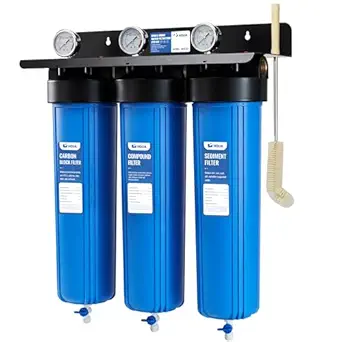 | Best for Maintenance Monitoring | Filtration stages: 3: sediment, carbon block, and GAC+KDF | Filter size: 20 × 5.5 inches | Listed reductions: Lead, mercury, arsenic, cadmium, chromium, chlorine, sediment, odors, and VOCs | VIEW LATEST PRICE | See Our Full Breakdown |
| Waterdrop WHF21-FG Two-Stage Whole-House Water Filter System |  | Best for Well Water | Filtration stages: 2 | Maximum flow rate: 15 GPM | Capacity: 50,000 gallons | VIEW LATEST PRICE | See Our Full Breakdown |
| Express Water Whole House Water Filter System, Ultimate Protection Pro, 3-Stage |  | Best for Easier Sediment Maintenance | Filtration stages: 3 | Pre-filter: Reusable 50-micron spin-down sediment filter | Capacity: Up to 100,000 gallons | VIEW LATEST PRICE | See Our Full Breakdown |
| iSpring WGB21B 2-Stage Whole House Water Filtration System |  | Best for Taste and Odor Improvement | Filtration stages: 2 | Sediment filter: 5-micron polypropylene | Capacity: Up to 50,000 gallons | VIEW LATEST PRICE | See Our Full Breakdown |
| Culligan Whole House Water Filter System with P5 Filter |  | Best Compact Sediment Guard | Model: WH-S200-C | Included filter: P5 cartridge | Connection size: 3/4 inch inlet and outlet | VIEW LATEST PRICE | See Our Full Breakdown |
| VEVOR 3-Stage Whole House Water Filter System, 4.5 x 20 in |  | Best High-Capacity Three-Stage Pick | Filtration stages: 3 | Filter types: Polypropylene sediment, KDF, CTO activated carbon | Cartridge size: 4.5 × 20 inches | VIEW LATEST PRICE | See Our Full Breakdown |
| whole house water filter system | Maximum flow rate | Filtration stages |
|---|---|---|
| Express Water 3-Stage Whole Ho | 17 gpm | 3 |
| iSpring WGB32BM Whole House Ir | 15 GPM | — |
| Waterdrop WHF21-PG 2-Stage Who | 15 gpm | — |
| PUREPLUS 2-Stage Whole House W | — | — |
| iSpring WGB32B Whole House Wat | 15 GPM | 3 |
| Culligan WH-HD200-C Heavy-Duty | 10 GPM | — |
| GE Whole House Water Filtratio | — | — |
| 3-Stage Whole House Water Filt | — | 3 |
| A. O. Smith Whole House Water | — | — |
| WF3-01 3-Stage Whole-House Wat | — | 3: sediment, carbon block, and GAC+KDF |
| Waterdrop WHF21-FG Two-Stage W | 15 GPM | 2 |
| Express Water Whole House Wate | — | 3 |
| iSpring WGB21B 2-Stage Whole H | 15 GPM | 2 |
| Culligan Whole House Water Fil | 4 GPM | — |
| VEVOR 3-Stage Whole House Wate | 15 GPM | 3 |
More Details on Our Top Picks
Express Water 3-Stage Whole House Water Filter System
The Express Water earns my overall pick for households that want several kinds of treatment in one main-line system. Its activated carbon, KDF, and polyphosphate target chlorine, heavy metals, and scale buildup, while pressure gauges give owners a way to monitor system performance. Compared with the iSpring WGB32BM, which puts a clearer emphasis on iron and manganese reduction, this is the more balanced choice when scale prevention and broad filtration are priorities. The 17 gpm flow rate also gives it a slight capacity advantage over the 15 gpm iSpring options. Its tradeoffs are substantial physical space and a 63-pound frame that calls for a sturdy installation area. It also does not reduce TDS, and its cartridges need periodic replacement.
Pros:- Combines activated carbon, KDF, and polyphosphate for several treatment goals
- 17 gpm maximum flow rate
- Pressure gauges and filter release buttons support routine maintenance
- Stainless steel freestanding frame
Cons:- Does not reduce total dissolved solids
- Large, heavy frame needs a suitable installation area
- Filters require replacement every 6–12 months or by capacity
Best for: Households seeking whole-home chlorine and scale treatment with a freestanding frame and visible pressure monitoring
Not ideal for: Buyers who need TDS reduction, have limited installation space, or want a system with fewer cartridge changes
- Filtration stages:3
- Purification methods:Activated carbon, KDF, polyphosphate
- Maximum flow rate:17 gpm
- Operating pressure:20–80 psi
- Connection size:1 inch
- Filter life:6–12 months or up to 100,000 gallons
- Dimensions:29 × 8.5 × 30 inches
- Frame material:Stainless steel
- TDS reduction:No
Our verdict“Choose the Express Water if you want broad whole-home treatment with scale control and can accommodate its large frame and scheduled filter changes.”
iSpring WGB32BM Whole House Iron and Manganese Water Filter System
For a home where iron staining or manganese is the central water concern, I rank the iSpring WGB32BM ahead of broader but less targeted options. Its stated reduction levels—up to 3.0 ppm iron and 1.0 ppm manganese—give buyers a more specific treatment focus than the Express Water system, whose listed mix emphasizes chlorine, heavy metals, and scale. Three stages also address sediment, chlorine, rust, herbicides, and industrial solvents, so this is not a single-contaminant setup. At 15 gpm and 100,000 gallons of capacity, it suits many whole-home installations. The main tradeoff is that it must be fitted to the main supply line, which makes installation planning necessary. Like the other iSpring option here, the WGB32B, it does not reduce TDS or remove healthy minerals.
Pros:- Targets iron up to 3.0 ppm and manganese up to 1.0 ppm
- Also filters sediment, chlorine, rust, herbicides, and industrial solvents
- 100,000-gallon stated filter capacity
- Lifetime technical support and DIY installation guidance
Cons:- Requires installation on the home’s main water supply line
- Does not reduce total dissolved solids
- Maximum flow rate is 15 gpm, below the Express Water system’s 17 gpm
Best for: Homeowners with iron or manganese in their water who want whole-home treatment and can install a main-line system
Not ideal for: Buyers seeking TDS reduction or households whose primary concern is not iron, manganese, or the listed contaminants
- Stages:3
- Iron reduction:Up to 3.0 ppm
- Manganese reduction:Up to 1.0 ppm
- Maximum flow rate:15 GPM
- Cartridge size:20 × 4.5 inches
- Inlet/outlet:1-inch NPT
- Sediment filtration:Down to 5 microns
- Filter capacity:100,000 gallons
- Warranty and support:1-year warranty; lifetime technical support
Our verdict“Pick the WGB32BM when iron and manganese are your main whole-home filtration targets and its 15 gpm flow suits your household.”
Waterdrop WHF21-PG 2-Stage Whole House Water Filter System, 5 Micron
The Waterdrop WHF21-PG is my compact pick for buyers who want a smaller whole-home setup for municipal water. At 14.37 × 7.48 × 15.55 inches, it takes less room than the Express Water system, whose frame measures 29 × 8.5 × 30 inches. Its sediment and activated carbon stages are described as addressing particles, chlorine, lead, and odors, with flow up to 15 gpm. That makes it a practical fit when space matters more than a longer stated capacity: its 50,000-gallon capacity is half the 100,000 gallons listed for the iSpring WGB32BM. Cartridge upkeep is also more frequent, with the PP filter due every 3–6 months and the GAC filter expected to last six months. The product data has conflicting pressure information, so buyers should verify the operating range before installation.
Pros:- Compact dimensions suit tighter installation areas
- Up to 15 gpm flow rate
- Targets sediment, chlorine, lead, and odors
- Includes a wrench and is designed for DIY installation
Cons:- 50,000-gallon capacity is below the 100,000 gallons listed for the iSpring systems
- PP and GAC filters have relatively frequent replacement schedules
- Product data gives conflicting operating-pressure information
Best for: DIY-minded homeowners on municipal water who need a compact system for sediment, chlorine, lead, and odor reduction
Not ideal for: Households on well water, buyers prioritizing longer filter capacity, or anyone needing a clearly specified pressure range
- Filter stages:2-stage system; also described as 5-stage filtration
- Maximum flow rate:15 gpm
- Capacity:50,000 gallons
- Filter life:GAC: 6 months; PP: 3–6 months
- Operating pressure:Description: 25–90 psi; specs also list 25 psi as upper pressure
- Maximum temperature:100 °F
- Dimensions:14.37 × 7.48 × 15.55 inches
- Inlet/outlet:1 inch
- Purification method:Activated carbon
Our verdict“Choose the Waterdrop WHF21-PG for a compact municipal-water installation if you accept more frequent filter changes and confirm its pressure requirements.”
PUREPLUS 2-Stage Whole House Water Filter with Clear Housing
The PUREPLUS is the simplest fit in this group for buyers who want to see the filter housing and have a pressure gauge to help track flow. Its composite polypropylene and iron removal stage pairs with a carbon block aimed at sediment, iron, chlorine, odors, and organic compounds. That gives it a different emphasis from the Waterdrop WHF21-PG, which has a stated 15 gpm flow rate and 50,000-gallon capacity but calls for more frequent cartridge changes. PUREPLUS provides no comparable flow or capacity figures, so I would treat it as a straightforward, compact option rather than a documented high-throughput choice. The clear housing and gauge can help with visual checks, but they do not fill in the missing service interval. Buyers should confirm cartridge availability and installation requirements before choosing it.
Pros:- Two stages target sediment, iron, chlorine, odors, and organic compounds
- Included pressure gauge helps monitor water flow
- Clear housing allows visual inspection
- Compact 10 × 4.5-inch listed dimensions
Cons:- No filter lifespan or replacement interval is specified
- No flow rate or capacity is provided
- Installation details are not included in the supplied product data
Best for: Homeowners who want a compact two-stage system with a visible housing and pressure gauge for routine checks
Not ideal for: Buyers who need a stated flow rate, filter lifespan, replacement schedule, or detailed installation guidance
- Stages:2
- Filter cartridges:Composite polypropylene and iron removal; carbon block
- Designed to reduce:Suspended particles, sediment, iron, chlorine, odors, and organic compounds
- Pressure gauge:Included
- Dimensions:10 × 4.5 inches
- Housing:Clear
Our verdict“Consider PUREPLUS if visible filter checks matter more to you than having published flow, capacity, and service-life figures.”
iSpring WGB32B Whole House Water Filter System
The iSpring WGB32B is the more focused choice for households whose whole-home goal is reducing chlorine and improving taste and odor while keeping healthy minerals. Its three-stage design and coconut shell carbon target chlorine, sediment, rust, tastes, odors, and herbicides, with stated chlorine reduction up to 99%. Compared with the WGB32BM, this model does not claim specific iron and manganese reduction, so I would choose the BM version when those minerals are the central issue. Both iSpring systems list 15 gpm flow and 100,000-gallon capacity, making the WGB32B a substantial main-line option. It does not remove TDS, and the cartridges must be unwrapped before use. Buyers should also plan for main-line installation and ongoing cartridge replacement rather than treating this as a maintenance-free filter.
Pros:- Up to 99% stated chlorine reduction
- Filters sediment, rust, tastes, odors, and herbicides
- Maintains healthy minerals in the water
- 15 GPM flow rate and 100,000-gallon capacity
Cons:- Does not remove total dissolved solids
- Does not list the specific iron and manganese reduction claims of the WGB32BM
- Cartridges must be unwrapped before installation and require replacement
Best for: Households on a main water line that want chlorine, taste, odor, and sediment filtration while retaining healthy minerals
Not ideal for: Buyers who need TDS reduction or specific iron and manganese treatment, or who do not want cartridge maintenance
- Filtration stages:3
- Chlorine reduction:Up to 99%
- Filter size:20 × 4.5 inches
- Inlet/outlet:1-inch NPT
- Maximum flow rate:15 GPM
- Capacity:100,000 gallons
- Carbon type:Coconut shell carbon
- TDS reduction:No
Our verdict“Choose the WGB32B for high-capacity whole-home chlorine and taste filtration when TDS and targeted iron treatment are not your priorities.”
Culligan WH-HD200-C Heavy-Duty Whole House Water Filter Housing
The Culligan WH-HD200-C is a good fit when the main goal is to catch sediment before it reaches plumbing and appliances, and you want to choose the cartridge yourself. Its clear housing makes it easier to see buildup, while the included shut-off, bypass, and pressure relief valves simplify cartridge changes. Compared with the GE GXWH20T, it is built around a 1-inch water main rather than 3/4-inch plumbing, so the connection size may decide between them. Both are housings that need a separate filter cartridge; neither is a complete filtration setup out of the box. The tradeoff is that buyers must select a compatible cartridge and confirm their plumbing size. This makes the Culligan more adaptable than an all-in-one cartridge system, but less straightforward for someone who wants a ready-to-run filter.
Pros:- Clear sump makes cartridge condition visible
- Includes shut-off, bypass, and pressure relief valves
- Compatible with a range of heavy-duty cartridges
- Up to 10 GPM flow rate
Cons:- Filter cartridge must be purchased separately
- Requires a 1-inch water main
- Filtration results depend on the cartridge selected
Best for: Homeowners with a 1-inch main who want to select a heavy-duty cartridge for sediment, rust, or scale concerns
Not ideal for: Buyers seeking a complete system with a filter included, or homes with 3/4-inch plumbing
- Model:WH-HD200-C
- Installation type:In-line
- Compatible water main:1 inch
- Maximum flow rate:10 GPM
- Purification method:Sedimentation with compatible cartridge
- Included components:Mounting bracket, housing wrench, shut-off and bypass valves, pressure relief valve
- Filter cartridge:Sold separately
Our verdict“Choose the Culligan if you have a 1-inch main and want control over the sediment cartridge used throughout your home.”
GE Whole House Water Filtration System with Installation Kit
The GE GXWH20T suits homeowners who want a basic sediment prefilter sized for common 3/4-inch plumbing. Its clear sump shows the filter, and the three-position bypass valve lets you change it without shutting off household water. The installation kit and remote reminder light also make routine upkeep easier to plan. Compared with the Culligan WH-HD200-C, GE is the more natural match for 3/4-inch lines, while Culligan is designed for a 1-inch main and offers a higher stated flow rate. Neither includes a filter, so both require a separate cartridge purchase. GE’s stated replacement interval is every three months, which means more frequent maintenance than a long-life whole-house carbon system such as the A. O. Smith 600,000-Gallon model. Its appeal is simple sediment control, not broad contaminant treatment.
Pros:- Fits 3/4-inch connections
- Three-position bypass supports filter changes without interrupting household water
- Clear sump makes filter condition easy to check
- Installation kit includes plumbing connections and mounting hardware
Cons:- Filter is not included
- Listed replacement interval is every three months
- Focused on sediment, sand, and rust rather than broad contaminant reduction
Best for: Homeowners with 3/4-inch plumbing who want a visible, bypass-equipped sediment prefilter and can keep up with quarterly cartridge changes
Not ideal for: Buyers who want a filter included or need filtration beyond sand, sediment, and rust reduction
- Model number:GXWH20T
- Connection size:3/4 inch
- Compatible filters:FXWTC, FXPWC, FXWSC, FXUSC
- Filter replacement interval:Every 3 months
- Features:3-position bypass valve, clear sump, pressure relief valve, mounting bracket, remote filter reminder light
- Included components:Filtration housing and installation kit
- Filter included:No
Our verdict“Pick the GE for a straightforward 3/4-inch sediment prefilter when you are comfortable buying cartridges separately and replacing them regularly.”
3-Stage Whole House Water Filter System with 9 Filters
This three-stage system is aimed at households that want sediment and carbon filtration across the whole home, with replacement sets already on hand. Its nine included filters provide three rounds of sediment, GAC carbon, and carbon block cartridges, while the stated 15 GPM flow rate is higher than the 7 GPM listed for the A. O. Smith carbon system. That difference may matter when several taps run at once, though actual household performance depends on installation and water conditions. The system is listed for city or well water and uses standard 3/4-inch connections. It can reduce chlorine, sediment, and odors while leaving minerals and TDS unchanged. Compared with the WF3-01, it includes more filter sets, but its description gives less detail about maintenance monitoring. Buyers should be ready to connect it directly to the water line.
Pros:- Includes three full sets of sediment, GAC carbon, and carbon block filters
- 15 GPM stated flow rate
- Three stages address sediment, chlorine, and odors
- Dual valves support filter changes without shutting off the main
Cons:- Does not reduce TDS
- Requires installation on the household water line
- Filter replacement interval is not specified in the supplied product data
Best for: Households wanting staged sediment and carbon filtration, a higher stated flow rate, and several cartridge sets included
Not ideal for: Buyers who need TDS reduction, want minimal plumbing work, or require detailed filter-life guidance
- Filtration stages:3
- Flow rate:15 GPM
- Inlet and outlet connections:3/4 inch
- Included filters:9 total: 3 PP sediment, 3 GAC carbon, 3 CTO carbon block
- Water compatibility:City water and well water
- TDS reduction:Does not reduce TDS
- Included accessories:Filter wrench, plumber’s tape, 2 brass connectors, 2 valves, user manual
Our verdict“Choose this system if you want staged carbon and sediment filtration with multiple replacement sets ready for future changes.”
A. O. Smith Whole House Water Filter System, 600,000-Gallon Capacity
The A. O. Smith is the clearest choice here for households focused on reducing chlorine taste and odor throughout the home without frequent cartridge changes. Its activated carbon filter is rated to reduce 96.9% of chlorine taste and odor, with capacity up to 600,000 gallons or six years. That is a different maintenance proposition from the GE GXWH20T, which calls for filter replacement every three months, and the nine-filter three-stage system, which includes spare sets but does not state an interval. A 7 GPM flow rate is more modest than that three-stage option’s 15 GPM, so this model may be less appealing where several fixtures often run together. It also does not soften water or reduce TDS, sulfur, or iron. The long service life is its defining advantage, paired with a narrower treatment scope.
Pros:- Rated to reduce 96.9% of chlorine taste and odor
- Capacity up to 600,000 gallons or six years
- Filters water throughout the home for drinking, cooking, and bathing
- Includes a shut-off valve, hose adapter, and nipple for installation
Cons:- Does not soften water or reduce TDS, sulfur, or iron
- 7 GPM flow rate is lower than the 15 GPM three-stage option in this lineup
- Additional installation tools may be needed
Best for: Homeowners prioritizing whole-home chlorine taste and odor reduction with infrequent filter replacement
Not ideal for: Households needing water softening, TDS, sulfur, or iron reduction, or a higher stated flow rate
- Model:AO-WH-FILTER
- Purification method:Activated carbon
- Chlorine reduction:96.9% of chlorine taste and odor
- Capacity and filter life:Up to 600,000 gallons or 6 years
- Flow rate:7 GPM
- Operating pressure:20–100 psi
- Certification:NSF/ANSI 42
- Dimensions:30.2 × 9.5 × 9.4 inches
Our verdict“Choose the A. O. Smith if chlorine taste and odor are your main concerns and you value a long stated filter life over broader treatment.”
WF3-01 3-Stage Whole-House Water Filtration System
The WF3-01 is suited to buyers who want more visibility into system upkeep and a stated focus on several heavy metals alongside sediment, chlorine, odors, and VOCs. Its pressure gauges can help flag a change in flow pressure, while the 180-day countdown timers provide a simple reminder to check filters. The A. O. Smith 600,000-Gallon system offers a much longer stated interval for chlorine reduction, but its listed treatment scope is narrower; WF3-01 instead takes a multi-stage approach with sediment, carbon block, and GAC+KDF filters. It is also more demanding on installation space, at 31 inches high and 23 inches wide. The supplied data does not specify a replacement interval beyond the timer, so buyers should confirm cartridge guidance before relying on the reminder as a service schedule.
Pros:- Three stages target sediment, chlorine, odors, VOCs, and several heavy metals
- Pressure gauges help monitor system conditions
- 180-day timers provide filter-check reminders
- Includes maintenance valves, housing brush, and pipe adapters
Cons:- Large footprint at 31 inches high and 23 inches wide
- Replacement interval is not specified beyond the timer
- Installation requires adequate space and water-line connections
Best for: Homeowners seeking staged filtration with maintenance indicators and flexible 3/4-inch or 1-inch pipe adapters
Not ideal for: Homes with limited utility-room space or buyers who want a clearly stated filter replacement lifespan
- Filtration stages:3: sediment, carbon block, and GAC+KDF
- Filter size:20 × 5.5 inches
- Listed reductions:Lead, mercury, arsenic, cadmium, chromium, chlorine, sediment, odors, and VOCs
- Dimensions:31 inches high × 23 inches wide × 8 inches deep
- Installation:Bracket-mounted or free-standing
- Pipe adapters:3/4-inch NPT or 1-inch NPT
- Filter timers:180-day countdown timers
- Monitoring and maintenance:Pressure gauges, pressure relief and drain valves, housing brush, maintenance record card
Our verdict“Pick the WF3-01 if maintenance visibility and a broader stated contaminant focus matter more to you than compact size or a published filter lifespan.”
Waterdrop WHF21-FG Two-Stage Whole-House Water Filter System
The Waterdrop WHF21-FG is the most targeted choice here for households dealing with iron or manganese alongside everyday sediment and chlorine. Its two-stage setup is described as reducing those contaminants and selected heavy metals, while the 15 GPM flow rate suits whole-home use better than the Culligan WH-S200-C, which is limited to 4 GPM and focuses on sediment. Waterdrop also lists municipal and well water as supported sources, and includes pre-installed cartridges and installation accessories to simplify setup.
The tradeoff is that its stated 50,000-gallon capacity and filter life of up to six months can vary with source-water quality and household use. This is a filtration system, not a TDS-reduction solution, and proper installation still calls for plumbing setup such as applying Teflon tape. I’d choose it for a well-water problem profile, rather than as a general upgrade without a known concern.
Pros:- Targets iron, manganese, chlorine, rust, sediment, and selected heavy metals
- Supports municipal and well water
- Rated for up to 15 GPM and 50,000 gallons
- Includes pre-installed cartridges, mounting bracket, and installation wrench
Cons:- Filter life varies with water quality and household usage
- Installation requires correct plumbing setup, including Teflon tape
Best for: Households on well water seeking filtration for iron, manganese, sediment, and chlorine at whole-home flow rates.
Not ideal for: Buyers who need a specified TDS reduction system or want a longer stated service interval than six months.
- Filtration stages:2
- Maximum flow rate:15 GPM
- Capacity:50,000 gallons
- Filter life:Up to 6 months
- Connections:1-inch NPT
- Filter size:10 × 4.5 inches
- Dimensions:14.37 × 7.48 × 15.55 inches
- Warranty:1 year
Our verdict“Choose the Waterdrop WHF21-FG if your well-water concerns include iron or manganese and you want a 15 GPM whole-house system.”
Express Water Whole House Water Filter System, Ultimate Protection Pro, 3-Stage
The Express Water Ultimate Protection Pro builds maintenance around a reusable 50-micron spin-down filter: it catches larger particles before they reach the specialty cartridges, which may help those cartridges last longer in sediment-heavy supplies. Its quick-change cartridges and pressure gauges also give homeowners practical cues and access for routine service. Compared with the iSpring WGB21B, which pairs a 5-micron sediment filter with carbon, this Express Water system adds a washable first step and states capacity up to 100,000 gallons.
That capacity does not tell me how well it handles a specific contaminant, though: the supplied product data gives no contaminant reduction ratings. The transparent housing helps show collected sediment, but the system still needs cartridge changes and periodic cleaning. I’d rank it for households that value a reusable prefilter and service visibility, while buyers choosing primarily by documented contaminant performance should look for more specific reduction data.
Pros:- Reusable 50-micron spin-down filter catches larger particles
- Quick-change cartridges simplify replacement
- Stated capacity of up to 100,000 gallons
- Pressure gauges and transparent sediment housing aid monitoring
Cons:- Product data does not provide specific contaminant reduction ratings
- Reusable prefilter cleaning and cartridge changes still require maintenance
Best for: Homeowners with visible sediment who want a reusable prefilter, pressure gauges, and quick-change cartridges.
Not ideal for: Buyers who need documented reduction ratings for particular contaminants before choosing a whole-house system.
- Filtration stages:3
- Pre-filter:Reusable 50-micron spin-down sediment filter
- Capacity:Up to 100,000 gallons
- Connections:1-inch standard
- Cartridges:Quick-change
- Housing:Transparent sediment housing
- Additional features:Pressure gauges; no wastewater
Our verdict“Pick this Express Water system if sediment management and visible pressure readings matter more to you than listed contaminant reduction ratings.”
iSpring WGB21B 2-Stage Whole House Water Filtration System
The iSpring WGB21B keeps its job clear: a 5-micron sediment filter catches fine particles, then a carbon CTO cartridge targets chlorine, taste, and odor. It retains healthy minerals and requires no power, making it a straightforward fit for homes that want cleaner-feeling tap water at multiple fixtures without a broader treatment system. Compared with the Waterdrop WHF21-FG, which is positioned for iron and manganese concerns, iSpring’s supplied description centers on sediment and chlorine-related issues.
The distinction matters because this system does not reduce total dissolved solids, and the product data does not claim iron or manganese reduction. Its capacity is up to 50,000 gallons, with filter life listed up to 12 months; actual replacement timing will depend on use and source water. I’d favor it for routine sediment and taste concerns, but not for buyers who need a specialized well-water treatment claim or TDS removal.
Pros:- 5-micron sediment filter paired with carbon CTO filtration
- Targets chlorine, bad tastes, odors, and sediment
- Retains healthy minerals and needs no power
- Includes mounting bracket, filter wrench, and pressure release valve
Cons:- Does not reduce total dissolved solids
- Filter replacement is needed about once a year, depending on use and water quality
Best for: Households seeking whole-home reduction of sediment, chlorine taste, and odor while retaining minerals.
Not ideal for: Buyers seeking TDS reduction or a system specifically described for iron and manganese.
- Filtration stages:2
- Sediment filter:5-micron polypropylene
- Capacity:Up to 50,000 gallons
- Filter life:Up to 12 months
- Maximum flow rate:15 GPM
- Inlet and outlet:1 inch
- Operating pressure:Up to 80 psi
- Temperature range:40–100 °F
Our verdict“Choose the iSpring WGB21B for whole-home sediment and chlorine taste concerns when TDS reduction is not a requirement.”
Culligan Whole House Water Filter System with P5 Filter
The Culligan WH-S200-C is a focused sediment guard for dirt, sand, and silt, with a clear housing that lets owners see the cartridge and a valve-in-head bypass plus pressure relief button for service. Its compact inline form can suit a smaller installation point where the goal is to protect plumbing and appliances from particles. That narrow purpose sets it apart from the iSpring WGB21B, which adds carbon filtration for chlorine taste and odor.
The main limitation is flow: Culligan lists a maximum of just 4 GPM, far below the 15 GPM figures for iSpring and Waterdrop, so it may constrain simultaneous household demand. The supplied data also specifies sediment filtration only, with no broader contaminant reduction claim. I’d treat it as a plumbing-protection prefilter or a modest-demand solution, not as a complete whole-house answer for taste, odor, or dissolved contaminants.
Pros:- Targets dirt, sand, and silt to help protect plumbing and appliances
- Clear housing makes cartridge condition easier to monitor
- Valve-in-head bypass and pressure relief button aid cartridge changes
- Compact inline installation
Cons:- Maximum flow rate is 4 GPM
- Product data specifies sediment filtration without broader contaminant reduction
Best for: Small homes or modest-demand installations needing a visible, serviceable filter for dirt, sand, and silt.
Not ideal for: Large households with simultaneous water demand or buyers seeking chlorine, taste, odor, or broader contaminant reduction.
- Model:WH-S200-C
- Included filter:P5 cartridge
- Connection size:3/4 inch inlet and outlet
- Maximum flow rate:4 GPM
- Operating pressure:30–100 psi
- Temperature range:40–100 °F
- Installation type:Inline
- Dimensions:6.57 × 6.18 × 15.94 inches
Our verdict“Use the Culligan as a compact sediment filter where flow demand is modest and broader treatment is not needed.”
VEVOR 3-Stage Whole House Water Filter System, 4.5 x 20 in
VEVOR combines a polypropylene sediment cartridge, KDF, and activated carbon in a large-format three-stage system. The listed targets include rust, sand, chlorine, certain heavy metals, and odors, giving it a broader stated scope than the Culligan WH-S200-C, which is described as a sediment filter only. Its 15 GPM flow rate and stated 100,000-gallon capacity also make it better suited to whole-home demand than a small inline sediment unit.
Those capabilities come with a real installation footprint: the unit measures 22.6 × 9.8 × 31.5 inches and weighs 48.9 pounds. It can be wall-mounted or floor-standing, but either setup needs room and secure support. Filter life is listed at six to twelve months, so cartridge upkeep remains part of ownership. I’d choose VEVOR when higher stated capacity and multiple filtration media matter more than compactness.
Pros:- Three stages target sediment, chlorine, certain heavy metals, and odors
- Stated capacity of up to 100,000 gallons
- Rated for up to 15 GPM
- Can be wall-mounted or floor-standing and includes a pressure gauge
Cons:- Large 22.6 × 9.8 × 31.5-inch footprint
- Weighs 48.9 pounds, requiring suitable installation support
- Cartridges need replacement about every 6–12 months
Best for: Households wanting three filtration media, a 15 GPM flow rating, and flexible mounting with room for a large system.
Not ideal for: Homeowners with limited utility-room space or those unable to support a 48.9-pound system.
- Filtration stages:3
- Filter types:Polypropylene sediment, KDF, CTO activated carbon
- Cartridge size:4.5 × 20 inches
- Maximum flow rate:15 GPM
- Capacity:100,000 gallons
- Filter life:6–12 months
- Connection:1-inch NPT
- Dimensions and weight:22.6 × 9.8 × 31.5 inches; 48.9 lb
Our verdict“Choose VEVOR if you have installation space and want a high-capacity, three-stage system with a 15 GPM flow rating.”
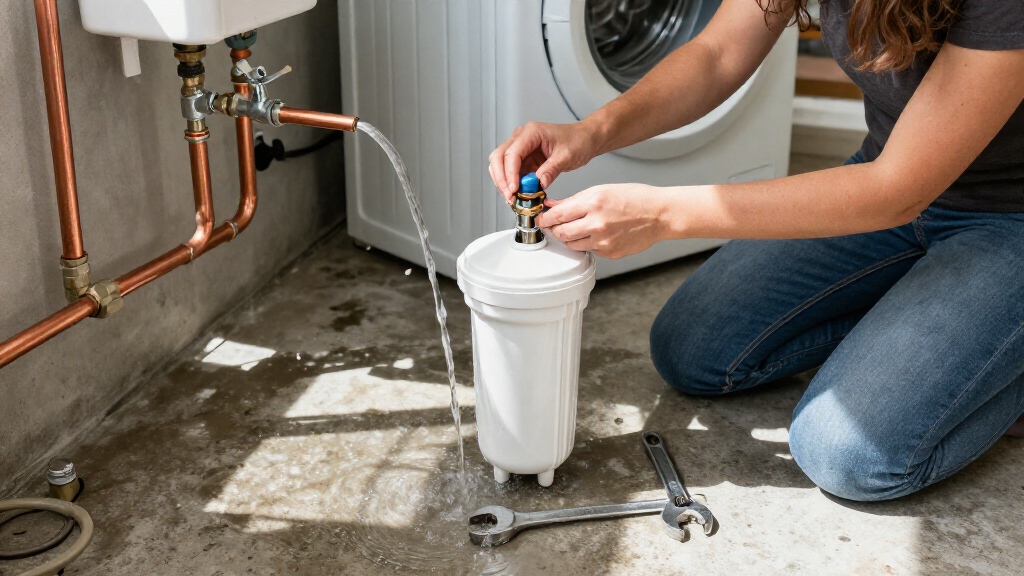
How We Picked
My ranking logic for these whole house water filter systems rests on five criteria, weighted by how much each affects real ownership. Filtration performance came first: how many stages, what micron rating, and whether the system targets specific contaminants or takes a general-purpose approach. Flow rate and capacity followed closely, because a filter that chokes a two-bathroom shower or needs replacement every three months costs more than its sticker price suggests. I then weighed build quality — housing material, pressure rating, and whether fittings and brackets are included — and maintenance burden, including how easy cartridges are to source and swap.
Finally, I factored in value and fit: a bare housing like the Culligan WH-HD200-C is not inherently worse than a fully loaded three-stage system; it simply serves a different buyer. Products rose in the rankings when they paired big blue 20-inch housings with generous capacity and readily available replacement cartridges. Products fell when replacement filters were proprietary, hard to find, or when the system’s filtration claims outstripped its actual cartridge specs.
Factors to Consider When Choosing Whole House Water Filter Systems
Choosing between whole house water filter systems comes down to matching the system to your water problem, your plumbing, and your tolerance for maintenance. These six factors separate a satisfying purchase from a frustrating one.Test Your Water Before You Buy
The single most common mistake in this category is buying a filter before knowing what needs filtering. A general-purpose carbon and sediment system will do almost nothing for iron staining or hard water scale, while an iron-specific system is wasted money if your problem is chlorine taste. Order a water test kit or check your annual consumer confidence report from your municipal supplier, and match the filter type to the actual contaminant list. Well water buyers should always test, since private wells are unregulated and contaminants vary street to street. If your report shows hardness rather than particulates or chemicals, a water softener — not a filtration system — is the right tool, and no system in this roundup will solve scale on its own.
Housing Size Dictates Real-World Performance
Filter housings come in standard 10-inch and big blue 20-inch sizes, and the difference shows up the moment two fixtures run at once. Larger housings present more surface area to the water, which means less pressure drop and longer cartridge life. A small 10-inch system might be fine for a one-bathroom condo, but in a family home it will need cartridge changes two to three times as often, quietly erasing any upfront savings. Check your household’s peak demand — roughly 3 gallons per minute per simultaneous fixture — and pick a housing rated comfortably above it. Bigger housings also require more installation clearance, so measure your available wall space near the main line before committing.
Stage Count vs. Cartridge Quality
Marketing loves stage counts, but a two-stage system with high-quality carbon block cartridges often outperforms a three-stage system stuffed with cheap generic filters. What matters is what each stage does: a sediment pre-filter protects downstream carbon stages from clogging, and the carbon stage does most of the chemical removal. A third stage only adds value when it does something distinct, like iron removal or finer polishing. Buyers should read the cartridge specifications, not the box, and confirm the micron rating and filter media match their water problem. Also verify that replacement cartridges are standard-sized and available from multiple sellers — proprietary cartridge formats lock you into one supplier’s pricing.
Installation Requirements and Honest Costs
Most systems in this category require cutting into your main water line, which means shutoff valves, a drain nearby, and ideally a licensed plumber if you are not comfortable with basic plumbing. Budget for fittings and tubing beyond what ships in the box, since included hardware is often minimal. Installation typically runs a few hundred dollars professionally, which can exceed the cost of the filter itself. Some systems include bypass valves, which simplify cartridge changes and let you keep water flowing during maintenance — a feature worth paying more for in busy households. If your main line is inaccessible or you rent, an under-sink system may be the more realistic choice.
Maintenance Cadence and Ongoing Cost
Cartridge replacement intervals range from three months for sediment pre-filters to six months for carbon stages to several years for high-capacity systems like the A. O. Smith. Multiply the annual cartridge cost by the number of stages before deciding a cheap system is cheap. A three-stage system consuming nine cartridges a year costs far more over five years than a high-capacity single-cartridge system. Pressure gauges help here: instead of guessing, you change cartridges when pressure drops, which often extends intervals in low-sediment municipal water. Consider your own willingness to do the work too — swapping cartridges involves shutting water off, depressurizing housings, and lifting wet filter assemblies.
Certification Claims and What They Actually Mean
Legitimate certifications come from NSF/ANSI standards, and the specific standard matters more than the word certified. NSF/ANSI 42 covers aesthetic effects like chlorine taste and odor, while NSF/ANSI 53 covers health-related contaminants like lead and cysts. Many budget systems carry no certification at all, or certify only the housing, not the filtration performance. That does not automatically mean they filter poorly, but it means the claims are unverified. If health contaminants are your concern, certification is non-negotiable; if you are filtering already-treated municipal water for taste and sediment, uncertified systems from reputable brands are a reasonable gamble.
Frequently Asked Questions
Do whole house water filter systems remove lead and other health contaminants?
It depends entirely on the cartridges, not the housing. Standard carbon and sediment cartridges address chlorine, taste, odor, and particulates, but lead removal requires cartridges certified to NSF/ANSI 53 with specific lead-removal media. Most general-purpose systems in this roundup, including the popular three-stage models, are designed for aesthetic improvement rather than health-contaminant removal. If your water test shows lead, arsenic, or cysts, look for certified cartridges or pair a whole house sediment system with a certified drinking-water filter at the tap. Buying a general system and assuming it handles lead is one of the most expensive misunderstandings in this category.
Will a whole house filter system reduce my water pressure?
Any filter adds some resistance, but well-sized systems keep the drop negligible in normal operation. The pressure loss becomes noticeable when cartridges clog or when a small housing serves a high-demand household. Big blue 20-inch systems like the iSpring WGB32B and Express Water 3-Stage handle simultaneous showers and appliance use with minimal impact, while compact 10-inch housings can struggle. Installing a pressure gauge before and after the system lets you watch cartridge condition and change filters before flow suffers. If your home already has marginal incoming pressure, oversize the housing rather than the stage count.
How often do I actually need to replace the filter cartridges?
Sediment pre-filters usually need changing every three to six months, carbon stages every six months, and high-capacity systems can run a year or longer between changes. Your actual interval depends on water quality: a well with heavy sediment will clog pre-filters fast, while clean municipal water may stretch intervals well past manufacturer recommendations. High-capacity options like the A. O. Smith 600,000-gallon system are designed specifically for buyers who want to minimize maintenance. Rather than following the calendar blindly, watch a pressure gauge and change cartridges when flow drops about 10 to 15 percent. That approach typically saves a cartridge or two per year.
Is a 2-stage or 3-stage whole house system better for my home?
Two-stage systems pair a sediment pre-filter with a carbon filter, which covers the needs of most municipal water users at lower cost and easier maintenance. Three-stage systems add a dedicated cartridge for something specific — finer sediment, iron, manganese, or extra carbon — and make sense when your water test shows a problem a two-stage setup cannot address. The iSpring WGB32BM earns its third stage with genuine iron-removal media, while some generic three-stage kits simply add a redundant filter. More stages also means more cartridges to buy and swap each year. Match the stage count to your water report rather than assuming more is better.
Can I install a whole house water filter system myself, or do I need a plumber?
A homeowner comfortable with basic plumbing can usually install one of these systems in an afternoon, since the process involves cutting the main line, fitting the housing, and checking for leaks. Systems that ship with installation kits, like the GE Whole House system, simplify the job with included fittings and brackets. You will need a main shutoff that actually works, space on the incoming line, and ideally a drain for spills during cartridge changes. The job gets complicated with older galvanized pipe, tight installation spaces, or homes where the main shutoff is unreliable. A professional installation typically costs a few hundred dollars and is worth it if you are not confident sweating pipe or working with compression fittings.
Conclusion
After comparing all fifteen systems, the right choice depends less on brand loyalty and more on what your water report says and how much maintenance you will tolerate. For best overall, the Express Water 3-Stage Whole House System delivers the best mix of filtration breadth, flow capacity, and accessible replacement cartridges. For best value, the Waterdrop WHF21-PG 2-Stage covers the essentials for typical municipal water at a lower ongoing cost than most three-stage rivals. For premium buyers, the A. O. Smith 600,000-Gallon system justifies its price through dramatically longer service intervals and higher capacity. For beginners, the GE Whole House Filtration System with Installation Kit removes the intimidation factor with included hardware and a simpler setup. For specific needs, the iSpring WGB32BM handles iron and manganese staining that would defeat general-purpose systems, while bare housings like the Culligan WH-HD200-C suit DIY-minded buyers who want to choose their own cartridges. Test your water first, size the housing to your household, and the right pick from this list becomes obvious.
Fall Picks
fall essentials
As an affiliate, we earn on qualifying purchases.