
Smart home leak sensors are small, inexpensive devices that can save you thousands in water damage by alerting you the moment a leak starts under a sink, behind a washer, or near a water heater. After comparing 15 popular models, the YoLink Water Leak Sensor 4 Kit with Hub stands out as the best overall pick thanks to its exceptional wireless range and rock-solid long-range connectivity, while the GoveeLife Smart Water Leak Detector 2 line offers the best value for most homes and the Moen Flo Wi-Fi detectors integrate best with professional-grade water monitoring ecosystems. The main tradeoffs in this category come down to hub versus hub-free designs, single-point sensing versus extended cable probes, and loud local alarms versus quiet app-only notifications. Whether you need whole-home coverage or a single sensor under the kitchen sink changes which model makes sense. Read on for the full breakdown of all 15 options and who each one fits best.

Get home appliances delivered free — and shop member deals
- Fast, free delivery on millions of items
- Access to Prime Big Deal Days deals on October 6–7
- Prime Video, Amazon Music and more included
Complete the kit


![[Genuine] Waterdrop PF-01A Water Filter Replacement for W...](https://m.media-amazon.com/images/I/41+5tl9EiKL._SX342_SY445_QL70_FMwebp_.jpg)
Key Takeaways
- Hub-based systems like YoLink and Tapo delivered the most reliable alerts through walls and across large homes, while standalone Wi-Fi sensors like the D-Link kit were simpler to set up but more dependent on strong router coverage near the leak site.
- GoveeLife dominates this lineup with six different kits, but the packaging differences matter more than the marketing suggests — the Detector 2 line and the adjustable 105 dB alarm version serve genuinely different needs, so picking the right variant saves money.
- If you want an extended sensing footprint rather than coverage at a single point, the GoveeLife model with the 4.92 ft cable probe is the only option here that catches leaks spread across a wider area like a water heater pan or washer drain.
- The Flood Buzz 12-pack skips smart features entirely, trading app alerts for the lowest per-sensor cost and zero setup — a pattern that makes it the clear choice for landlords and rental units where tenants won’t manage an app.
- Multi-packs with a hub (X-Sense, Stechro, YoLink) consistently beat single-sensor purchases on per-unit cost, so buyers planning whole-home coverage should almost never buy a starter kit plus separate sensors one at a time.
| D-Link Wi-Fi Water Leak Detector Starter Kit with Two Sensors |  | Best for Multi-Room Alerts | Included sensors: 2 | Sensing cable length: 1.5 ft (plus 3 ft extension) | Siren volume: 100 dB | VIEW LATEST PRICE | See Our Full Breakdown |
| Moen Flo Wi-Fi Water Leak Detectors, 3-Pack |  | Best for Whole-Home Water Ecosystems | Quantity: 3 detectors | Connectivity: 2.4 GHz Wi-Fi | Alerts: Moen Smart Water Network app notifications | VIEW LATEST PRICE | See Our Full Breakdown |
| Aqara Zigbee Water Leak Sensor, 3-Pack |  | Best for Smart Home Automators | Pack size: 3 sensors | Connectivity: Zigbee | Required hub: Aqara Hub (sold separately) | VIEW LATEST PRICE | See Our Full Breakdown |
| X-Sense Wi-Fi Water Leak Detector Kit with 3 Sensors and Base Station (SWS54) | 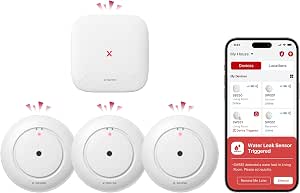 | Best Value Kit | Sensors: 3 | Detection probes: 2 upper and 4 bottom probes per sensor | Detection depth: As shallow as 0.4 mm | VIEW LATEST PRICE | See Our Full Breakdown |
| Tapo Smart Water Leak Detector T300 |  | Best for Fast Response | Model: T300 | Detection: Dual-side sensing with 6 probes | Response time: As fast as 1 second | VIEW LATEST PRICE | See Our Full Breakdown |
| GoveeLife Smart Water Leak Detector 2, 4-Pack |  | Best Long-Range Coverage | Pack size: 4 detectors | Connectivity: Wi-Fi gateway, 2.4 GHz | Wireless range: Up to 1,968.5 feet | VIEW LATEST PRICE | See Our Full Breakdown |
| Flood Buzz Small Water Leak Detectors, 12-Pack |  | Best Zero-Setup Backup Layer | Pack size: 12 detectors | Power source: One 12V alkaline battery per unit (sealed) | Battery life: Up to 3 years | VIEW LATEST PRICE | See Our Full Breakdown |
| GoveeLife Upgraded Smart Water Leak Detector, 6 Pack |  | Best for Whole-Home Smart Coverage | Quantity: 6 sensors | Wireless range: Up to 1,804 feet | Alarm volume: Up to 105 dB, 4 adjustable levels | VIEW LATEST PRICE | See Our Full Breakdown |
| GoveeLife Upgraded Smart Water Leak Detector, 4 Pack |  | Best for Multi-Floor Homes | Pack size: 4 sensors | Wireless range: Up to 1,804 feet through up to 5 walls | Alarm volume: Up to 105 dB, 4 adjustable levels | VIEW LATEST PRICE | See Our Full Breakdown |
| GoveeLife Water Leak Detector with Adjustable 105 dB Alarm, 5-Pack |  | Best Standalone Alarms with Smart Upgrade Path | Pack quantity: 5 detectors | Alarm volume: Up to 105 dB, 4 adjustable settings | Sensor probes: 2 sets per detector | VIEW LATEST PRICE | See Our Full Breakdown |
| Stechro Wi-Fi Water Leak Detector Kit with App Alerts, 4 Sensors and Gateway |  | Best for Growing Coverage | Connectivity: 2.4 GHz Wi-Fi via gateway | Included sensors: 4 (expandable to 24 per gateway) | App: TUYA | VIEW LATEST PRICE | See Our Full Breakdown |
| YoLink Water Leak Sensor 4 Kit with Hub, 6-Pack |  | Best Whole-Home Coverage | Package contents: 1 YoLink Hub and 6 Leak Sensor 4 units | Wireless range: Up to 2,034 ft. in open air | Connectivity: LoRa | VIEW LATEST PRICE | See Our Full Breakdown |
| GoveeLife Smart Water Leak Detector 2, 6-Pack |  | Best Value Multi-Pack | Pack size: 6 detectors | Maximum range: 1,968 feet | Wireless technology: LoRa | VIEW LATEST PRICE | See Our Full Breakdown |
| GoveeLife Smart Water Leak Detector, 5-Pack |  | Best for Damp Areas | Pack size: 5 sensors | Connectivity range: Up to 1,804 ft (550 m) | Alarm volume: Up to 105 dB, four volume levels | VIEW LATEST PRICE | See Our Full Breakdown |
| GoveeLife Smart Water Leak Detector with 4.92 ft Cable |  | Best for Hard-to-Reach Spots | Cable length: 4.92 ft | Detection modes: Water alarm and water-level detection | Connectivity: 915 MHz Sub-1G; gateway needs 2.4 GHz Wi-Fi | VIEW LATEST PRICE | See Our Full Breakdown |
| smart home leak sensor | Alarm volume | Battery life | Connectivity |
|---|---|---|---|
| D-Link Wi-Fi Water Leak Detect | — | — | Wi-Fi, no hub required |
| Moen Flo Wi-Fi Water Leak Dete | — | — | 2.4 GHz Wi-Fi |
| Aqara Zigbee Water Leak Sensor | — | — | Zigbee |
| X-Sense Wi-Fi Water Leak Detec | 120 dB | — | — |
| Tapo Smart Water Leak Detector | 90 dB (adjustable) | Up to 3 years | — |
| GoveeLife Smart Water Leak Det | 100 dB | Over 5 years (AAA batteries included) | Wi-Fi gateway, 2.4 GHz |
| Flood Buzz Small Water Leak De | Up to 95 dB | Up to 3 years | None — local alarm only |
| GoveeLife Upgraded Smart Water | Up to 105 dB, 4 adjustable levels | Up to 5 years | — |
| GoveeLife Upgraded Smart Water | Up to 105 dB, 4 adjustable levels | Up to 5 years | — |
| GoveeLife Water Leak Detector | Up to 105 dB, 4 adjustable settings | Up to 5 years (built-in) | — |
| Stechro Wi-Fi Water Leak Detec | Adjustable up to 120 dB | Up to 3 years | 2.4 GHz Wi-Fi via gateway |
| YoLink Water Leak Sensor 4 Kit | 105 dB | — | LoRa |
| GoveeLife Smart Water Leak Det | Up to 100 dB | Over 5 years under normal use | — |
| GoveeLife Smart Water Leak Det | Up to 105 dB, four volume levels | Up to 5 years | — |
| GoveeLife Smart Water Leak Det | 105 dB | Up to 5 years | 915 MHz Sub-1G; gateway needs 2.4 GHz Wi-Fi |
More Details on Our Top Picks
D-Link Wi-Fi Water Leak Detector Starter Kit with Two Sensors
What sets the D-Link Starter Kit apart from single-purpose pads like the Moen Flo 3-Pack is its four-layer alert strategy: phone notifications, a 100 dB siren, an LED strobe, and optional Google Assistant announcements. That matters if you live with someone who sleeps through push alerts or keeps their phone silenced. The plug-in master unit with its 1.5 ft sensing cable covers more ground than a coin-sized contact pad, catching water that migrates along a baseboard, and the system scales to 17 monitored areas. The tradeoff is architecture: the remote pod depends on AAA batteries, and unlike the fully wireless X-Sense SWS54, this kit still wants an outlet for the master unit. Legacy D-Link sensor owners should also verify compatibility before adding pods.
Pros:- Four alert channels: app notification, 100 dB siren, LED strobe, and Google Assistant announcements
- Sensing cable catches spreading water better than small contact pads
- Expandable from 2 monitored areas up to 17 with additional pods
- Connects over Wi-Fi with no hub required
Cons:- Remote pods run on AAA batteries, adding ongoing maintenance
- Not compatible with DCH-161-US, DCH-S1621KT, or DCH-S163 legacy sensors
Best for: Households that need loud, multi-format alerts across several rooms and want room to expand coverage over time
Not ideal for: Anyone deep in the D-Link legacy ecosystem — older DCH-series sensors won’t pair with this kit
- Included sensors:2
- Sensing cable length:1.5 ft (plus 3 ft extension)
- Siren volume:100 dB
- Maximum monitored areas:17
- Remote pod battery life:Up to 2 years on AAA batteries
- Connectivity:Wi-Fi, no hub required
- Smart home integration:Google Assistant
Our verdict“Buy this if you want the loudest, most redundant alerting of the group and plan to grow coverage room by room.”
Moen Flo Wi-Fi Water Leak Detectors, 3-Pack
The Moen Flo detectors make the most sense for one specific buyer: someone who already owns, or intends to buy, the Moen Flo Smart Water Shutoff. Compared with the Aqara Zigbee 3-Pack, there is no hub purchase and no ecosystem lock-in beyond Wi-Fi — but the real payoff is integration. A detected leak doesn’t just ping your phone; it can trigger the Flo valve to shut off your home’s water automatically. That closes the gap every other sensor in this lineup leaves open: knowing about a burst pipe at work is only useful if something stops the flow. On their own, though, these are fairly plain moisture pads. They lack the D-Link kit’s siren-and-strobe redundancy and depend on a 2.4 GHz network.
Pros:- Pairs with the Moen Flo Shutoff for automatic water cutoff on detection
- Continuous moisture monitoring with app notifications
- Three detectors in one pack for multi-point coverage
- No hub required beyond standard Wi-Fi
Cons:- Requires a 2.4 GHz Wi-Fi network
- The Flo Shutoff that unlocks the system’s real value is sold separately
- No built-in siren, unlike the D-Link and X-Sense kits
Best for: Homeowners with a Moen Flo shutoff valve, or those planning a whole-home smart water system with automatic water cutoff
Not ideal for: Renters or buyers who just want standalone alerts — without the Flo valve, these offer less than cheaper hub-free rivals
- Quantity:3 detectors
- Connectivity:2.4 GHz Wi-Fi
- Alerts:Moen Smart Water Network app notifications
- Shutoff integration:Compatible with Moen Flo Shutoff (sold separately)
- Hub required:No
Our verdict“This is the pick when detection should lead to action — but only if you’re committed to the Moen Flo ecosystem.”
Aqara Zigbee Water Leak Sensor, 3-Pack
If your home already runs on Apple HomeKit, Google Home, or Alexa, the Aqara sensors slot into routines the others can’t touch. A detected leak can trigger lights, sirens, or any Aqara device — imagine a basement flood turning on every hallway light at 3 a.m. The engineering is strong for the price class: these detect water as shallow as 0.5 mm, slightly deeper than the X-Sense SWS54’s 0.4 mm but fine for real pooling, and the IP67 housing survives the damp corners where you’d actually mount one. The catch is ecosystem math. Unlike the hub-free Moen Flo detectors, you need an Aqara Hub, and Aqara doesn’t officially support third-party Zigbee dongles — so budget for the hub and keep sensors within its 33 ft range.
Pros:- Works with Apple HomeKit, Google Home, and Alexa via an Aqara Hub
- Detects water as shallow as 0.5 mm
- IP67 waterproof housing with rust-proof coating
- Compact, wire-free installation with no screws needed
Cons:- Requires a compatible Aqara Hub sold separately
- Third-party hubs and Zigbee USB dongles are not officially supported
- Sensors must sit within about 33 ft of the hub for stable operation
Best for: Smart home enthusiasts with HomeKit, Google, or Alexa setups who want leak events to trigger broader automations
Not ideal for: Buyers wanting a plug-and-play kit — the required hub and 33 ft wireless range add cost and placement constraints
- Pack size:3 sensors
- Connectivity:Zigbee
- Required hub:Aqara Hub (sold separately)
- Detection depth:0.5 mm (0.02 in)
- Wireless range:Up to 10 m (33 ft) from hub
- Water resistance:IP67
- Installation:No wiring or screws required
Our verdict“The clear choice for automation-first households, provided you accept the hub dependency and range limits.”
X-Sense Wi-Fi Water Leak Detector Kit with 3 Sensors and Base Station (SWS54)
Three sensors, a base station, and a shared alarm for less ecosystem friction than most rivals — the X-Sense SWS54 is the value play here. Its standout trick is dual-probe detection: two upper probes catch drips from above (under a supply line or behind a fridge) while four bottom probes sense pooling water down to 0.4 mm, the shallowest threshold in this batch. When one sensor trips, the base station sounds off too, so you hear trouble even if the leak is in a distant basement — something standalone pads like the Moen Flo three-pack can’t manage without your phone. Sharing with up to 12 users suits a family or small rental property. The compromises: 2.4 GHz Wi-Fi only, and that impressive 1,804 ft range is an open-field figure that shrinks indoors.
Pros:- Upper and bottom probes detect both drips and pooling water
- Sensor and base station sound a 120 dB alarm together
- Supports sharing alerts with up to 12 users
- IP66-rated sensors handle moisture-prone placement
Cons:- No 5 GHz Wi-Fi support
- 1,804 ft wireless range is rated for open areas and will be shorter through walls
Best for: Budget-minded homeowners or small landlords who want multi-sensor coverage and loud alarms without hub or ecosystem costs
Not ideal for: Homes with only 5 GHz Wi-Fi networks, or those needing each alert routed through smart home platforms like HomeKit
- Sensors:3
- Detection probes:2 upper and 4 bottom probes per sensor
- Detection depth:As shallow as 0.4 mm
- Alarm volume:120 dB
- Wireless range:Up to 1,804 ft (550 m) in open areas
- Wi-Fi compatibility:2.4 GHz only
- Water resistance:IP66
- App access sharing:Up to 12 users
Our verdict“The best coverage-per-dollar pick for families and landlords who prioritize loud, shared alarms over smart home integration.”
Tapo Smart Water Leak Detector T300
Speed is the Tapo T300’s whole argument. Six dual-side probes trigger its alarm in as little as 1 second — valuable under a washing machine hose, where seconds of early warning matter. Compared with the X-Sense SWS54’s 120 dB output, the T300’s adjustable 90 dB alarm is quieter, but the T300 counters with best-in-class stamina: up to 3 years on two AAA batteries, versus roughly 2 years for the D-Link’s remote pods. The IP67 rating means it shrugs off the humidity of a crawlspace or utility closet. The structural drawback mirrors the Aqara sensors: it’s a paperweight without a Tapo Hub. If you already own Tapo cameras or plugs, this is a natural add-on; if not, factor the hub into the total cost before comparing prices against hub-free kits.
Pros:- Alarm triggers in as little as 1 second via six dual-side probes
- Up to 3 years of battery life on replaceable AAA cells
- Instant app notifications for leaks and low batteries
- IP67 waterproof and dustproof construction
Cons:- Requires a separate Tapo Hub to function
- Real-world battery life may fall short of the 3-year claim
- 90 dB alarm is noticeably quieter than the X-Sense and D-Link sirens
Best for: Tapo ecosystem owners, and anyone protecting fast-failure points like washing machine hoses who needs instant detection
Not ideal for: First-time buyers starting from scratch — the mandatory Tapo Hub makes a single sensor an expensive proposition
- Model:T300
- Detection:Dual-side sensing with 6 probes
- Response time:As fast as 1 second
- Alarm volume:90 dB (adjustable)
- Battery:2x AAA replaceable
- Battery life:Up to 3 years
- Water resistance:IP67
- Hub required:Yes (Tapo Hub)
Our verdict“The fastest-reacting sensor in this lineup, ideal for Tapo households guarding high-risk leak points.”
GoveeLife Smart Water Leak Detector 2, 4-Pack
Nearly 2,000 feet of LoRa range is what separates this kit from Wi-Fi-only options like the D-Link starter kit, which needs every sensor close to your router. That makes this option the better fit for sprawling homes where sensors live in a basement, crawlspace, or detached shed far from the network. Six probes per detector (two on top, four underneath) also mean it catches rising water as well as floor-level puddles, something single-contact units like the Flood Buzz cannot do. The tradeoff is the hub-and-spoke design: without the gateway on a 2.4 GHz network, you get no remote alerts at all, just the local 100 dB alarm. Compared with the upgraded GoveeLife 6-pack below, the alarm here is slightly quieter and not adjustable, but the range is longer and batteries come in the box.
Pros:- SMS, app, and email alerts extend protection beyond earshot of the alarm
- 1,968.5-foot wireless range reaches basements, sheds, and outbuildings
- Six probes per unit detect both floor leaks and overhead drips
- IP66 housing and included batteries rated for over five years
Cons:- Gateway only supports 2.4 GHz Wi-Fi, which trips up newer mesh networks
- No remote alerts without the gateway — it is a single point of failure
- Alarm volume is fixed at 100 dB with no way to tone it down
Best for: Homeowners with large or multi-floor properties who need sensors far from the router and want phone alerts wherever they are
Not ideal for: Small apartments or anyone on a 5 GHz-only network — the gateway constraint and long range are wasted here
- Pack size:4 detectors
- Connectivity:Wi-Fi gateway, 2.4 GHz
- Wireless range:Up to 1,968.5 feet
- Alerts:SMS, app, email, audible alarm
- Alarm volume:100 dB
- Battery life:Over 5 years (AAA batteries included)
- Water resistance:IP66
- Compatibility:Alexa, Google Assistant, IFTTT; up to 100 sensors
Our verdict“This pick makes the most sense for large properties where distance kills ordinary Wi-Fi sensors but remote alerts are still non-negotiable.”
Flood Buzz Small Water Leak Detectors, 12-Pack
Sometimes the smartest sensor is the one you can deploy in thirty seconds. No app, no hub, no pairing — these detectors work the moment water touches the metal prongs, which makes them ideal as a second line of defense behind a smart system like the Moen Flo 3-pack. Where smart sensors guard the big three (water heater, washer, main valve), a dozen of these can blanket every toilet, sink, and fridge line in the house for the price of one connected kit. The catch is baked in: no phone alerts, a sealed battery that dies with the unit around the three-year mark, and a 95 dB alarm that is really only useful if you are home and nearby. Compared with anything GoveeLife in this lineup, you trade intelligence for sheer coverage and simplicity.
Pros:- Completely setup-free — place and forget, no hub or account needed
- 12 units allow near-total coverage of a whole home’s water points
- Compact 1.75-inch footprint slips under sinks and behind toilets
- 95 dB alarm is loud enough to hear within a room or two
Cons:- Sealed battery is not replaceable — the entire unit is disposable after ~3 years
- No connectivity of any kind, so alerts only work if you are home
- Alarm carries poorly across floors or open-plan layouts
Best for: Owners of an existing smart leak system who want cheap, instant-fill coverage at every minor water point in the house
Not ideal for: Frequent travelers or remote landlords — a local-only alarm is useless when nobody is home to hear it
- Pack size:12 detectors
- Power source:One 12V alkaline battery per unit (sealed)
- Battery life:Up to 3 years
- Alarm volume:Up to 95 dB
- Sensor type:Contact prongs
- Connectivity:None — local alarm only
- Dimensions:1.75 × 1.5 × 1.5 inches
Our verdict“Buy these to supplement a smart system, not replace one — unmatched simplicity for fill-in coverage where a hub-powered sensor would be overkill.”
GoveeLife Upgraded Smart Water Leak Detector, 6 Pack
This is the kit for someone protecting an entire house in one purchase — six sensors covering every major appliance plus spares for the HVAC drain pan and the guest bathroom. Compared with the Detector 2 4-pack, the upgrades are practical rather than gimmicky: adjustable alarm volume across four levels means the sensor under a nursery sink will not blast at full tilt, and IP67 waterproofing (a step above the older kit’s IP66) means a sensor that gets soaked during a real flood can survive to report again. The 105 dB top setting also outshouts everything else in this roundup except its own 4-pack sibling. The same structural weakness applies, though: everything routes through a GoveeLife gateway on 2.4 GHz Wi-Fi, and if you already own an Aqara hub or Tapo hub, those ecosystems will not talk to these sensors.
Pros:- Six sensors cover a whole home’s major leak points in one kit
- Adjustable 105 dB alarm with app-based silencing avoids alarm fatigue
- IP67 rating survives full immersion during an actual flood
- 1,804-foot range with alerts through walls
Cons:- Requires a separate compatible GoveeLife gateway to function smartly
- Gateway limited to 2.4 GHz Wi-Fi networks
- GoveeLife ecosystem lock-in limits mixing with other smart home platforms
Best for: New homeowners outfitting a full house at once who want app, SMS, and email alerts from every water source
Not ideal for: Buyers already invested in Zigbee hubs like Aqara or Tapo — these sensors are locked to the GoveeLife gateway
- Quantity:6 sensors
- Wireless range:Up to 1,804 feet
- Alarm volume:Up to 105 dB, 4 adjustable levels
- Battery life:Up to 5 years
- Alerts:App, SMS, and email
- Gateway requirement:GoveeLife H5059/H5830 on 2.4 GHz Wi-Fi
Our verdict“The most efficient way to blanket an entire home in connected leak protection, provided you accept the GoveeLife gateway as the center of it all.”
GoveeLife Upgraded Smart Water Leak Detector, 4 Pack
The headline spec here is Sub-1G connectivity rated to punch through up to five walls — a concrete claim the roundup’s Wi-Fi-direct options like the Stechro kit cannot make, since ordinary Wi-Fi sensors degrade fast once drywall and floors get involved. For a two-story home with a basement, that means the gateway can live by the router while sensors sit three floors down without dropped connections. Functionally this 4-pack mirrors the 6-pack above — same 105 dB adjustable alarm, same IP67 rating, same five-year battery — so the choice between them is purely about sensor count versus budget. A flashing LED adds a visual cue the Flood Buzz units lack, useful in a noisy laundry room where alarms compete with the washer. The gateway dependency and 2.4 GHz limit remain the price of admission.
Pros:- Signal rated through up to five walls, suiting basements and upper floors
- Adjustable alarm up to 105 dB with app silencing
- Flashing LED gives a visual alert alongside sound
- IP67 waterproofing and up to 5-year battery life
Cons:- Does not include the required GoveeLife gateway
- Gateway works only on 2.4 GHz Wi-Fi
- Fewer sensors than the similarly priced 6-pack alternative
Best for: Owners of multi-story or wall-heavy homes where signal penetration matters more than sensor count
Not ideal for: Renters or anyone without a gateway already — this pack adds nothing smart without the H5059/H5830 hub
- Pack size:4 sensors
- Wireless range:Up to 1,804 feet through up to 5 walls
- Alarm volume:Up to 105 dB, 4 adjustable levels
- Alerts:App, SMS, email, flashing LED
- Battery life:Up to 5 years
- Gateway requirement:GoveeLife H5059/H5830, 2.4 GHz Wi-Fi
Our verdict“Choose this over the 6-pack when concrete walls and multiple floors are your enemy rather than sheer coverage area.”
GoveeLife Water Leak Detector with Adjustable 105 dB Alarm, 5-Pack
This 5-pack occupies a middle ground that the rest of the lineup skips over: it works fully as a set of standalone local alarms out of the box, with smart features available later if you buy the H5044 gateway. That makes it a smarter buy than the disposable Flood Buzz 12-pack for anyone who wants loud local protection now and phone alerts eventually, since you are not throwing the units away in three years. The two sets of probes per detector improve detection odds around appliances with uneven floors, and four volume settings keep the 105 dB ceiling from becoming a nuisance. One warning worth more than the rest combined: the gateway requirement is specific to the H5044 — owners of the common H5040 or H5043 hubs will find these sensors refuse to pair, a frustration no other GoveeLife pack in this roundup shares.
Pros:- Fully functional as standalone alarms with no gateway purchase required
- Two probe sets per unit improve detection on uneven surfaces
- 105 dB alarm with four adjustable volume settings
- Built-in battery rated for up to 5 years — not disposable like basic alarms
Cons:- Smart features need a separate H5044 gateway that is not included
- Incompatible with H5040 and H5043 gateways, a real trap for existing GoveeLife owners
- No remote alerts of any kind until the gateway is purchased
Best for: Budget-conscious buyers who want immediate local alarms and may add remote monitoring via the H5044 gateway later
Not ideal for: Existing GoveeLife hub owners with an H5040 or H5043 — these sensors will not connect to them
- Pack quantity:5 detectors
- Alarm volume:Up to 105 dB, 4 adjustable settings
- Sensor probes:2 sets per detector
- Battery life:Up to 5 years (built-in)
- Gateway for remote alerts:GoveeLife H5044 (not included)
- Gateway compatibility:Not compatible with H5040 or H5043
Our verdict“A sensible hedge for buyers who want loud alarms today and the option of app alerts tomorrow — just verify you are buying the matching H5044 hub.”
Stechro Wi-Fi Water Leak Detector Kit with App Alerts, 4 Sensors and Gateway
Most kits in this roundup lock you into the sensor count in the box, but the Stechro gateway supports up to 24 sensors, which makes this four-sensor starter set the natural choice for anyone planning to blanket a large property over time. The IP66 rating and adjustable alarm up to 120 dB put it on par with the GoveeLife 5-Pack for damp-area durability, and the touch mute button is a thoughtful touch the Flood Buzz 12-Pack can’t match. Where it falls short is alerts: push notifications are free, but SMS, phone, and email alerts sit behind a subscription, while the YoLink 4 Kit below includes text and email alerts with no recurring fee. Compared with the YoLink kit, you also get fewer sensors for the money and a shorter stated battery life.
Pros:- Gateway supports up to 24 sensors for whole-home expansion
- Adjustable alarm up to 120 dB with one-touch mute
- IP66 waterproof housing for damp environments
- Included batteries rated for up to three years
Cons:- SMS, phone, and email alerts require a paid subscription
- No 5 GHz Wi-Fi support on the gateway
- Shorter battery life than the five-year GoveeLife and YoLink sensors
Best for: Homeowners who want to start with four sensors and expand coverage to a basement, water heater, and multiple bathrooms on one gateway
Not ideal for: Buyers who want text and email alerts without a subscription — the recurring cost adds up compared with YoLink or GoveeLife
- Connectivity:2.4 GHz Wi-Fi via gateway
- Included sensors:4 (expandable to 24 per gateway)
- App:TUYA
- Alarm volume:Adjustable up to 120 dB
- Water resistance:IP66
- Battery:2 AAA alkaline per sensor (included)
- Battery life:Up to 3 years
- Dimensions:4 x 4 x 0.87 inches
Our verdict“This pick makes the most sense for buyers who plan to scale up coverage on a single gateway and are happy with free app alerts.”
YoLink Water Leak Sensor 4 Kit with Hub, 6-Pack
If you’re protecting an entire house — water heater, washing machine, sump pit, and every sink — this is the kit built for the job. Six sensors plus a hub rated for 300+ devices means you won’t outgrow it the way you might the Stechro setup. The standout is LoRa wireless with up to 2,034 feet of open-air range, comfortably ahead of the GoveeLife Smart Water Leak Detector 2’s 1,968 feet, and the Control-D2D local automation keeps working during internet outages — something no Wi-Fi-only option in this roundup can claim. Tradeoffs exist: the 105 dB alarm trails Stechro’s 120 dB ceiling, and real-world range through walls will be lower than the open-air figure. You’ll also be swapping AAA batteries eventually, though five-year typical life softens that.
Pros:- Six sensors and a hub supporting 300+ devices
- LoRa range up to 2,034 feet in open air
- Local Control-D2D automation works during internet outages
- App, email, and SMS alerts included without subscription
- Typical battery life up to five years
Cons:- Open-air range drops in real-world indoor conditions
- AAA batteries will eventually need replacement
- Alarm tops out at 105 dB, quieter than some rivals
Best for: Owners of larger homes or rental properties who want six-point coverage, long-range communication, and alerts that survive an internet outage
Not ideal for: Small apartments — six sensors and a hub is more hardware than a condo with one water heater and two sinks needs
- Package contents:1 YoLink Hub and 6 Leak Sensor 4 units
- Wireless range:Up to 2,034 ft. in open air
- Connectivity:LoRa
- Alerts:App, email, and SMS/text
- Local control:YoLink Control-D2D
- Alarm volume:105 dB
- Battery:2 AAA per sensor
- Hub capacity:Supports 300+ YoLink devices
Our verdict“Buyers covering a whole house from one hub should pick this over smaller kits; anyone with a single trouble spot can spend less elsewhere.”
GoveeLife Smart Water Leak Detector 2, 6-Pack
Matched sensor-for-sensor against the YoLink 6-Pack, this GoveeLife kit undercuts it on complexity while delivering nearly the same coverage story: six detectors, LoRa range up to 1,968 feet, and five-plus years of battery life on included AAA cells. Unlike the Stechro kit, app, SMS, and email alerts come standard with no subscription, and the IP66 rating makes the units suitable for the damp corners near a sump pump where cheaper dumb sensors like the Flood Buzz 12-Pack give you no remote notification at all. The compromises are familiar ones: the gateway is 2.4 GHz Wi-Fi only, and unlike YoLink’s Control-D2D, automations depend on your internet connection staying up. The 100 dB alarm is also the quietest among the kits here, though still loud enough to hear from an adjacent room.
Pros:- Six detectors with batteries included
- Free app, SMS, and email alerts with no subscription
- LoRa range up to 1,968 feet
- Works with Alexa, Google Assistant, and IFTTT
Cons:- Gateway only supports 2.4 GHz Wi-Fi
- No local control during internet outages like YoLink’s D2D
- 100 dB alarm is quieter than rival kits
Best for: Budget-conscious homeowners who want maximum sensor count with free multi-channel alerts and Alexa, Google, or IFTTT routines
Not ideal for: Anyone whose router only broadcasts 5 GHz — the gateway requires a 2.4 GHz connection to deliver alerts
- Pack size:6 detectors
- Maximum range:1,968 feet
- Wireless technology:LoRa
- Alerts:SMS, app, and email
- Alarm volume:Up to 100 dB
- Battery life:Over 5 years under normal use
- Compatibility:Alexa, Google Assistant, IFTTT
- Wi-Fi support:2.4 GHz
Our verdict“For six-sensor coverage at the lowest hassle and cost per sensor, this kit is the value pick; outage-proof automation seekers should step up to YoLink.”
GoveeLife Smart Water Leak Detector, 5-Pack
This five-pack earns its spot on one spec that matters in genuinely wet locations: an IP67 rating, a full notch above the IP66 on the GoveeLife Detector 2 six-pack and the Stechro kit. That extra sealing makes the difference under a crawlspace or beside a condensing furnace where humidity and splashes are constant. The adjustable alarm with four volume levels up to 105 dB plus app-based silence and device-finding also gives it finer control than the Detector 2’s fixed 100 dB output. Range is strong at up to 1,804 feet — a bit short of both the YoLink and Detector 2 figures, though negligible indoors. The catch is ecosystem lock-in: sensors only work with GoveeLife H5059/H5830 gateways, so if you’re building around a YoLink or Aqara hub, this pack won’t join the party.
Pros:- IP67 waterproof rating, above the IP66 class of most rivals
- Adjustable 105 dB alarm with app silence and device finding
- App, SMS, and email alerts included
- Batteries included with up to five-year stated life
Cons:- Locked to GoveeLife H5059/H5830 gateways, 2.4 GHz Wi-Fi only
- Five sensors cost more per unit than the six-pack Detector 2 kit
- Batteries will eventually need replacement
Best for: Homeowners monitoring consistently damp spots like crawlspaces, sump crocks, or furnace rooms where a higher waterproof rating pays off
Not ideal for: Buyers already committed to a non-GoveeLife hub ecosystem — these sensors require a compatible GoveeLife gateway
- Pack size:5 sensors
- Connectivity range:Up to 1,804 ft (550 m)
- Alarm volume:Up to 105 dB, four volume levels
- Water resistance:IP67
- Battery life:Up to 5 years
- Batteries:10 AAA batteries included
- Mounting:Wall mount
- Gateway requirement:2.4 GHz Wi-Fi; GoveeLife H5059/H5830 compatible
Our verdict“Choose this pack when wet, humid install locations demand the best sealing; choose the Detector 2 six-pack when you value quantity over rating.”
GoveeLife Smart Water Leak Detector with 4.92 ft Cable
Every other sensor in this roundup has to sit exactly where water might pool — this one sends a 4.92-foot cable probe down into the gap instead, so the transmitter stays accessible while the probe reaches under a dishwasher, behind a wall-mounted water heater, or inside a tight sump crock. It’s also the only option here with a selectable water-level detection mode, letting you watch for rising water rather than just surface contact — closer in spirit to what the Moen Flo detectors do, at a fraction of the ecosystem commitment. Notification coverage is generous: app, SMS, email, flashing light, and a 105 dB alarm. The drawback is structural: it’s a single point of coverage, and it needs the same GoveeLife gateway as the 5-Pack, so buying this alone means adding a hub. The listing also mixes IP66 and IP67 claims, so treat the sealing spec with mild skepticism.
Pros:- 4.92 ft cable probe reaches hidden and cramped locations
- Dual modes: leak alarm and water-level detection
- App, SMS, email, flashing light, and 105 dB audible alerts
- Stated battery life up to five years with batteries included
Cons:- Requires a separately compatible GoveeLife gateway with 2.4 GHz Wi-Fi
- Only covers a single detection point
- Conflicting IP66/IP67 claims in the listing create uncertainty about sealing
Best for: Anyone monitoring one awkward spot — under a dishwasher, inside a sump crock, or behind a tight-installed appliance — where a flat sensor can’t reach
Not ideal for: Whole-home buyers — one cabled sensor can’t match the five- or six-point coverage of the multi-packs in this guide
- Cable length:4.92 ft
- Detection modes:Water alarm and water-level detection
- Connectivity:915 MHz Sub-1G; gateway needs 2.4 GHz Wi-Fi
- Maximum range:550 meters
- Alerts:App, SMS, email, flashing light, audible alarm
- Alarm volume:105 dB
- Battery:6 AAA alkaline batteries, included
- Battery life:Up to 5 years
- Compatibility:Alexa, Google, smartphone; GoveeLife H5059/H5830 gateways
Our verdict“This is the specialist pick for one unreachable leak point paired with a GoveeLife gateway — everyone else should buy a multi-pack.”
How We Picked
I evaluated each sensor on five buyer-relevant criteria: alert reliability (how dependable notifications are when you are away from home), connectivity and range (whether the signal reaches through floors and walls from basements and crawl spaces), alarm volume (how audible the local siren is without a phone), setup and ecosystem fit (how easily it works with Alexa, Google Home, or SmartThings), and value per sensor when bought as a multi-pack. Sensors that depend on a hub were judged on the total cost including that hub, not just the sticker price of the sensors themselves.
The ranking favors models that balance dependability with practical coverage. Whole-home systems with strong wireless range placed higher because a leak sensor that fails to alert you from a basement is worse than no sensor at all. Budget single-point detectors ranked well when their alarm volume and build quality held up, while kits that lock you into weak ecosystems or offer redundant variants of the same hardware were ranked lower and positioned for narrower use cases.
| smart home leak sensor | Battery life |
|---|---|
| D-Link Wi-Fi Water Leak Detect | — |
| Moen Flo Wi-Fi Water Leak Dete | — |
| Aqara Zigbee Water Leak Sensor | — |
| X-Sense Wi-Fi Water Leak Detec | — |
| Tapo Smart Water Leak Detector | Up to 3 years |
| GoveeLife Smart Water Leak Det | Over 5 years (AAA batteries included) |
| Flood Buzz Small Water Leak De | Up to 3 years |
| GoveeLife Upgraded Smart Water | Up to 5 years |
| GoveeLife Upgraded Smart Water | Up to 5 years |
| GoveeLife Water Leak Detector | Up to 5 years (built-in) |
| Stechro Wi-Fi Water Leak Detec | Up to 3 years |
| YoLink Water Leak Sensor 4 Kit | — |
| GoveeLife Smart Water Leak Det | Over 5 years under normal use |
| GoveeLife Smart Water Leak Det | Up to 5 years |
| GoveeLife Smart Water Leak Det | Up to 5 years |
Factors to Consider When Choosing Smart Home Leak Sensors
Choosing between smart home leak sensors comes down to matching the technology to your home’s layout and your own habits. Before buying any of the 15 models above, work through these factors to avoid the most common — and costly — mistakes.Hub Versus Hub-Free: The Decision That Shapes Everything
The single biggest fork in this category is whether a sensor needs a hub or connects directly to Wi-Fi. Hub-based systems like YoLink, Tapo, Aqara, X-Sense, and Stechro use low-power protocols that penetrate walls and floors far better than home Wi-Fi, which matters enormously if your water heater is in a basement or your laundry room sits at the far end of the house. The tradeoff is an upfront cost for the hub and one more device on your network. Hub-free Wi-Fi sensors like the D-Link and GoveeLife standalone units are faster to deploy but can drop offline exactly when your router hiccups. A common mistake is buying a cheap hub-free sensor for a basement only to discover the signal never reaches reliably — always check where your router is relative to where the leaks are most likely.
Coverage Area: Point Sensors Versus Cable Probes
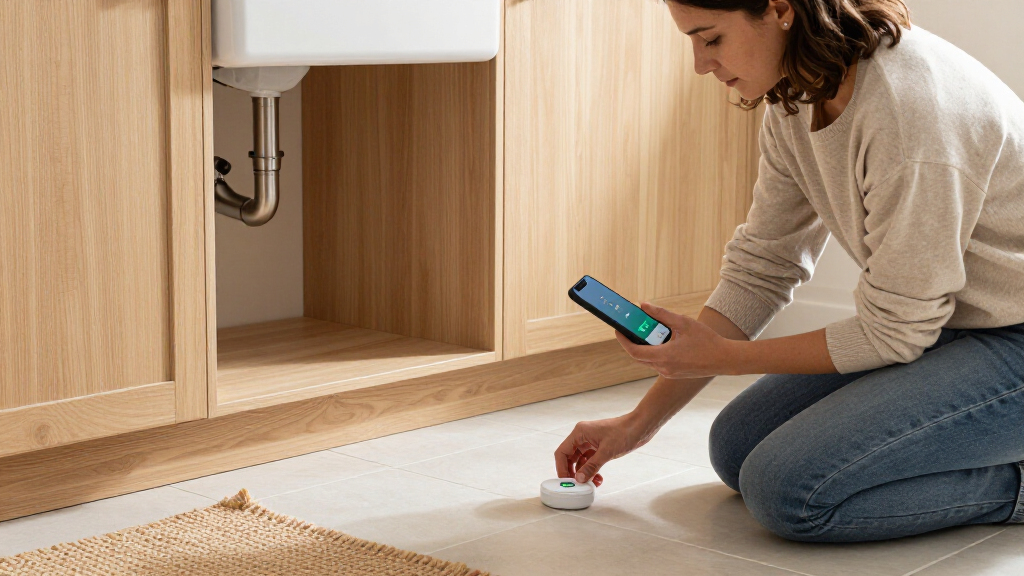
Most leak sensors detect water only at their own two metal contact points, meaning they protect a patch of floor roughly the size of a coaster. That works under a sink drain valve, but it fails for appliances that leak from unpredictable spots — a water heater can drip from the tank seam, a fitting at the back, or the relief valve. Cable-probe models like the GoveeLife with the 4.92 ft cable solve this by stretching a sensing cable across a wider zone. A frequent buyer error is placing one point sensor next to a water heater and assuming the whole appliance is covered. If you are protecting an appliance rather than a single fitting, budget for either a cable probe or multiple sensors placed strategically around the base.
Alarm Volume and Alert Redundancy
App notifications are useless if your phone is on silent or you are on a plane, which is why local alarm volume separates the serious detectors from the toys. Models in the 100+ dB range, like the GoveeLife adjustable 105 dB version, are loud enough to wake you at night — comparable to a smoke alarm — while some compact puck-style sensors chirp quietly enough to go unnoticed in a closed laundry room. The best setups layer both: a loud local siren for when you are home and phone alerts for when you are away. Buyers who rely solely on app alerts often discover too late that their notification settings were never properly configured, so test the alarm before you trust the system.
Ecosystem Compatibility and Automation
If you already run a smart home, a leak sensor that plays nicely with your platform multiplies its value. Zigbee sensors like the Aqara pair natively with SmartThings and Home Assistant, Tapo sensors slot into TP-Link’s ecosystem, and Moen Flo devices tie into broader water-shutoff automation. A sensor that supports routines can trigger other devices — for example, flashing smart lights or triggering a smart shutoff valve when water is detected. The mistake to avoid here is buying into an ecosystem you do not use: a beautifully integrated Tapo sensor is just a basic alarm if the rest of your home runs on a different platform. Check compatibility before the purchase, not after.
Battery Life and Long-Term Maintenance
Leak sensors are install-and-forget devices, which makes battery life a hidden cost and a hidden failure point. Hub-based Zigbee and LoRa sensors typically run one to two years or more on coin cells, while Wi-Fi sensors drain batteries faster because they maintain a constant network connection — some need swapping every few months. More importantly, a dead battery means silent failure, so low-battery alerts through the app are non-negotiable for any sensor you place in hard-to-reach spots. Buyers often mount sensors behind appliances and never check them again; prefer models that report battery status remotely, and set a calendar reminder to replace cells annually regardless of what the app claims.
Scaling Cost: Buy for the Home You Have
Per-sensor pricing drops sharply with multi-packs, and the sweet spot in this lineup is usually the 4-to-6 sensor kits. A realistic minimum coverage plan includes the water heater, washing machine, kitchen sink, and any bathroom with a toilet or tub upstairs — water from an upstairs leak travels down through ceilings. Buying a 12-pack like the Flood Buzz makes sense for landlords covering multiple units, but overbuying smart sensors for low-risk spots wastes money you could put toward a smart shutoff valve instead. The right approach is to map your leak risks first, count the locations, then buy the kit size that matches — not the other way around.
Frequently Asked Questions
Do I need a hub, or will a Wi-Fi leak sensor work fine?
It depends on where the sensors will sit. If your leak risks are near your router — under a kitchen sink, beside a first-floor laundry — a direct Wi-Fi sensor works reliably and skips the extra hardware. But for basements, crawl spaces, attics, or homes with thick walls, hub-based systems using Zigbee or LoRa maintain a far more dependable connection because those protocols penetrate obstacles better and do not compete with your household Wi-Fi traffic. The hub also lets many sensors share one network entry point, which scales better as you add coverage. If you are only buying one or two sensors for close-range spots, skip the hub; if you are building whole-home coverage, factor the hub into your budget from day one.
Where should I place leak sensors for the best protection?
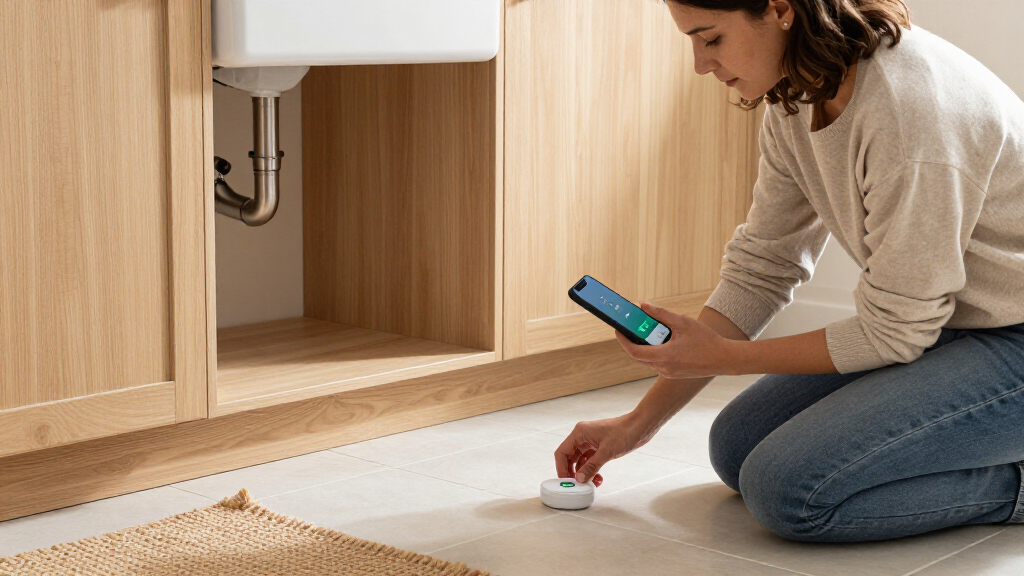
Priority one is the water heater, since tank failures can release dozens of gallons continuously. Next come the washing machine supply hoses, the space under the kitchen sink, dishwasher and refrigerator water lines, and toilets or tubs on upper floors — an upstairs leak damages the ceilings and rooms below it. Place sensors on the floor at the lowest point near the appliance, directly under any fitting or valve where a drip would land. For appliances that can leak anywhere around the base, either use a cable-probe sensor stretched along the perimeter or place multiple point sensors around it. Do not forget the main water shutoff area and any sump pump, which fails exactly when you need it most.
Can a leak sensor actually stop a leak, or does it just alert me?
On their own, every sensor in this roundup only detects and alerts — none of them shuts off water. But several can be paired with smart water shutoff valves that close the main line automatically when a sensor trips, turning a detection system into a prevention system. Hub-based ecosystems handle this integration most cleanly, which is one reason Moen Flo and YoLink place highly for homeowners serious about protection. The practical ceiling for most people is fast alerts plus a plumber’s number on hand, but if you travel frequently or own a second home, a sensor-plus-shutoff-valve combo is the setup that actually prevents damage while you are unreachable. Budget accordingly: the valve hardware costs more than any sensor kit in this guide.
Are cheap non-smart detectors like the Flood Buzz good enough?
For some situations, yes — but only if someone is around to hear them. The Flood Buzz-style detectors sound a local alarm with no app, no hub, and no setup, which makes them ideal for rental units, vacation properties you visit often, or spots where a tenant or family member will be present. The obvious failure mode is that a loud alarm does nothing when nobody is home, which is exactly when slow leaks cause the most damage. Smart sensors close that gap by reaching your phone anywhere. A sensible hybrid approach used by many homeowners is smart sensors at high-risk, high-damage locations and cheap alarms as backup coverage in low-stakes spots like a garage utility sink.
How many leak sensors do I actually need for one house?
Most single-family homes are well covered with four to six sensors: water heater, washing machine, kitchen sink, dishwasher, and any upstairs bathroom. Add one or two more if you have a sump pump, a refrigerator with an ice maker line, or an attic-mounted water heater. The 4-pack and 6-pack kits in this lineup exist precisely because that count covers a typical home, and buying that way costs far less per sensor than purchasing individually. Where people go wrong is in distribution — three sensors clustered in one bathroom protect one room, while the same three spread across the water heater, laundry, and kitchen protect the whole house’s highest-risk points. Map your plumbing first, then match the kit size to the map.
Conclusion
For most buyers, the YoLink Water Leak Sensor 4 Kit with Hub is the best overall choice — its long-range connectivity handles basements and large homes where cheaper sensors drop offline. If value is the priority, the GoveeLife Smart Water Leak Detector 2, 4-Pack covers a typical home’s key risk points at the lowest sensible cost per sensor without relying on a hub. Homeowners wanting a premium, prevention-oriented setup should look at the Moen Flo Wi-Fi detectors, which integrate with a broader water monitoring and shutoff ecosystem.
Beginners who want the simplest possible start will appreciate the D-Link Wi-Fi starter kit — plug in, connect, done. For specific needs: the GoveeLife model with the 4.92 ft cable is the pick for water heaters and appliances with unpredictable leak points; the Aqara Zigbee 3-pack suits existing SmartThings or Home Assistant users; the loud GoveeLife 105 dB version is best where you need to hear an alarm from another room; and the Flood Buzz 12-pack is the practical answer for landlords covering multiple units. Match the sensor to the room it protects, and even the cheapest option on this list will do its job when it matters.
NFL season / tailgating Picks
team gear
As an affiliate, we earn on qualifying purchases.