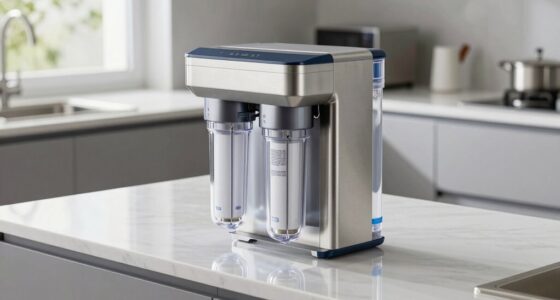
Among these whole house water filter systems, I would put the Waterdrop WHF3T-PG 3-Stage first for its balance of filtration stages and broad household use, while the A. O. Smith 600,000-gallon system stands out for buyers prioritizing long service capacity and the HQUA WF3-03 for homes seeking UV treatment. The main tradeoff is between simpler systems that are easier to maintain and multi-stage setups aimed at more specific water concerns. Flow rate, filter replacement, available installation space, and the contaminants a system is designed to reduce all affect the right choice. No single setup suits every water source or home size. Read on for the full breakdown and guidance on matching a system to your household.

Get home appliances delivered free with Prime
- Fast, free delivery on millions of items
- Prime Video, Amazon Music and more included
- Member-only deals all year
Complete the kit


Key Takeaways
- The Waterdrop WHF3T-PG leads as the general-purpose pick because its three-stage format offers a middle ground between simpler two-stage filtration and more specialized systems.
- The A. O. Smith system stands apart on stated capacity, making its 600,000-gallon figure a key point for buyers comparing service life rather than filtration stages alone.
- UV treatment changes the HQUA WF3-03’s role: it is the lineup’s distinct option for shoppers who want an additional treatment method, not just another cartridge combination.
- Specialized water problems call for specialized filters; the iSpring WGB32BM is the specific choice among these models for iron and manganese concerns.
- Several entries share similar three-stage layouts, so the deciding factors are often filter purpose, housing size, maintenance demands, and fit with the home’s water flow—not the stage count by itself.
| Waterdrop WHF21-PG 2-Stage Whole-House Water Filter System |  | Best for Straightforward Municipal-Water Filtration | Filtration: Two-stage system with 5-micron PP sediment and coconut-shell GAC carbon filters | Chlorine reduction: Up to 98.42%; tested to NSF/ANSI 42 | Capacity: 50,000 gallons | VIEW LATEST PRICE | See Our Full Breakdown |
| Waterdrop WHF3T-PG 3-Stage Whole House Water Filter System, 5 Micron |  | Best for Well-and-Municipal Versatility | Filtration media: Multi-layer PP, KDF, granular activated carbon, and carbon fiber | Capacity: 100,000 gallons | Maximum flow rate: 15 GPM | VIEW LATEST PRICE | See Our Full Breakdown |
| 3-Stage Whole House Water Filter System with 9 Filters, 0.5-Micron Filtration |  | Best for Visible Filter Monitoring | Filtration stages: 3 | Included filters: 9 total: 3 PP sediment, 3 GAC carbon, and 3 CTO carbon block | Filtration claims: Targets chlorine, sediment, rust, and odors; does not reduce TDS | VIEW LATEST PRICE | See Our Full Breakdown |
| A. O. Smith Whole House Water Filter System, 600,000-Gallon Capacity |  | Best for Long Service Life | Purification method: Activated carbon | Chlorine reduction: Up to 96.9% of chlorine taste and odor | Capacity and filter life: 600,000 gallons; up to 6 years | VIEW LATEST PRICE | See Our Full Breakdown |
| HQUA WF3-03 3-Stage Whole House Water Filtration System with UV Filter | 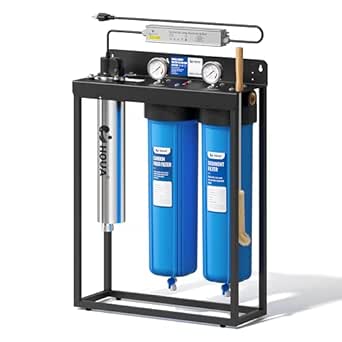 | Best for UV Treatment | Stages and methods: 3 stages; carbon block, ion exchange, and UV | UV filter: 55W; listed at 12 GPM | Flow rate: 3–15 GPM | VIEW LATEST PRICE | See Our Full Breakdown |
| Express Water Ultimate Protection 3-Stage Whole House Water Filter System |  | Best for Heavy-Metal and Scale Concerns | Stages: 3 | Filtration methods: Activated carbon, KDF, polyphosphate | Maximum flow rate: 17 gpm | VIEW LATEST PRICE | See Our Full Breakdown |
| iSpring WGB32B 3-Stage Whole House Water Filter System |  | Best for Straightforward DIY Carbon Filtration | Filtration stages: 3 | Filter types: 5-micron sediment filter and two coconut-shell carbon block filters | Maximum flow rate: 15 GPM | VIEW LATEST PRICE | See Our Full Breakdown |
| VEVOR 3-Stage Whole House Water Filter System, 4.5 x 20-Inch |  | Best for Flexible Mounting | Filtration stages: 3 | Filter types: Polypropylene sediment, KDF, activated carbon (CTO) | Cartridge size: 4.5 × 20 in. | VIEW LATEST PRICE | See Our Full Breakdown |
| VEVOR 3-Stage Whole House Water Filter System |  | Best for Iron and Manganese Targeting | Filtration stages: 3 | Filter media: Polypropylene sediment, IMR, CTO activated carbon | Cartridge size: 4.5 × 20 in. | VIEW LATEST PRICE | See Our Full Breakdown |
| iSpring Ultimate Whole-House Water Filter System with Auto-Flush Sediment Filter |  | Best for Reduced Sediment-Filter Maintenance | Filtration stages and methods: Auto-flushing sediment, compound filter, coconut-shell carbon block, scale inhibition | Maximum flow rate: 15 GPM | Stated capacity: 250,000 gallons | VIEW LATEST PRICE | See Our Full Breakdown |
| HQUA WF3-01 3-Stage Whole House Water Filtration System | 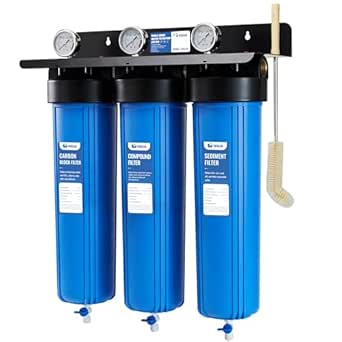 | Best for Monitored, Hands-On Maintenance | Filtration stages: 3 | Filter size: 20 × 5.5 inches | Stated capacity: 100,000 gallons | VIEW LATEST PRICE | See Our Full Breakdown |
| iSpring WGB32BM Iron Manganese Whole House Water Filter System |  | Best for Iron and Manganese | Filtration stages: 3 | Stated capacity: 100,000 gallons | Maximum flow rate: 15 gpm | VIEW LATEST PRICE | See Our Full Breakdown |
| Express Water Ultimate Protection 3-Stage Whole House Water Filter System |  | Best for Higher Flow and Reusable Prefiltration | Filtration stages: 3 | Sediment prefilter: Reusable 50-micron spin-down filter | Connections: 1-inch standard connections | VIEW LATEST PRICE | See Our Full Breakdown |
| whole house water filter system | Maximum flow rate | Connections | Dimensions and weight | Filtration stages |
|---|---|---|---|---|
| Waterdrop WHF21-PG 2-Stage Who | 15 GPM | 1-inch inlet and outlet | — | — |
| Waterdrop WHF3T-PG 3-Stage Who | 15 GPM | 1-inch inlet and outlet | 22.9 × 8.46 × 26.1 inches; 19.1 kg | — |
| 3-Stage Whole House Water Filt | — | 3/4-inch inlet and outlet | 14 × 13 × 10 inches; 12 pounds | 3 |
| A. O. Smith Whole House Water | 7 GPM | — | — | — |
| HQUA WF3-03 3-Stage Whole Hous | — | 1-inch FNPT inlet and outlet | 22 × 9.5 × 28 inches; 44 pounds | — |
| Express Water Ultimate Protect | 17 gpm | — | 29 × 8.5 × 30 in.; 63 lb | — |
| iSpring WGB32B 3-Stage Whole H | 15 GPM | 1-inch NPT | — | 3 |
| VEVOR 3-Stage Whole House Wate | 15 GPM | 1-inch NPT | 22.6 × 9.8 × 31.5 in.; 48.9 lb | 3 |
| VEVOR 3-Stage Whole House Wate | 15 gpm | 1-inch NPT | 22.6 × 9.8 × 31.5 in.; 51.8 lb | 3 |
| iSpring Ultimate Whole-House W | 15 GPM | 1-inch NPT | 25 × 22 × 17 in.; 66.7 lb | — |
| HQUA WF3-01 3-Stage Whole Hous | 15 gpm | — | — | 3 |
| iSpring WGB32BM Iron Manganese | 15 gpm | — | — | 3 |
| Express Water Ultimate Protect | 17 gpm | 1-inch standard connections | 29 × 8.5 × 30 inches; 66 pounds | 3 |
More Details on Our Top Picks
Waterdrop WHF21-PG 2-Stage Whole-House Water Filter System
The Waterdrop WHF21-PG keeps the setup focused: a 5-micron sediment cartridge catches particles, while coconut-shell carbon targets chlorine taste and odor. Its stated 15 GPM flow rate suits homes that want whole-house treatment without stepping up to a larger multi-stage unit. Chlorine reduction was tested to NSF/ANSI 42, and the cartridges meet NSF/ANSI 372 lead-free requirements—useful distinctions, though they do not certify reduction of every contaminant.
Compared with the Waterdrop WHF3T-PG, this system has fewer filtration media and a lower stated capacity, but its simpler design may be easier to maintain. The tradeoff is recurring cartridge replacement: the sediment filter may need changing every three to six months, and the manufacturer recommends municipal water to help extend service life. I’d skip it for untreated well water or buyers seeking specialized contaminant treatment.
Pros:- Combines a 5-micron sediment filter with coconut-shell GAC carbon for particles and chlorine taste and odor.
- Stated maximum flow rate of 15 GPM supports whole-house use.
- Chlorine reduction tested to NSF/ANSI 42; cartridges meet NSF/ANSI 372 lead-free requirements.
- Includes a filter wrench and is designed for DIY installation.
Cons:- Sediment cartridges may require replacement every three to six months.
- Manufacturer recommends municipal water, limiting its fit for well-water users.
- Two-stage filtration is less varied than the Waterdrop WHF3T-PG’s sediment, KDF, and carbon media.
Best for: Households on municipal water that want sediment and chlorine taste-and-odor reduction with a relatively simple two-cartridge system.
Not ideal for: Well-water households or buyers targeting specific contaminants beyond the stated sediment and chlorine reduction; the manufacturer recommends municipal water.
- Filtration:Two-stage system with 5-micron PP sediment and coconut-shell GAC carbon filters
- Chlorine reduction:Up to 98.42%; tested to NSF/ANSI 42
- Capacity:50,000 gallons
- Maximum flow rate:15 GPM
- Filter life:GAC about 6 months; PP 3–6 months
- Operating pressure:25–90 PSI
- Connections:1-inch inlet and outlet
- Dimensions:14.37 × 7.48 × 15.55 inches
Our verdict“Choose this Waterdrop for straightforward municipal-water sediment and chlorine treatment, but not for well water or broader contaminant-specific filtration.”
Waterdrop WHF3T-PG 3-Stage Whole House Water Filter System, 5 Micron
The Waterdrop WHF3T-PG adds KDF media to sediment and carbon filtration, giving it a broader stated treatment scope than the two-stage Waterdrop WHF21-PG. It is designed for both well and municipal water and targets sediment, rust, chlorine, heavy metals, and odors. A 15 GPM maximum flow rate and 100,000-gallon stated capacity make it the more ambitious Waterdrop option for buyers who want several media types in one whole-house system.
The tradeoff is less clarity around upkeep: product information lists both up to 12 months and a 90-day filter cycle. I would confirm replacement intervals for the supplied cartridges and the household’s water conditions before choosing it. Its 22.9 × 8.46 × 26.1-inch size also takes more room than the WHF21-PG. The listed testing and materials claims do not establish reduction of every named contaminant, so buyers with a specific water-quality concern should check the relevant documentation.
Pros:- Uses multi-layer PP, KDF, granular activated carbon, and carbon fiber media.
- Designed for both well and municipal water and targets sediment, rust, chlorine, heavy metals, and odors.
- Stated 15 GPM maximum flow rate and 100,000-gallon capacity.
- Includes three cartridges, a wrench, and expansion screws.
Cons:- Filter-life information conflicts between up to 12 months and a 90-day cycle.
- The 22.9 × 8.46 × 26.1-inch unit needs more installation space than the Waterdrop WHF21-PG.
- Not intended for operation below 40°F.
Best for: Households using well or municipal water that want sediment, carbon, and KDF media in one whole-house setup and have room for a larger unit.
Not ideal for: Buyers who need clear, consistent cartridge-replacement guidance or have installation space below 40°F; the listed filter-life information conflicts.
- Filtration media:Multi-layer PP, KDF, granular activated carbon, and carbon fiber
- Capacity:100,000 gallons
- Maximum flow rate:15 GPM
- Filter life:Listed as up to 12 months; product information also lists a 90-day cycle
- Maximum supported TDS:1,000 ppm
- Operating temperature:40–100°F
- Connections:1-inch inlet and outlet
- Dimensions and weight:22.9 × 8.46 × 26.1 inches; 19.1 kg
- Materials testing:IAPMO R&T to NSF/ANSI/CAN 372 for lead-free materials; KDF media meets NSF/ANSI 42
Our verdict“Pick the WHF3T-PG over the simpler WHF21-PG when you want multiple media types for well or municipal water and can verify cartridge intervals.”
3-Stage Whole House Water Filter System with 9 Filters, 0.5-Micron Filtration
This three-stage system’s clearest distinction is practical maintenance: clear housings let owners see trapped debris, and dual valves allow filter changes without shutting off the main supply. It includes nine cartridges—three sets of PP sediment, GAC carbon, and CTO carbon block filters—so buyers have replacements on hand. Like the Waterdrop WHF3T-PG, it is presented for well and city water, but its stated treatment centers on chlorine, sediment, rust, and odors rather than KDF media or broader heavy-metal claims.
The product data lists a 15 GPM flow rate, though the listed capacity is 10,000 gallons, lower than the Waterdrop systems’ stated capacities. Its specs also call the installation type under-sink despite the whole-house title, and list 3/4-inch connections; I’d verify installation compatibility before buying. It preserves minerals and does not reduce TDS, so it is a poor fit for buyers seeking dissolved-solids reduction.
Pros:- Includes nine filters across PP sediment, GAC carbon, and CTO carbon block stages.
- Clear housings make accumulated debris visible for monitoring.
- Dual valves allow filter changes without shutting off the main water supply.
- Stated 15 GPM flow rate and includes installation accessories.
Cons:- Listed capacity is 10,000 gallons, below the stated capacities of both Waterdrop systems.
- Does not reduce TDS and preserves minerals.
- Product specs list under-sink installation despite the whole-house product title; verify fit before purchase.
Best for: Homeowners who prioritize visual cartridge checks, want spare filter sets included, and have compatible 3/4-inch plumbing.
Not ideal for: Buyers who need TDS reduction, higher stated capacity, or certainty about whole-house installation; the product data lists under-sink installation.
- Filtration stages:3
- Included filters:9 total: 3 PP sediment, 3 GAC carbon, and 3 CTO carbon block
- Filtration claims:Targets chlorine, sediment, rust, and odors; does not reduce TDS
- Flow rate:15 GPM
- Capacity:10,000 gallons
- Filter life:Up to 24 months
- Connections:3/4-inch inlet and outlet
- Dimensions and weight:14 × 13 × 10 inches; 12 pounds
- Included accessories:Filter wrench, plumber’s tape, two brass connectors, two valves, and user manual
Our verdict“Choose this system for visible filter monitoring and included spare cartridges only after confirming that its installation type and 3/4-inch connections match your plumbing.”
A. O. Smith Whole House Water Filter System, 600,000-Gallon Capacity
The A. O. Smith AO-WH-Filter is the low-maintenance choice in this group: its activated carbon filter is rated for up to six years or 600,000 gallons, with no drainage or backwashing. It targets chlorine taste and odor throughout the home, including water used for drinking, cooking, bathing, and showering. That long service interval contrasts with the Waterdrop WHF21-PG, whose sediment cartridge may need replacement every three to six months.
The tradeoff is narrower treatment and lower flow: its stated maximum is 7 GPM, compared with 15 GPM for the Waterdrop systems. It does not soften water or reduce TDS, sulfur, or iron, so this is not a fix for hard water or those specific concerns. The NSF/ANSI 42 certification applies to its stated chlorine taste-and-odor reduction, not every possible contaminant. I’d favor it when fewer filter changes matter more than multi-stage treatment or higher peak flow.
Pros:- Filter rated for up to six years or 600,000 gallons.
- Reduces up to 96.9% of chlorine taste and odor.
- No drainage, backflushing, or water waste required.
- NSF/ANSI 42 certification and a six-year limited warranty.
Cons:- Maximum flow rate of 7 GPM is lower than the 15 GPM Waterdrop systems.
- Does not soften water or reduce TDS, sulfur, or iron.
- Installation may require additional tools.
Best for: Households focused on chlorine taste and odor that want a long filter interval and do not need softening or reduction of TDS, sulfur, or iron.
Not ideal for: Large households with high simultaneous water demand, or buyers needing iron, sulfur, TDS, or hardness treatment; its flow is 7 GPM and it does not address those issues.
- Purification method:Activated carbon
- Chlorine reduction:Up to 96.9% of chlorine taste and odor
- Capacity and filter life:600,000 gallons; up to 6 years
- Maximum flow rate:7 GPM
- Certification:NSF/ANSI 42
- Operating pressure:20–100 PSI
- Temperature range:40–90°F
- Connection:3/4-inch NPT
- Limitations:Does not soften water or reduce TDS, sulfur, or iron
Our verdict“Choose the A. O. Smith when long intervals between filter changes and chlorine taste-and-odor reduction matter more than high flow or broader treatment.”
HQUA WF3-03 3-Stage Whole House Water Filtration System with UV Filter
The HQUA WF3-03 is the most involved option here, pairing sediment and carbon filtration with a 55W UV unit. That makes it the distinct pick for buyers seeking UV treatment alongside whole-house filtration, rather than the mainly chlorine-focused approach of the A. O. Smith AO-WH-Filter. It also includes three pressure gauges and filter timers, giving owners ways to track system conditions and cartridge schedules instead of relying only on elapsed time.
That added equipment comes with a real installation burden: the unit weighs 44 pounds, measures 22 × 9.5 × 28 inches, and needs space, mounting support, and routine cartridge maintenance. Its stated flow range is 3–15 GPM, while the UV specification lists 12 GPM, so buyers should check the actual flow needs for their home. The supplied claims about PFAS, heavy metals, and microorganisms should be checked against product-specific test data for the contaminants a household plans to address.
Pros:- Combines sediment and carbon filtration with a 55W UV filter.
- Pressure gauges and countdown timers help monitor operation and filter changes.
- Can be installed free-standing or wall-mounted.
- Includes pressure-relief and drain valves, a cleaning brush, and installation fittings.
Cons:- At 44 pounds and 22 × 9.5 × 28 inches, it needs substantial installation space and support.
- Cartridges and UV components require ongoing maintenance.
- Listed flow range is 3–15 GPM, while the UV specification lists 12 GPM; buyers should verify suitability for their demand.
Best for: Homeowners who want UV treatment added to sediment and carbon filtration, have room and plumbing support for a larger unit, and will monitor maintenance.
Not ideal for: Buyers seeking a compact, simple installation or those unwilling to maintain UV and cartridge components; the unit is heavy and needs dedicated space.
- Stages and methods:3 stages; carbon block, ion exchange, and UV
- UV filter:55W; listed at 12 GPM
- Flow rate:3–15 GPM
- Capacity:100,000 gallons
- Operating pressure:25–116 PSI
- Connections:1-inch FNPT inlet and outlet
- Dimensions and weight:22 × 9.5 × 28 inches; 44 pounds
- Installation:Free-standing or wall-mounted
- Operating temperature:40–125°F
Our verdict“Pick the HQUA WF3-03 if UV treatment is a priority and you can accommodate its larger installation and maintenance needs.”
Express Water Ultimate Protection 3-Stage Whole House Water Filter System
I’d shortlist this Express Water system for households that want more than chlorine and sediment reduction: its activated carbon and KDF stages are designed to reduce several heavy metals, while polyphosphate treatment helps limit scale buildup in plumbing and appliances. That makes it a more targeted choice for those concerns than the iSpring WGB32B, which focuses on sediment, chlorine, taste, and odor and preserves dissolved minerals. The included stainless steel stand, pressure gauges, and release buttons add practical monitoring and service features. The tradeoff is a large, heavy installation and a stated six-month filter cycle, shorter than the iSpring’s stated one-year filter life. I’d also check your water test results before relying on any system for a specific contaminant.
Pros:- Designed to reduce chlorine and multiple heavy metals, including lead, arsenic, mercury, chromium, and cadmium.
- Polyphosphate stage helps limit scale buildup in plumbing and appliances.
- Pressure gauges and release buttons support monitoring and filter changes.
- Freestanding stainless steel stand provides a sturdy installation frame.
Cons:- Stated filter life is about six months, requiring regular replacement.
- At 63 pounds and 29 × 8.5 × 30 inches, it needs substantial space and careful installation.
- A whole-house filter should not be treated as a substitute for water testing or contaminant-specific treatment verification.
Best for: Homeowners looking to reduce chlorine and several listed heavy metals while limiting scale buildup, with room for a freestanding system.
Not ideal for: Households short on utility-room space or anyone seeking longer stated intervals between routine cartridge changes.
- Stages:3
- Filtration methods:Activated carbon, KDF, polyphosphate
- Maximum flow rate:17 gpm
- Capacity:100,000 gallons
- Filter life cycle:6 months
- Operating pressure:20–80 psi
- Installation:Freestanding; stainless steel stand included
- Dimensions and weight:29 × 8.5 × 30 in.; 63 lb
- Warranty:1-year manufacturer warranty
Our verdict“Choose this Express Water system if heavy-metal reduction and scale control matter more to you than a compact footprint or longer filter intervals.”
iSpring WGB32B 3-Stage Whole House Water Filter System
The iSpring WGB32B is the simpler fit for households focused on chlorine, sediment, rust, taste, and odor rather than scale treatment or dissolved-mineral removal. Its 5-micron sediment stage catches particles before two coconut-shell carbon block filters, and the stated one-year filter life is less demanding than the six-month cycle listed for the Express Water Ultimate Protection system. At up to 15 GPM with standard 1-inch NPT connections, it suits many whole-house installations, while the DIY-oriented package includes a housing wrench. This system preserves minerals and does not reduce TDS, so it is not a solution for dissolved salts or hardness. Compared with the more feature-heavy iSpring Ultimate system, it is lighter and less complex, but lacks an auto-flushing sediment filter and scale inhibitor.
Pros:- Three stages combine a 5-micron sediment filter with two coconut-shell carbon block filters.
- Designed to reduce chlorine and help address sediment, rust, tastes, odors, and herbicides.
- Stated one-year filter life and 100,000-gallon capacity.
- DIY installation package includes a housing wrench and uses 1-inch NPT connections.
Cons:- Does not remove TDS or dissolved minerals.
- Requires 20 × 4.5-inch replacement cartridges.
- Its 15 GPM maximum flow rate is lower than the 17 GPM listed for the Express Water Ultimate Protection system.
Best for: DIY homeowners seeking a conventional whole-house system for chlorine, sediment, and taste-and-odor concerns, without TDS reduction.
Not ideal for: Buyers who need scale inhibition, dissolved-mineral reduction, or treatment aimed at contaminants beyond the listed filtration claims.
- Filtration stages:3
- Filter types:5-micron sediment filter and two coconut-shell carbon block filters
- Maximum flow rate:15 GPM
- Capacity:100,000 gallons
- Filter life:1 year
- Connections:1-inch NPT
- Cartridge dimensions:20 × 4.5 in.
- Product dimensions and weight:24.5 × 8 × 28 in.; 45 lb
- Warranty:1-year limited manufacturer warranty
Our verdict“Pick the WGB32B for familiar, DIY-friendly carbon filtration when you do not need scale treatment or TDS reduction.”
VEVOR 3-Stage Whole House Water Filter System, 4.5 x 20-Inch
This VEVOR’s clearest advantage over the iSpring WGB32B is installation flexibility: its alloy-steel frame supports wall mounting or floor-standing placement, which can help when the plumbing layout limits one approach. The three stages use polypropylene sediment, KDF, and activated carbon to target particles, chlorine, certain heavy metals, and odors. A pressure gauge provides a useful visual cue as the system operates, and the included wrench supports cartridge changes. Its 15 GPM flow rate and stated 100,000-gallon capacity put it in a similar broad-use class to the iSpring, but VEVOR lists a shorter, variable six-to-12-month filter life. The frame also occupies a sizable footprint and weighs nearly 49 pounds, so this is not a compact or effortless retrofit.
Pros:- Wall-mount or floor-standing installation offers flexibility around the main water line.
- Three stages target sediment, chlorine, certain heavy metals, and odors.
- Pressure gauge helps monitor system operation.
- Uses 4.5 × 20-inch cartridges and includes a filter wrench.
Cons:- Filter life is listed as six to 12 months, so replacement timing may vary.
- The 22.6 × 9.8 × 31.5-inch frame is bulky and weighs 48.9 pounds.
- Maximum flow rate is 15 GPM, below the 17 GPM listed for the Express Water system.
Best for: Homeowners who need the choice of wall-mounted or floor-standing installation and want sediment, chlorine, and odor filtration.
Not ideal for: People with limited installation space, those unable to support a heavy frame, or buyers who want a clearly stated one-year cartridge interval.
- Filtration stages:3
- Filter types:Polypropylene sediment, KDF, activated carbon (CTO)
- Cartridge size:4.5 × 20 in.
- Maximum flow rate:15 GPM
- Maximum filtration capacity:100,000 gallons
- Filter life:6–12 months
- Connections:1-inch NPT
- Installation and frame:Wall mount or floor-standing; alloy steel
- Dimensions and weight:22.6 × 9.8 × 31.5 in.; 48.9 lb
Our verdict“Choose this VEVOR when mounting flexibility is a priority and you can accommodate its large frame and variable filter schedule.”
VEVOR 3-Stage Whole House Water Filter System
Among the two VEVOR systems here, this model is the more specific match for buyers concerned about iron and manganese: its sediment, IMR, and activated-carbon stages are listed for rust, iron, manganese, chlorine, odors, and other impurities. The 4.5 × 20-inch cartridges, steel frame, pressure gauge, and wall-or-floor installation resemble the other VEVOR pick, so the deciding point is the treatment media rather than the form factor. Against the iSpring WGB32B, which emphasizes sediment and carbon filtration, this VEVOR makes a more targeted iron-and-manganese claim. Its limits are familiar: a large, heavy frame, 15 GPM maximum flow, and filter replacement every six to 12 months. Buyers should confirm the media suits their water test results before choosing it for a specific contaminant.
Pros:- Filter stages are listed to target iron and manganese alongside rust, chlorine, and odors.
- Steel frame supports wall-mounted or floor-standing installation.
- Pressure gauge and included wrench aid monitoring and cartridge service.
- Standard 4.5 × 20-inch cartridges are used.
Cons:- The system weighs 51.8 pounds and has a large 22.6 × 9.8 × 31.5-inch footprint.
- Filter replacement is listed at six to 12 months.
- Its 15 GPM maximum flow rate may be less suitable for homes seeking the higher listed flow of the Express Water system.
Best for: Households whose water testing indicates iron or manganese concerns and who want a framed, three-stage whole-house filter.
Not ideal for: Buyers who need a compact unit, a longer defined filter interval, or a system selected without water-test guidance for iron and manganese.
- Filtration stages:3
- Filter media:Polypropylene sediment, IMR, CTO activated carbon
- Cartridge size:4.5 × 20 in.
- Maximum flow rate:15 gpm
- Filtration capacity:100,000 gallons
- Filter life:6–12 months
- Connections:1-inch NPT
- Installation and materials:Wall-mounted or floor-standing; alloy steel and polypropylene
- Dimensions and weight:22.6 × 9.8 × 31.5 in.; 51.8 lb
Our verdict“Pick this VEVOR over the other VEVOR model when iron and manganese targeting is the main reason for adding whole-house filtration.”
iSpring Ultimate Whole-House Water Filter System with Auto-Flush Sediment Filter
The iSpring Ultimate is the most feature-rich option in this group, combining an auto-flushing sediment filter with compound and coconut-shell carbon filtration plus a scale inhibitor. That setup is aimed at households wanting sediment, chlorine, and several listed contaminants addressed while helping limit scale and corrosion. Its stated 250,000-gallon capacity is higher than the 100,000-gallon figures for the iSpring WGB32B and both VEVOR systems, and automatic flushing can reduce hands-on sediment-filter upkeep. The tradeoffs are substantial: at 66.7 pounds, it is the heaviest pick here, and its 25 × 22 × 17-inch body needs room near the main supply line. Like the WGB32B, it does not reduce TDS; its scale inhibitor also leaves calcium and magnesium in the water.
Pros:- Auto-flushing sediment filter reduces the need for manual sediment-filter cleaning.
- Combines sediment, compound, and coconut-shell carbon filtration with a scale inhibitor.
- Stated capacity is 250,000 gallons with a maximum flow rate of 15 GPM.
- Designed for DIY installation with 1-inch NPT connections and lifetime free technical support.
Cons:- Does not reduce TDS or remove calcium and magnesium.
- At 66.7 pounds and 25 × 22 × 17 inches, it requires substantial room and installation support.
- Scale inhibition helps limit scale formation but does not soften water by removing hardness minerals.
Best for: DIY homeowners who want auto-flushing sediment management, broader listed contaminant coverage, and scale inhibition in one whole-house setup.
Not ideal for: Buyers who need TDS or hardness-mineral removal, or who have limited room and support capacity for a heavy system.
- Filtration stages and methods:Auto-flushing sediment, compound filter, coconut-shell carbon block, scale inhibition
- Maximum flow rate:15 GPM
- Stated capacity:250,000 gallons
- Cartridge size:20 × 4.5 in.
- Connections:1-inch NPT
- TDS reduction:Does not reduce TDS
- Maximum water TDS level:300 ppm
- Dimensions and weight:25 × 22 × 17 in.; 66.7 lb
- Warranty and support:1-year manufacturer warranty; lifetime free technical support
Our verdict“Choose the iSpring Ultimate if automatic sediment flushing and scale inhibition matter more than compact size or TDS reduction.”
HQUA WF3-01 3-Stage Whole House Water Filtration System
I’d shortlist the HQUA WF3-01 for households that want several filtration media and clear maintenance cues in one whole-house setup. Its sediment, carbon block, and GAC+KDF stages target particles, chlorine, odors, VOCs, and several heavy metals, while the pressure gauges and 180-day timers give owners practical prompts to check the system. Compared with the iSpring WGB32BM, which focuses its media on iron and manganese, the HQUA’s stated contaminant targets are broader; it also includes service valves and a housing brush. The tradeoff is a 15 gpm maximum flow rate, below the Express Water system’s 17 gpm, plus a hefty 44-pound assembly. I’d also verify the installation footprint before buying: the supplied dimensions conflict, and the listed installation type says under sink despite its whole-house positioning.
Pros:- Three media stages target sediment, chlorine, odors, VOCs, and several heavy metals.
- Pressure gauges and 180-day timers help owners monitor system condition and service timing.
- Pressure-relief and drain valves, plus a housing brush, support filter maintenance.
- Adapters accommodate 3/4-inch or 1-inch NPT connections.
Cons:- The 15 gpm maximum flow rate is lower than the Express Water system’s stated 17 gpm.
- At 44 pounds, the unit needs secure support during installation.
- The listed dimensions conflict, and the installation type is identified as under sink despite the whole-house description.
Best for: Homeowners seeking broad sediment, chlorine, and metal filtration with gauges and timers to guide routine filter checks.
Not ideal for: Buyers who need a clearly documented installation footprint, higher stated flow than 15 gpm, or a lighter unit for a difficult-to-access installation.
- Filtration stages:3
- Filter size:20 × 5.5 inches
- Stated capacity:100,000 gallons
- Maximum flow rate:15 gpm
- Targeted reductions:Lead, mercury, arsenic, cadmium, chromium, chlorine, sediment, odors, and VOCs
- Operating temperature:40–125 °F
- Maximum supported TDS:500 ppm
- Weight:44 pounds
Our verdict“Choose the HQUA WF3-01 if you want multiple contaminant-targeting stages and built-in maintenance cues, and can confirm its installation dimensions first.”
iSpring WGB32BM Iron Manganese Whole House Water Filter System
I’d put the iSpring WGB32BM ahead of general-purpose systems when iron or manganese is the main water problem. Its catalytic media stage is specified for reducing iron up to 3.0 ppm and manganese up to 1.0 ppm, alongside sediment and chlorine filtration; the system also preserves healthy minerals rather than reducing TDS. That makes its purpose more targeted than the HQUA WF3-01, whose listed contaminant targets span several metals but do not give the same iron and manganese limits. The iSpring provides a 15 gpm maximum flow rate and capacity of up to 100,000 gallons, described as about a year of use. The tradeoff is that it won’t soften water or lower TDS, so buyers needing those outcomes will need another treatment approach. Its 55-pound weight also calls for sturdy mounting.
Pros:- Catalytic media is specified to reduce iron up to 3.0 ppm and manganese up to 1.0 ppm.
- Sediment and coconut-shell carbon stages also target sediment, chlorine, and rust.
- Up to 100,000 gallons of capacity is described as about a year of use.
- Standard 1-inch NPT connections and a stated 15 gpm flow rate support whole-house plumbing.
Cons:- Does not reduce TDS or soften water.
- At 55 pounds, the system needs a solid installation location.
- The stated operating temperature range ends at 100 °F.
Best for: Households with a water test showing iron or manganese within the system’s stated reduction limits, who want whole-house treatment while retaining minerals.
Not ideal for: Buyers seeking TDS reduction, water softening, or treatment for iron and manganese levels above the stated limits.
- Filtration stages:3
- Stated capacity:100,000 gallons
- Maximum flow rate:15 gpm
- Operating pressure:25–80 psi
- Operating temperature:40–100 °F
- Filter life cycle:1 year
- Dimensions:24.5 × 8 × 28 inches
- Weight:55 pounds
Our verdict“Pick the iSpring WGB32BM when iron and manganese are your primary concerns, but skip it if you need softening or TDS reduction.”
Express Water Ultimate Protection 3-Stage Whole House Water Filter System
Among these three, I’d favor the Express Water Ultimate Protection for homes where flow headroom and sediment prefiltration matter most. Its stated 17 gpm maximum flow rate exceeds the 15 gpm limits listed for both the HQUA WF3-01 and iSpring WGB32BM, while its reusable 50-micron spin-down filter can catch larger particles before water reaches the specialty cartridges. A transparent housing and pressure gauges make inspection easier, and quick-change cartridges simplify servicing. The system also targets chlorine, heavy metals, and scale, giving it a different emphasis from the iSpring’s specific iron-and-manganese focus. The costs in space and upkeep are real: it weighs 66 pounds, stands 29 × 8.5 × 30 inches, and its filters are specified for replacement every six months. I’d check the installation area and service schedule before choosing it.
Pros:- Its stated 17 gpm maximum flow rate is higher than the 15 gpm figures for the HQUA and iSpring systems.
- Reusable 50-micron spin-down prefilter can capture larger sediment before it reaches specialty filters.
- Transparent sediment housing and pressure gauges aid visual checks and system monitoring.
- Quick-change cartridges and an included stainless steel stand support servicing and installation.
Cons:- Filters are specified for replacement every six months.
- At 66 pounds and 29 × 8.5 × 30 inches, it needs substantial space and sturdy support.
- The 50-micron prefilter is for larger particles, so it does not replace the system’s specialty filtration stages.
Best for: Households with higher simultaneous water demand and sediment that want a reusable prefilter, visible monitoring, and quick-change cartridges.
Not ideal for: Buyers with limited installation space, anyone unable to support a 66-pound system, or households seeking less frequent than six-month cartridge service.
- Filtration stages:3
- Sediment prefilter:Reusable 50-micron spin-down filter
- Connections:1-inch standard connections
- Maximum flow rate:17 gpm
- Stated capacity:Up to 100,000 gallons
- Filter life cycle:6 months
- Operating pressure:20–80 psi
- Dimensions and weight:29 × 8.5 × 30 inches; 66 pounds
Our verdict“Choose the Express Water system if you value a higher stated flow rate and reusable sediment prefiltration and have room for its large, heavy installation.”

How We Picked
I compared the 13 listed systems as whole-house solutions, focusing on what changes the buying decision: stated filtration approach, intended water concerns, capacity information, installation footprint, maintenance needs, and likely fit for different household demands. I gave more weight to clearly differentiated use cases than to stage count alone, since three stages do not automatically mean better performance or broader contaminant reduction. I also considered whether a system’s format gives buyers a practical reason to choose it over a simpler or more specialized alternative.
The ranking favors options that balance household usefulness with a clear role in the lineup. The Waterdrop WHF3T-PG takes the general-purpose lead; the A. O. Smith earns attention for its stated capacity, and the HQUA WF3-03 ranks as a distinct UV-equipped choice. Models designed for narrower needs, such as iron and manganese treatment, remain strong candidates for the right water profile but are less suitable as default picks. Before buying, I would verify the manufacturer’s contaminant claims against a recent water test and confirm flow and replacement-filter details for the exact model.
Factors to Consider When Choosing Whole House Water Filter Systems
Choosing a system starts with the water entering your home, not with the number of cartridges in a product name. I would use these factors to narrow the field before comparing individual models.
Start With a Water Test, Not a Guess
A test helps separate measurable concerns from symptoms that can have several causes. Private-well owners may need a broader lab test, while municipal customers can review their utility’s water report and test at the tap if they suspect a problem inside the home. Match results to the manufacturer’s reduction claims; a filter marketed for taste or sediment may not address a dissolved contaminant. Avoid choosing a system based only on cloudy water, odor, or online anecdotes. A test can also prevent paying for treatment your water does not need.
Match Filtration to the Contaminant
Different media target different substances, so “more stages” is not a reliable shortcut to better treatment. Sediment filters catch particles, while other cartridges may target chlorine, taste, or particular dissolved contaminants; UV units address a different treatment need. Check the exact model documentation for named contaminants and test conditions rather than relying on broad wording such as “purification.” If iron, manganese, hardness, or microbial concerns are present, confirm that the proposed system is suitable for those levels and may need a dedicated treatment stage. A whole-house filter also does not automatically make water safe to drink.
Check Flow Rate Against Peak Household Use
A system must handle the household’s demand when several fixtures run at once, not just a single faucet. Compare the system’s rated flow and pressure-drop information with the home’s plumbing and expected peak use. A restrictive filter can affect showers, laundry, and appliances throughout the house. Larger households or homes with multiple bathrooms should pay particular attention to this tradeoff. If the manufacturer does not make flow performance clear, ask for the specification before installation rather than assuming a higher stage count will work at full household demand.
Budget for Filter Changes and Service Access
The initial unit is only part of the ownership decision: replacement cartridges, how often they are changed, and how easy they are to reach all affect the long-term workload. Check replacement-filter availability and the stated service interval under realistic water conditions. Heavy sediment or unusually high contaminant levels can shorten filter life, so published intervals may not match every home. Leave enough room to shut off the water and remove housings without moving other equipment. A system with more stages may offer targeted treatment, but it can also mean more cartridges to monitor and replace.
Plan for Installation, Plumbing, and Space
Whole-house systems are usually installed where the main water line enters the home, so measure the available wall and service space before ordering. Confirm pipe size, connection type, bypass arrangements, and whether installation requires a plumber or electrical connection, particularly for UV or automatic-flush features. Tight utility areas can make routine cartridge changes awkward even when the unit physically fits. Some systems also need a nearby drain or power source, depending on their design. Include installation complexity in the decision rather than treating it as a small afterthought.
Know When to Choose a Specialized Treatment
A standard cartridge system may not be the right answer for every water issue. High hardness is generally addressed with a water softener, while some well-water problems call for a dedicated treatment process selected from test results. UV treatment is not a substitute for removing sediment or dissolved chemicals, and it may need clear water and ongoing lamp care to work as intended. Specialized options can add value when they address a confirmed concern, but they add cost, space, or maintenance when bought without a clear reason. Choose the simplest system that meets the verified need, and use separate treatment when the water profile calls for it.
Frequently Asked Questions
Can a whole-house filter make well water safe to drink?
Not by itself in every case. Well water can contain different combinations of bacteria, nitrate, metals, and other contaminants, and a general-purpose cartridge system may not address them all. Start with a lab test and compare the results with the exact system’s documented reduction claims. The HQUA WF3-03 adds UV treatment, but UV does not remove dissolved chemicals or replace appropriate prefiltration. Retest after treatment if safety is the goal.
Should I choose a UV-equipped system or a standard multi-stage filter?
Choose based on the problem you are trying to solve, not on the presence of an extra component. UV is intended for microbial treatment and does not remove sediment, chlorine, or dissolved contaminants. A standard multi-stage cartridge system may better fit concerns such as particles, taste, or particular chemical reductions, depending on its media. For a well with a confirmed microbial concern, UV may be relevant alongside suitable prefiltration. Check power, lamp replacement, and maintenance requirements before deciding.
Is a three-stage system always better than a two-stage system?
No. The stage count describes the arrangement, not the quality or suitability of filtration. A two-stage unit with media matched to your water may be a better choice than a three-stage model that does not target your concern. Additional stages can expand treatment options, but they can also add replacement tasks and affect flow. Compare the specific filter media, contaminant claims, capacity, and upkeep rather than selecting by stage count alone.
How do I know whether a whole-house filter will reduce water pressure?
Look for the system’s rated flow and pressure-drop information, then compare it with your home’s peak demand. A filter that is undersized, clogged, or exposed to heavy sediment can restrict flow at multiple fixtures. A larger household should check simultaneous-use needs rather than relying on a rating measured under different conditions. Proper sizing and timely cartridge changes can help limit pressure problems. If specifications are unclear, ask the manufacturer or installer before purchase.
Can I install a whole-house filter myself, and what should I check first?
Some homeowners with plumbing experience may be able to install a system, but the work involves cutting into the main water line and making leak-proof connections. Check pipe size, connection compatibility, clearance for cartridge changes, and any electrical or drain requirements before starting. UV and automatic-flush features may add installation steps beyond a basic cartridge setup. A licensed plumber is a sensible choice if the layout is tight or you are unsure about local requirements. Plan for a bypass or shutoff arrangement so service does not leave the home without water.
Conclusion
For most households comparing these options, I would start with the Waterdrop WHF3T-PG as the best overall, while treating it as a general-purpose choice to verify against a water test. The A. O. Smith is my capacity-focused pick for buyers who value its stated 600,000-gallon capacity, and the Waterdrop WHF21-PG is the simpler starting point for beginners who prefer a two-stage setup over a more involved system. For a more specialized or premium-style setup, I would look at the iSpring Ultimate with auto-flush, after confirming that its added feature fits the home’s needs and service setup. The HQUA WF3-03 suits buyers seeking UV treatment, while the iSpring WGB32BM is the targeted choice for iron and manganese concerns. The best value is not the model with the most stages; it is the least complicated system that matches your test results, flow needs, and maintenance capacity.