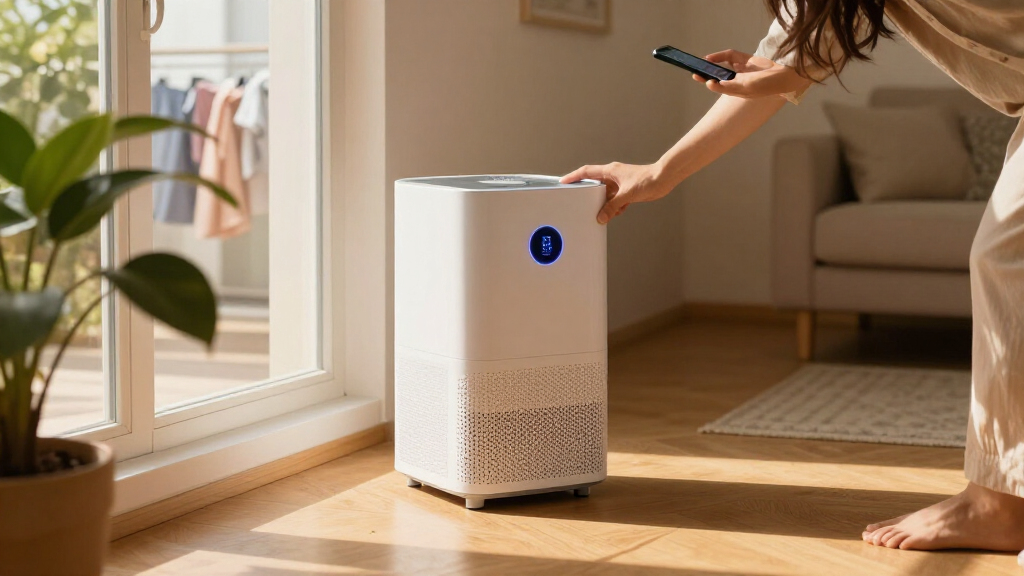
Smart dehumidifiers let you monitor humidity and adjust settings from an app, but the right choice depends on room size, drainage, and how much capacity you need. I’d put the LG PuriCare 50-Pint Wi-Fi Dehumidifier first for its familiar smart-home controls and balanced capacity, while the DREO 73-Pint models stand out for buyers who need stronger moisture removal. For smaller spaces, the Midea Cube 20-Pint offers a more compact approach. The main tradeoff is between capacity and footprint, with continuous drainage and app features also shaping everyday convenience. Read on for my full comparison and recommendations by buyer type.

Get home appliances delivered free with Prime
- Fast, free delivery on millions of items
- Prime Video, Amazon Music and more included
- Member-only deals all year
Complete the kit


Key Takeaways
- The LG PuriCare 50-Pint earns the overall lead by pairing substantial capacity with ThinQ app control, while the larger DREO models are better suited to demanding moisture loads.
- Capacity claims vary across the lineup: compare the stated pint rating and room coverage in the exact model listing, since similarly sized names do not guarantee equivalent output.
- Drainage can matter as much as smart control: hose connections on several models can reduce bucket emptying, while tank-based options require more hands-on upkeep.
- Small-room buyers have distinct choices: the Midea 22-Pint and Cube 20-Pint target more modest spaces, rather than bringing a large-capacity unit into a tighter room.
- The lineup’s smart features are not interchangeable: app control is called out on some products, but buyers should check which alerts, schedules, and integrations their preferred app actually supports.
| LG PuriCare 50-Pint Wi-Fi Dehumidifier with ThinQ App |  | Best Overall | Capacity: 50 pints per day | Recommended area: 4,500 square feet | Tank volume: 14.3 pints | VIEW LATEST PRICE | See Our Full Breakdown |
| Midea 50-Pint Dehumidifier for Areas up to 4,500 Sq. Ft. |  | Best for Smart Home Flexibility | Capacity: 50 pints per day | Coverage area: 4,500 square feet | Tank capacity: 1.6 gallons | VIEW LATEST PRICE | See Our Full Breakdown |
| DREO Energy Star 2025 Smart Dehumidifier, 73-Pint, 1.85-Gallon Tank |  | Best for Large, Energy-Conscious Spaces | Capacity: Up to 73 pints per day at 95°F and 90% RH | Tank capacity: 7 L (1.85 gallons) | Noise level: 41 dB | VIEW LATEST PRICE | See Our Full Breakdown |
| Manastin 35-Pint Dehumidifier with Wi-Fi App Control |  | Best Compact Smart Pick | Capacity: 35 pints per day | Listed coverage: Up to 2,500 square feet; product information also lists 1,000 square feet | Humidity range: 30%–80% RH | VIEW LATEST PRICE | See Our Full Breakdown |
| DREO 73-Pint Smart Dehumidifier with 1.85-Gallon Tank |  | Best for Energy Monitoring | Capacity: 73 pints per day | Recommended area: 2,000 square feet | Tank capacity: 7 liters (1.85 gallons) | VIEW LATEST PRICE | See Our Full Breakdown |
| GoveeLife Smart Dehumidifier for Home, 4,500 sq. ft., 50–137 Pints, 2-Gallon Bucket |  | Best for Smart Home Integration | Coverage: 4,500 sq. ft. | Dehumidification capacity: 50–137 pints | Water tank: 2 gallons | VIEW LATEST PRICE | See Our Full Breakdown |
| Midea 22-Pint Dehumidifier for Rooms up to 1,500 Sq. Ft. |  | Best for Quiet, Everyday Rooms | Coverage: 1,500 sq. ft. | Moisture removal: 22 pints per day | Tank capacity: 0.8 gallons | VIEW LATEST PRICE | See Our Full Breakdown |
| Midea Cube 20-Pint Dehumidifier for Basement, 1500 sq ft, Energy Star |  | Best for Long Runs Between Emptying | Coverage: 1,500 sq. ft. | Dehumidification capacity: 20 pints per day | Tank volume: 3.2 gallons | VIEW LATEST PRICE | See Our Full Breakdown |
| DREO 75-Pint Smart Dehumidifier for Up to 4,500 Sq. Ft. |  | Best for Quiet, High-Capacity Control | Coverage: Up to 4,500 sq. ft. | Maximum moisture removal: 75 pints per day | Water tank: 1.85 gallons (7 L) | VIEW LATEST PRICE | See Our Full Breakdown |
| Smart Compressor Dehumidifier with Drain Hose for Rooms up to 1,000 Sq. Ft. |  | Best Compact Pick for Small Spaces | Coverage: Up to 1,000 sq. ft. | Dehumidification capacity: 8.7 pints/day under DOE conditions; up to 28.5 pints/day at 95°F and 90% RH | Tank volume: 1.6 liters | VIEW LATEST PRICE | See Our Full Breakdown |
| ENERGY STAR Wi-Fi Dehumidifier, 100-Pint Capacity, with Drain Hose |  | Best for Large, Damp Spaces | Coverage area: Up to 6,000 sq. ft. | Moisture removal: Up to 100 pints/day at 95°F, 90% RH; up to 60 pints/day at 86°F, 80% RH | Water tank capacity: 4.28 L (1.13 gal) | VIEW LATEST PRICE | See Our Full Breakdown |
| smart dehumidifier | Dimensions | Noise level |
|---|---|---|
| LG PuriCare 50-Pint Wi-Fi Dehu | 11.02 × 16.73 × 23.86 inches | — |
| Midea 50-Pint Dehumidifier for | 11.1 × 15.43 × 24.25 inches | 49 dBA low; 54 dBA high |
| DREO Energy Star 2025 Smart De | — | 41 dB |
| Manastin 35-Pint Dehumidifier | 9.21 × 12.18 × 20.21 inches | — |
| DREO 73-Pint Smart Dehumidifie | 9.17 × 14.57 × 24.49 inches | 41 dB |
| GoveeLife Smart Dehumidifier f | — | — |
| Midea 22-Pint Dehumidifier for | 10.51 × 15.31 × 19.8 in. | 47 dBA |
| Midea Cube 20-Pint Dehumidifie | 13.5 × 13.5 × 13.54 in. | — |
| DREO 75-Pint Smart Dehumidifie | — | 41 dB |
| Smart Compressor Dehumidifier | 6.7 × 10.7 × 15.4 in. | 38 dB in sleep mode; around 42 dB on high fan speed |
| ENERGY STAR Wi-Fi Dehumidifier | — | 45 dB |
More Details on Our Top Picks
LG PuriCare 50-Pint Wi-Fi Dehumidifier with ThinQ App
LG PuriCare is my best overall choice for buyers who want app control paired with a substantial 50-pint daily capacity. Its ThinQ Wi-Fi controls let you check and adjust the unit remotely, while continuous drainage can reduce trips to empty its 14.3-pint tank. Compared with the Midea 50-Pint Dehumidifier, LG offers a larger listed tank and a quiet-operation focus; Midea counters with three speeds, voice assistant support, and wheels for moving between rooms. LG’s two speeds make its operation simpler, but give you fewer fan settings to tailor airflow. At 43.4 pounds, it is also a substantial appliance to reposition. I’d choose it for a large, damp room where reliable app access matters more than portability or extra speed options.
Pros:- Removes up to 50 pints of moisture per day
- ThinQ app provides Wi-Fi monitoring and control
- Continuous drainage can reduce manual tank emptying
- Quiet operation is suited to occupied rooms
Cons:- The 14.3-pint tank may need frequent emptying without a drain hose
- At 43.4 pounds, it is cumbersome to carry between rooms
- Two speeds offer less airflow choice than the Midea 50-Pint model
Best for: Homeowners managing persistent dampness in a large basement or living area who want remote humidity control and can use a drain hose.
Not ideal for: People who need to move a dehumidifier between floors often or rely on tank-only operation and want fewer emptying stops.
- Capacity:50 pints per day
- Recommended area:4,500 square feet
- Tank volume:14.3 pints
- Speeds:2
- Power:545 watts
- Dimensions:11.02 × 16.73 × 23.86 inches
- Weight:43.4 pounds
- Smart control:Wi-Fi via LG ThinQ app
- Warranty:1-year limited
Our verdict“Choose the LG PuriCare for large spaces where app control and continuous drainage matter more than portability or multiple fan speeds.”
Midea 50-Pint Dehumidifier for Areas up to 4,500 Sq. Ft.
Midea’s 50-pint model suits buyers who want smart control that reaches beyond a phone app. It works with Alexa and Google Assistant, offers three speeds, and rolls on wheels, giving it more day-to-day flexibility than the two-speed LG PuriCare. Its 1.6-gallon tank and continuous drainage provide two ways to handle collected water, though the drain hose is not included. The 49 dBA low setting and 54 dBA high setting give a clearer sense of its sound than the LG’s general quiet-operation description, and the high setting may be noticeable in a bedroom. DREO’s 73-pint models remove more moisture per day, but this Midea is a sensible fit when voice control and room-to-room mobility matter more than maximum capacity.
Pros:- App and voice assistant control through Alexa and Google Assistant
- Three speeds allow more airflow adjustment than the LG PuriCare
- Wheels make it easier to move between rooms
- Offers removable-tank and continuous-drain operation
Cons:- Drainage hose is not included
- The 1.6-gallon tank can require regular emptying
- High-speed noise is listed at 54 dBA
Best for: Smart-home households that want voice assistant control and a wheeled 50-pint unit for moving among large rooms.
Not ideal for: Buyers seeking a very quiet bedroom unit or expecting to start continuous drainage without obtaining a hose.
- Capacity:50 pints per day
- Coverage area:4,500 square feet
- Tank capacity:1.6 gallons
- Humidity range:35%–85%
- Noise level:49 dBA low; 54 dBA high
- Speeds:3
- Power:470 watts
- Dimensions:11.1 × 15.43 × 24.25 inches
- Smart control:SmartHome app, Alexa, and Google Assistant
Our verdict“Pick this Midea if voice control and easy room-to-room movement are more useful to you than DREO’s higher moisture-removal capacity.”
DREO Energy Star 2025 Smart Dehumidifier, 73-Pint, 1.85-Gallon Tank
For a large, persistently damp space, DREO’s 73-pint model puts capacity and energy information at the center of its smart features. Its app offers real-time energy monitoring, which gives owners a way to track use alongside humidity. It also lists 41 dB operation, a lower stated figure than the Midea 50-Pint’s 49 dBA low setting, though the measurements may not be directly comparable. The ENERGY STAR 2025 certification and stated 30% lower energy use than standard DOE models will appeal to buyers focused on efficiency, but actual savings depend on conditions and use. Compared with the 73-pint DREO DR-HDH003S, this version lists no recommended floor area in the supplied data, so I’d verify its fit for the room before choosing it.
Pros:- Removes up to 73 pints per day under the stated test conditions
- App includes real-time energy monitoring
- Listed 41 dB operation may suit quieter spaces
- ENERGY STAR 2025 certification and continuous drainage option
Cons:- The supplied product data does not state a recommended floor area
- Tank needs manual emptying when continuous drainage is not used
- Actual energy savings depend on usage and conditions
Best for: Owners of large, damp basements or garages who want high moisture-removal capacity, app-based energy tracking, and continuous drainage.
Not ideal for: Buyers who need a clearly stated room-size recommendation or plan to rely on the tank through long stretches of heavy use.
- Capacity:Up to 73 pints per day at 95°F and 90% RH
- Tank capacity:7 L (1.85 gallons)
- Noise level:41 dB
- Certification:ENERGY STAR 2025
- Energy use claim:Uses 30% less energy than standard DOE models
- Drainage:Manual tank or continuous hose drainage
- Smart features:DREO app control and real-time energy monitoring
- Maximum runtime:Up to 15 hours
Our verdict“Choose this DREO for high-capacity moisture removal and energy tracking, after confirming its room-size fit for your space.”
Manastin 35-Pint Dehumidifier with Wi-Fi App Control
Manastin’s 35-pint unit is the smaller-capacity choice for buyers who still want app control. At 22.4 pounds, it is substantially lighter than the LG PuriCare and Midea 50-pint models, making it easier to reposition within a home. The Smart Life app, touch panel, three modes, and included drain hose give it practical control options; auto shutoff also stops operation when the 0.8-gallon tank fills. Its listed coverage is inconsistent, though: the description says up to 2,500 square feet while product information also lists 1,000 square feet. That uncertainty makes it harder to match confidently to a large basement, especially beside the clearly listed 4,500-square-foot LG. I’d reserve it for a smaller space and confirm the coverage claim before buying.
Pros:- Lighter than the LG and Midea 50-pint models
- Smart Life app and touch-panel controls
- Includes a drain hose for continuous drainage
- Three modes, adjustable humidity, and a 24-hour timer
Cons:- Coverage is listed inconsistently as 1,000 and up to 2,500 square feet
- Does not support 5 GHz Wi-Fi
- The 0.8-gallon tank is smaller than those of the larger DREO models
Best for: Apartment dwellers or homeowners with a smaller damp room who want app control in a lighter, easier-to-reposition unit.
Not ideal for: People choosing a dehumidifier for a large basement who need a reliable coverage figure or 5 GHz Wi-Fi support.
- Capacity:35 pints per day
- Listed coverage:Up to 2,500 square feet; product information also lists 1,000 square feet
- Humidity range:30%–80% RH
- Tank capacity:0.8 gallons
- Drain hose:39 inches, included
- Power:230 watts
- Dimensions:9.21 × 12.18 × 20.21 inches
- Weight:22.4 pounds
- Smart control:Smart Life app over 2.4 GHz Wi-Fi
Our verdict“Consider Manastin for a smaller room where a lighter smart unit is useful, but confirm its coverage before relying on it for a large area.”
DREO 73-Pint Smart Dehumidifier with 1.85-Gallon Tank
DREO’s DR-HDH003S pairs 73-pint capacity with a defined 2,000-square-foot recommendation, making it easier to match to a room than the other 73-pint DREO listing, whose supplied data gives no floor-area figure. Its app-based energy monitoring, adjustable humidity, and included drain hose support hands-off management once it is set up. The 1.85-gallon tank is larger than Manastin’s 0.8-gallon tank, but heavy moisture removal can still mean emptying it when continuous drainage is unavailable. At 33 pounds, it is also heavier than Manastin, though lighter than the LG PuriCare. Three fan speeds and auto, continuous, and smart modes provide useful adjustment, but buyers who need coverage beyond the listed area should look elsewhere.
Pros:- 73-pint daily capacity for substantial moisture loads
- Lists a specific recommended area of 2,000 square feet
- App provides remote control and energy monitoring
- Drain hose is included for continuous drainage
Cons:- At 33 pounds, it is less convenient to carry than the Manastin
- The 1.85-gallon tank still needs emptying without continuous drainage
- Listed coverage is lower than the 4,500-square-foot LG and Midea models
Best for: Homeowners with spaces up to 2,000 square feet who want app-based energy tracking, flexible modes, and a supplied drain hose.
Not ideal for: People managing spaces larger than the listed coverage or those who need a lightweight unit to carry frequently.
- Capacity:73 pints per day
- Recommended area:2,000 square feet
- Tank capacity:7 liters (1.85 gallons)
- Noise level:41 dB
- Airflow:163 CFM
- Fan speeds:3
- Dimensions:9.17 × 14.57 × 24.49 inches
- Weight:33 pounds
- Modes:Auto, continuous, and smart
Our verdict“Choose this DREO for a space up to 2,000 square feet where high capacity and app energy tracking are priorities.”
GoveeLife Smart Dehumidifier for Home, 4,500 sq. ft., 50–137 Pints, 2-Gallon Bucket
App, voice, and IFTTT controls give this GoveeLife a wider smart home reach than the Midea 22-Pint Dehumidifier, which lists Wi-Fi and Alexa and Google Assistant support. Automatic humidity control and four modes, including Dryer, help tailor operation to changing room conditions. Its stated 50–137-pint capacity and 4,500-square-foot coverage suit larger, damp areas, while the 2-gallon bucket offers a middle ground between tank-emptying frequency and unit size.
The tradeoff is that connectivity depends on 2.4 GHz Wi-Fi and phone location being enabled. The included 3-foot hose supports continuous drainage, but a garden hose for other drainage setups is not included. High-speed operation may also add heat to the room. This pick makes the most sense for buyers who will use its connected controls and broad mode selection; the simpler Midea 22-Pint is a better fit for smaller spaces.
Pros:- App, voice, and IFTTT compatibility provide flexible smart home control
- Automatic humidity sensing and four operating modes support varied room needs
- Washable filter and automatic defrost reduce routine upkeep
- Included 3-foot hose enables continuous drainage
Cons:- Connectivity requires 2.4 GHz Wi-Fi and phone location enabled
- A garden hose for drainage is not included
- High-speed operation may emit heat
Best for: Smart home users who want app, voice, and IFTTT control for a large damp area
Not ideal for: Buyers with 5 GHz-only Wi-Fi or those who want a unit that adds little heat during high-speed operation
- Coverage:4,500 sq. ft.
- Dehumidification capacity:50–137 pints
- Water tank:2 gallons
- Controls:App, voice, and touch
- Connectivity:2.4 GHz Wi-Fi and Bluetooth
- Smart home compatibility:Alexa, Google Assistant, and IFTTT
- Modes:Low, Medium, High, and Dryer
- Drain hose:Included, 3 ft
Our verdict“Choose the GoveeLife if connected controls and broad coverage matter more to you than simple setup or avoiding added heat.”
Midea 22-Pint Dehumidifier for Rooms up to 1,500 Sq. Ft.
The Midea 22-Pint suits buyers who want smart control in a room-sized footprint without stepping up to the larger capacities of the GoveeLife Smart Dehumidifier or DREO 75-Pint Smart Dehumidifier. Its 47 dBA noise rating, two speeds, and portable wheels make it a practical choice for a living area or bedroom where the unit may need to be moved or run regularly. Wi-Fi and Alexa and Google Assistant compatibility add remote control, while auto restart and defrost support less hands-on operation.
Its 0.8-gallon tank is the main compromise: in damp conditions, buyers may need to empty it often unless they set up continuous drainage. The drain hose is not included, so that route takes an extra purchase. At 22 pints per day and 1,500 square feet of coverage, it is better suited to moderate moisture than a large basement or a consistently wet space. Choose it for a quieter, manageable room unit; choose the GoveeLife for broader coverage and more operating modes.
Pros:- Wi-Fi and Alexa and Google Assistant compatibility enable remote control
- 47 dBA noise rating suits rooms where quieter operation matters
- Wheels make the 33.5-pound unit easier to reposition
- Auto restart and auto defrost support more consistent operation
Cons:- 0.8-gallon tank can require frequent emptying
- Continuous-drain hose is not included
- 22-pint capacity is modest beside larger-area options such as the DREO 75-Pint
Best for: Households managing moderate moisture in a bedroom or living area that benefits from Wi-Fi control and portability
Not ideal for: Owners of large, persistently damp basements or anyone who wants a large tank and included drain hose
- Coverage:1,500 sq. ft.
- Moisture removal:22 pints per day
- Tank capacity:0.8 gallons
- Humidity setting:35% to 85%
- Noise level:47 dBA
- Connectivity:Wi-Fi; Alexa and Google Assistant compatible
- Drainage:Tank or continuous hose drainage
- Dimensions:10.51 × 15.31 × 19.8 in.
Our verdict“Pick the Midea 22-Pint for a quieter, portable smart unit in a moderate-size room, provided its small tank fits your routine.”
Midea Cube 20-Pint Dehumidifier for Basement, 1500 sq ft, Energy Star
The Midea Cube makes tank capacity its defining advantage: its 3.2-gallon tank holds substantially more water than the 0.8-gallon tank in the Midea 22-Pint Dehumidifier. That can mean fewer trips to empty it when continuous drainage is not practical. Wi-Fi app control and Alexa and Google Assistant integration keep it within the smart dehumidifier category, while the lift-and-twist design lets the unit nest into a more compact form for storage or drainage.
The compromise is lower moisture removal: at 20 pints per day, it is not the choice for heavy dampness that calls for the GoveeLife Smart Dehumidifier’s much higher stated capacity. Although the design supports flexible placement, the unit weighs 33.3 pounds, so it is not especially light to move. Two fan speeds also limit airflow adjustment. This Cube fits buyers who value a larger reservoir and storage flexibility over faster moisture removal or fine control.
Pros:- 3.2-gallon tank reduces emptying compared with the Midea 22-Pint’s 0.8-gallon tank
- Lift-and-twist design switches between extended and nested configurations
- Wi-Fi app control and Alexa and Google Assistant integration
- Continuous drainage option with included hose
Cons:- 20-pint daily capacity is lower than larger-capacity options such as the GoveeLife
- 33.3-pound weight can make moving it awkward
- Two fan speeds offer limited airflow adjustment
Best for: Basement owners who want a large tank to reduce emptying and appreciate a unit that can nest for storage
Not ideal for: People dealing with heavy moisture who need higher daily removal or more fan-speed choices
- Coverage:1,500 sq. ft.
- Dehumidification capacity:20 pints per day
- Tank volume:3.2 gallons
- Speeds:2
- Wattage:214 watts
- Airflow:150 CFM
- Dimensions:13.5 × 13.5 × 13.54 in.
- Connectivity:Wi-Fi app control; Alexa and Google Assistant compatible
Our verdict“Choose the Midea Cube if you want a smart unit with an unusually large tank and can accept slower moisture removal.”
DREO 75-Pint Smart Dehumidifier for Up to 4,500 Sq. Ft.
The DREO 75-Pint pairs a 75-pint daily capacity with app-based humidity targets, energy monitoring, scheduling, and filter reminders. That makes its smart features useful for more than switching the unit on remotely: buyers can track operation and set a routine for a large area. Its listed 41 dB noise level and sleep mode offer a quieter-use option than the GoveeLife Smart Dehumidifier, whose description flags added heat at high speed but gives no noise figure. ENERGY STAR 2025 certification adds another point of distinction in this lineup.
The 1.85-gallon tank is small relative to the stated capacity, so heavy-use operation may call for frequent emptying; continuous drainage can reduce that chore. Compared with the Midea Cube, the DREO prioritizes moisture removal and monitoring over a large onboard reservoir and compact nesting design. It is a strong fit for buyers who want detailed app control in a large space, but less appealing if they need long tank-only runs.
Pros:- 75-pint daily moisture removal for large damp areas
- App offers humidity targets, energy monitoring, scheduling, and filter reminders
- 41 dB noise level and sleep mode support quieter operation
- Continuous drainage option reduces reliance on the tank
Cons:- 1.85-gallon tank may need frequent emptying during heavy use
- Large coverage and capacity may be excessive for a small room
- Continuous drainage is useful for reducing tank maintenance, but requires a suitable drain setup
Best for: Owners of large damp spaces who want high stated capacity, quiet operation, and app monitoring
Not ideal for: Buyers who cannot use continuous drainage and want a large tank for unattended heavy-duty operation
- Coverage:Up to 4,500 sq. ft.
- Maximum moisture removal:75 pints per day
- Water tank:1.85 gallons (7 L)
- Tank runtime:Up to 15 hours
- Noise level:41 dB
- Smart features:App control, humidity targets, energy monitoring, scheduling, and filter reminders
- Drainage:Manual emptying or continuous drainage with 25 mm hose
- Certification:ENERGY STAR 2025
Our verdict“Choose the DREO 75-Pint for a large area where quiet operation and detailed app monitoring matter more than tank-only runtime.”
Smart Compressor Dehumidifier with Drain Hose for Rooms up to 1,000 Sq. Ft.
This compact smart compressor model is aimed at smaller rooms where a full-size unit like the Midea 22-Pint would be more machine than the space needs. At 8.7 pints per day under DOE conditions, its stated capacity is modest; the separate figure of up to 28.5 pints applies at 95°F and 90% RH, so results vary with conditions. App scheduling, full-tank alerts, and a 38 dB sleep mode give it useful bedroom-friendly controls, while the included drain hose can help avoid frequent tank checks during continuous operation.
The 1.6-liter tank is small, making the hose especially relevant if the unit runs often. Its 1,000-square-foot coverage and two fan speeds also keep it in a different class from the GoveeLife Smart Dehumidifier, which targets much larger areas and offers more modes. Automatic defrost supports cooler spaces within its 41°F to 95°F operating range. Choose this model for compactness and scheduling, not for rapid drying of a large or very damp basement.
Pros:- App control supports schedules, monitoring, and full-tank alerts
- 38 dB sleep mode can suit bedrooms and family spaces
- Included drain hose supports continuous drainage
- Automatic defrost and washable filter simplify routine upkeep
Cons:- 1.6-liter tank may need frequent emptying without continuous drainage
- DOE capacity of 8.7 pints per day is far below larger models such as the GoveeLife
- Capacity figures vary considerably with temperature and humidity
Best for: Apartment dwellers or bedroom users seeking a compact smart unit with sleep mode and a supplied drain hose
Not ideal for: People managing large, persistently damp areas or relying on high daily removal under typical DOE conditions
- Coverage:Up to 1,000 sq. ft.
- Dehumidification capacity:8.7 pints/day under DOE conditions; up to 28.5 pints/day at 95°F and 90% RH
- Tank volume:1.6 liters
- Noise level:38 dB in sleep mode; around 42 dB on high fan speed
- Wattage:190 watts
- Operating temperature:41°F to 95°F (5°C to 35°C)
- Dimensions:6.7 × 10.7 × 15.4 in.
- Features:Wi-Fi/app control, continuous draining, auto shutoff, auto defrost, washable filter, timer, and schedule
Our verdict“Pick this compact model for a smaller room where app scheduling and quiet sleep operation matter more than high moisture-removal capacity.”
ENERGY STAR Wi-Fi Dehumidifier, 100-Pint Capacity, with Drain Hose
For a large basement or open-plan area that needs serious moisture removal, this model brings the roundup’s broadest stated coverage: up to 6,000 sq. ft. and up to 100 pints per day under the listed high-humidity conditions. That capacity sets it apart from the LG PuriCare 50-Pint Wi-Fi Dehumidifier, which is a more modest fit for spaces that do not need this much extraction. App and Alexa controls let you adjust humidity without walking to the unit, while three modes and three fan speeds give more control over how it runs. The tradeoff is that output falls to 60 pints per day under the other listed test conditions, and the 4.28 L tank is small relative to its capacity. Continuous drainage is the practical choice for long runs; an extended garden hose must be supplied separately.
Pros:- Rated for up to 6,000 sq. ft. of coverage
- Removes up to 100 pints per day under specified high-humidity conditions
- Tuya Smart or Smart Life app control and Amazon Alexa compatibility
- Included drain hose, automatic tank shutoff, and wheels
Cons:- The 4.28 L tank can require frequent emptying without continuous drainage
- A standard 3/4 in garden hose for extended drainage is not included
- The washable filter requires regular cleaning
Best for: Homeowners managing a large, persistently damp basement who can use continuous drainage and want app or Alexa control.
Not ideal for: People with a small room or no suitable drain location, since its high-capacity design may be more than they need and the tank needs regular emptying.
- Coverage area:Up to 6,000 sq. ft.
- Moisture removal:Up to 100 pints/day at 95°F, 90% RH; up to 60 pints/day at 86°F, 80% RH
- Water tank capacity:4.28 L (1.13 gal)
- Drainage:Included 3.3 ft drain hose; compatible with standard 3/4 in garden hose
- Humidity range:30%–80% RH
- Controls:Touch panel, Tuya Smart or Smart Life app, Amazon Alexa
- Operating modes and fan speeds:Comfort, Basement, Continuous; 3 fan speeds
- Noise level:45 dB
- Dimensions and weight:13.62 × 10.47 × 19.57 in; 30.9 lb
Our verdict“Choose this model for a large, damp area where high extraction capacity and smart controls matter and continuous drainage is available.”
How We Picked
I ranked these smart dehumidifiers by how well their stated capacity, app control, drainage, and room coverage align with common household needs. I gave more weight to balanced usefulness than to the largest pint number alone: a unit should fit the space and be practical to maintain. I also considered whether the product information clearly identifies smart controls and drainage options, since those features affect daily use.
The order reflects those tradeoffs. The LG leads as a broadly capable connected option; the DREO 73-Pint units follow for buyers who put moisture-removal capacity first. Mid-capacity and lower-capacity Midea models rank well for smaller areas, while products with less specific smart-feature detail or a narrower stated fit sit lower. Check the exact model specifications before buying, especially where listings use different capacity or coverage figures.
Factors to Consider When Choosing Smart Dehumidifiers
Choosing a smart dehumidifier starts with the room and the way you plan to run it. I’d settle the practical questions first—where it will sit, how water will leave the unit, and what you want the app to do—then compare capacity and connected features.
Match capacity to the moisture problem
Room area is only one part of sizing: a damp basement with persistent seepage can need more capacity than a similarly sized bedroom. Think about how often the space feels clammy, whether laundry dries there, and whether moisture appears on walls or windows. A unit that is too small may run for long stretches without bringing humidity down, while an oversized model can take up more floor space than the room warrants. Use the maker’s coverage as a starting point, not a promise for every home. When conditions are severe, look for a higher-capacity unit and consider addressing leaks or ventilation at the same time.
Decide how water will drain
A bucket is straightforward if you only need occasional dehumidification and can empty it regularly. For a basement or a unit running for long periods, a hose connection can spare repeated trips, but it needs a suitable drain and a route that keeps water flowing downhill. Some setups may require a pump if the drain sits above the outlet; a basic gravity hose will not move water uphill. Check whether the hose is included and whether the unit stops when its tank fills. A convenient drain plan can matter more over months of use than a small difference in rated capacity.
Check what the app actually controls
“Wi-Fi” can mean remote on and off, or it can include schedules, humidity targets, status alerts, and voice assistant support. Decide which tasks you want to do from your phone before choosing a model, then confirm those functions in the manufacturer’s current app documentation. A useful alert can tell you a tank is full or a filter needs attention, while basic remote control may be enough if you only adjust settings occasionally. Also consider whether the unit’s controls remain usable if your internet connection drops. Do not assume that two products labeled smart offer the same automations or integrations.
Plan for noise, placement, and airflow
Compressor dehumidifiers need space for air to circulate, so a tight corner or a blocked intake can hurt their usefulness. Before buying, measure the intended spot and leave room around the vents as the manual specifies. If the unit will run near a bedroom or living area, check the stated noise information and consider when it will operate. A larger-capacity unit can be more effective in a damp space, but its footprint and sound may be less comfortable in a small room. Wheels and handles can help if you expect to move it between rooms.
Look beyond the headline energy label
An ENERGY STAR label can help narrow the field, but it does not tell you what a particular unit will cost to run in your home. Runtime, humidity settings, room conditions, and how often doors are open all affect energy use. Compare the label and rated performance for the exact model rather than relying on a family name or an older listing. A lower-capacity unit may run longer if it is undersized for a damp basement, which can defeat the appeal of choosing a smaller appliance. Paying more for capacity or app features makes sense only when those features match your space and routine.
Frequently Asked Questions
Can I leave a smart dehumidifier running while I’m away?
Many units can operate unattended, but set them up with the drain and safety behavior in mind. A hose connected to a suitable drain is more practical for extended runs than a bucket that may fill while you are away. Confirm that the model stops when its tank is full and check whether its app can alert you to that condition. Follow the manual’s clearance and placement guidance, and avoid running it where water leaks could damage nearby belongings. Remote control helps with monitoring, but it does not replace a safe drainage setup.
Will a Wi-Fi dehumidifier work if my internet goes down?
App access and remote alerts usually depend on a working network, so those features may be unavailable during an outage. Many models still have physical controls for basic operation, though the available functions vary. Check the manual for whether humidity settings and automatic shutoff continue without Wi-Fi. If reliable local operation matters, prioritize clear onboard controls and automatic humidity management. You can then treat the app as a convenience rather than the only way to run the appliance.
Should I choose a bigger pint rating than my room coverage suggests?
Not automatically: a higher rating can help in a consistently damp basement, but it may mean a larger unit and more demanding placement. Room coverage figures are manufacturer estimates and do not capture every source of moisture, such as a leak or poor ventilation. Match capacity to both the room and its conditions, then address ongoing water entry separately. If you are between sizes, consider how severe the dampness is and how often you expect the machine to run. Compare the exact model’s capacity and coverage rather than relying on a similar product name.
Is a drain hose worth prioritizing if the unit has a large tank?
A large tank reduces how often you empty it, but it does not remove that chore during long or humid stretches. A hose is especially useful for basements, laundry areas, and other places where the appliance may run for much of the day. It only helps if you have a compatible drain and can route the hose correctly. If you plan to move the unit often or use it only occasionally, a tank may be simpler. Choose based on your run time and drain access, not tank size alone.
What smart features are worth prioritizing?
Start with the tasks you would actually do remotely: checking current conditions, changing a target, setting a schedule, or receiving a full-tank alert. Those functions can make a practical difference if the dehumidifier sits in a basement or another room you rarely visit. Voice assistant support is useful only if it fits the system you already use. Confirm that the feature is supported by the precise model and its current app, since smart capabilities can vary across product lines. If you mainly want automatic humidity control, a reliable onboard humidistat may matter more than a long list of app features.
Conclusion
For the best overall fit, I recommend the LG PuriCare 50-Pint for buyers seeking balanced capacity and app control. The Midea 22-Pint is my best value-style choice for a smaller room where a high-capacity appliance would be unnecessary, while the DREO 73-Pint models are the premium picks for tougher moisture loads. For beginners, the Midea Cube 20-Pint offers a lower-capacity entry point for modest spaces. If your priority is sustained use in a large area, compare the DREO 75-Pint and 100-Pint hose-equipped models against your drain setup and room conditions. Choose by matching the unit’s capacity, app functions, and drainage to the job you need it to do.
Cold & flu season Picks
humidifiers
As an affiliate, we earn on qualifying purchases.