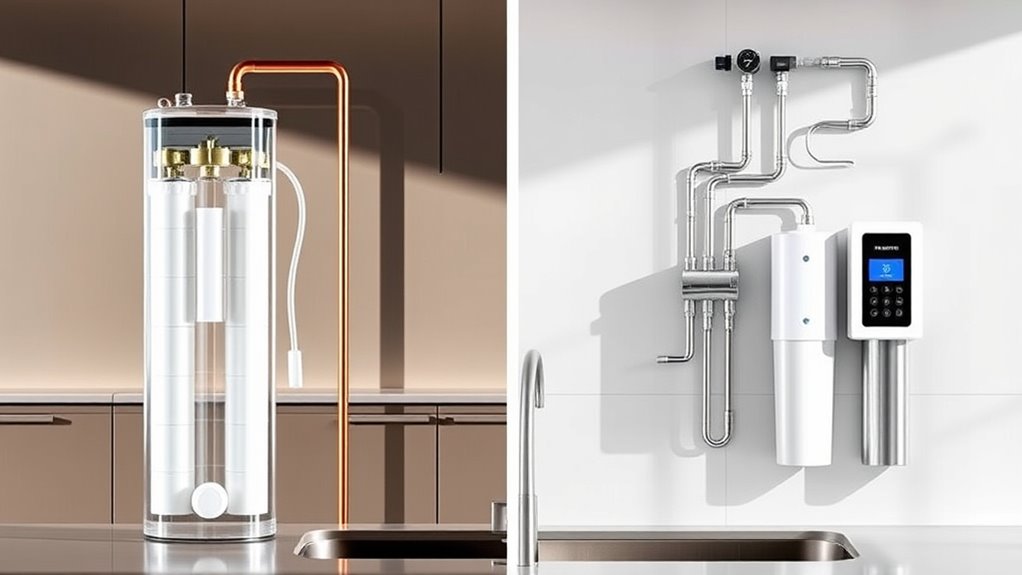

Choosing between Whole House RO and hybrid systems depends on your priorities. Whole House RO provides the highest purity, removing heavy metals, chemicals, and pathogens, but it wastes more water and costs more initially. Hybrid systems offer good filtration with lower costs and water waste, making them more eco-friendly and economical in the long run. If you want a deeper understanding of benefits and trade-offs, keep exploring to find the best fit for your home.
Key Takeaways
- Whole House RO provides higher purification but wastes more water and incurs higher installation and maintenance costs.
- Hybrid systems balance effective filtration with improved water efficiency, reducing waste and operational expenses.
- Whole House RO is ideal for households prioritizing maximum water purity despite higher costs and environmental impact.
- Hybrid systems are more sustainable, environmentally friendly, and benefit from technological advancements for better reliability.
- Cost, water conservation, and household water quality needs influence whether a homeowner chooses Whole House RO or a hybrid system.

When choosing a water filtration system for your home, understanding the differences between Whole House Reverse Osmosis (RO) and hybrid systems is essential. Both options aim to supply clean, safe water, but they differ markedly in how they operate, their water efficiency, and overall costs. Your decision should consider these factors to match your household’s needs and budget.
Whole House RO systems are known for their thorough filtration process. They use reverse osmosis membranes to remove a wide range of contaminants, including heavy metals, chemicals, and pathogens. This results in exceptionally pure water coming directly from every tap in your home. However, the process isn’t very water-efficient. RO systems tend to waste a considerable amount of water during operation—often three to four gallons for every gallon of purified water produced. This inefficiency can lead to higher water bills and increased strain on your household’s water supply, especially if your water source is limited or metered. When considering a Whole House RO, you need to conduct a detailed cost analysis. While the initial installation costs can be high, you should also factor in ongoing expenses like wastewater, maintenance, and filter replacements. The high water waste means your water bills could increase over time, which might offset some of the benefits of the pure water quality.
Whole House RO provides excellent purification but wastes significant water, increasing costs and water usage.
In contrast, hybrid systems combine different filtration technologies, typically including carbon filters, UV sterilization, and sometimes smaller reverse osmosis modules. They are designed to strike a balance between water efficiency and filtration quality. Hybrid systems tend to be more water-efficient than full RO setups, reducing waste and conserving resources. This makes them a more sustainable choice if you’re concerned about water conservation or want to minimize operational costs. Although they may not remove every trace of contaminants as thoroughly as a dedicated Whole House RO, they still provide excellent filtration for most household needs. When performing a cost analysis, hybrid systems generally have lower upfront costs and reduced ongoing expenses. Their improved water efficiency means you’ll see lower water bills over time, making them a cost-effective solution for many households. Additionally, advancements in water filtration technology continue to enhance the performance and reliability of hybrid systems.
Ultimately, your choice hinges on your priorities. If you demand the absolute purest water and your household can handle higher water waste and costs, a Whole House RO may suit you best. If water efficiency, lower maintenance, and cost savings are more important, then a hybrid system provides a practical, sustainable alternative. Carefully evaluate your water quality needs, budget, and environmental concerns to select the system that aligns with your household’s priorities and ensures you get the best value for your investment.
Frequently Asked Questions
How Much Do Installation Costs Typically Vary Between Systems?
You’ll find that installation costs for whole house RO systems tend to be higher, often ranging from $3,000 to $8,000, due to their complexity and size. Hybrid systems usually cost less upfront, typically between $2,000 and $6,000, making them more affordable for many homeowners. Your system’s affordability depends on factors like home size, water quality, and installation requirements, so it’s smart to get multiple quotes to find the best deal.
Can Hybrid Systems Handle Higher Water Flow Rates?
Surprisingly, hybrid systems can often handle higher water flow rates thanks to their combined filtration methods. With better flow capacity and system scalability, they’re designed to adapt as your water needs grow. So, if you’re thinking bigger, don’t worry—hybrid systems can keep up, ensuring you get clean water without bottlenecks. It’s almost like they’re built for the challenge, making them a smart choice for larger households.
What Maintenance Is Required for Each System Type?
You need to regularly replace filters and clean both systems to keep them functioning well. For Whole House RO systems, change the sediment and carbon filters every 6 to 12 months and sanitize the system annually. Hybrid systems also require filter replacements and periodic cleaning of the membranes. Staying consistent with maintenance guarantees your system runs efficiently, prolongs its lifespan, and ensures your water remains clean and safe.
How Do These Systems Impact Water Pressure Throughout the House?
Did you know that a typical home’s water pressure ranges from 40 to 60 psi? Whole house RO systems can reduce water pressure slightly, which may affect your daily use, but hybrid systems usually maintain better pressure due to their design. Your choice impacts system efficiency and water flow, so consider how each system manages pressure to guarantee consistent water supply throughout your house.
Are There Specific Water Qualities That Favor One System Over the Other?
If your water is very hard or contains high levels of specific contaminants, a whole house hybrid system might be better because it efficiently handles water hardness and removes a broad range of contaminants. For softer water with fewer impurities, a whole house RO system can be effective. Consider your water quality; high hardness and heavy contaminant presence generally favor hybrid systems for extensive treatment.
Conclusion
Choosing between a Whole House RO and a Hybrid System depends on your water needs and budget. Think of it like selecting a Swiss Army knife—each has its strengths, but only one fits all your needs. A Whole House RO offers pure, reliable water, like a trusty knight, while a Hybrid system balances efficiency and convenience, like a modern gadget. Weigh the pros and cons, and you’ll find the perfect solution for your castle’s water supply.