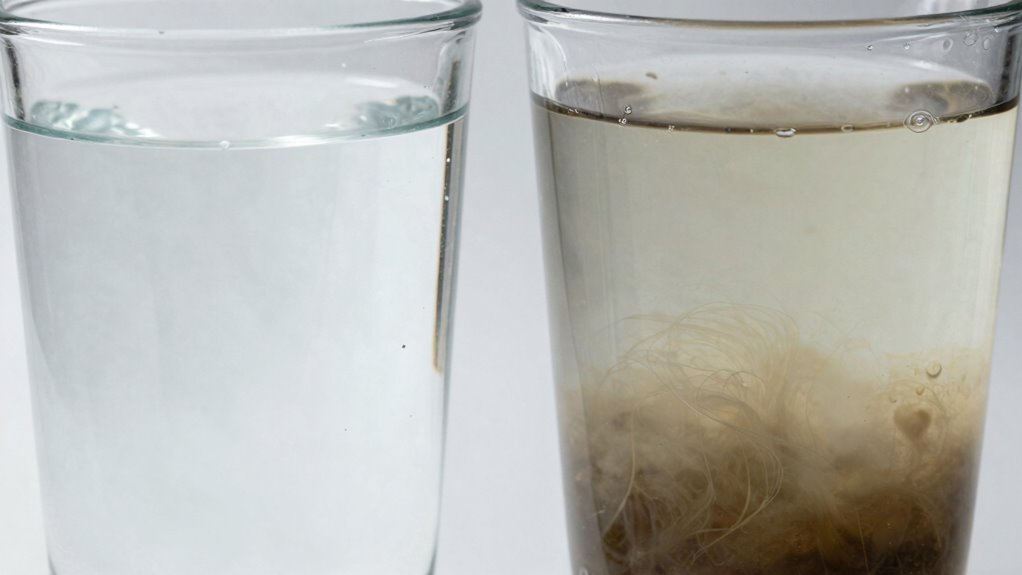
Understanding the difference between turbidity and cloudiness is essential for accurate water assessment. Cloudiness can come from dissolved substances like minerals or organic matter, which don’t impact light transmission much. Turbidity, however, refers specifically to suspended particles that scatter light and reduce transparency. Recognizing this distinction helps prevent misdiagnosis of water quality. If you want to know how optical properties truly influence water clarity, there’s more to uncover below.

Get home appliances delivered free — and shop member deals
- Fast, free delivery on millions of items
- Access to Prime Big Deal Days deals on October 6–7
- Prime Video, Amazon Music and more included
Key Takeaways
- Turbidity measures light scattering caused by suspended particles, while cloudiness can result from dissolved substances without affecting optical properties.
- High turbidity indicates actual particles in water that impair transparency, unlike cloudiness, which may be caused by dissolved materials.
- Accurate water quality assessment depends on turbidity, not just visual cloudiness, preventing misdiagnosis of contamination.
- Understanding the difference helps distinguish between optical interference from particles and other causes of water murkiness.
- The key word “turbidity” ensures precise evaluation of how particles impact water clarity and optical properties.

Have you ever wondered what makes water appear cloudy or murky? It’s a question that often comes up, especially when evaluating water quality or trying to interpret what you see in a natural body of water. The key lies in understanding water clarity, which directly relates to the optical properties of water. When water looks murky, it’s because its optical properties have changed—more particles are suspended in it scatter and absorb light, reducing transparency. This is what we commonly call turbidity, a measure of how much particles are floating around in the water, making it less see-through. But it’s important to distinguish turbidity from mere cloudiness, which can sometimes be misleading if you’re not familiar with the science behind it.
Turbidity isn’t just about how dirty water looks; it’s a specific measurement of how particles—like silt, algae, bacteria, or other suspended solids—affect the water’s optical properties. These particles interfere with the passage of light, diminishing water clarity. When water has high turbidity, it absorbs and scatters light to a greater extent, preventing you from seeing through it clearly. This is noteworthy because the optical properties of water directly influence how we perceive its clarity. The more particles are present, the murkier the water appears, and the lower its water clarity becomes. If you’re testing water quality, measuring turbidity provides an objective way to quantify these optical changes, giving you a clearer picture—pun intended—of what’s going on beneath the surface.
Understanding this distinction helps prevent misdiagnosis when evaluating water sources. Cloudiness can sometimes be caused by dissolved substances, like minerals or organic compounds, which don’t necessarily affect optical properties in the same way suspended particles do. For instance, mineral-rich water might look cloudy but have low turbidity because the particles are dissolved, not suspended. Conversely, water with high turbidity might look relatively clear to the naked eye if the particles are very fine or evenly dispersed, but in reality, its optical properties have been noticeably altered, reducing water clarity. Recognizing these differences means you can interpret water conditions more accurately, whether for environmental monitoring, drinking water safety, or recreational activities.
In essence, the word “turbidity” becomes a critical term that saves you from misdiagnosis. It’s a precise indicator of how suspended particles affect the optical properties of water, directly impacting water clarity. Knowing this allows you to distinguish between different causes of murkiness, ensuring you don’t jump to conclusions based on appearance alone. Instead, you base your evaluation on the scientific understanding that turbidity measures the interference particles cause with light transmission, which is the true determinant of how clear or murky water appears. This clarity in understanding can make all the difference in making informed decisions about water quality and health. Recognizing the role of suspended particles in affecting water transparency is essential for accurate assessment and management.
As an affiliate, we earn on qualifying purchases.
Frequently Asked Questions
How Do Turbidity and Cloudiness Affect Water Treatment Processes?
Turbidity and cloudiness directly impact your water treatment processes by affecting filtration techniques and chemical additives. High turbidity requires more intensive filtration to remove suspended particles, while cloudiness can hinder chemical reactions needed for purification. You need to adjust filtration rates and dosing of chemical additives accordingly, ensuring effective removal of contaminants. Recognizing the difference helps you optimize treatment steps, preventing misdiagnosis and ensuring clean, safe water.
Can Turbidity and Cloudiness Indicate the Presence of Specific Contaminants?
You notice the water’s turbidity and cloudiness, and suddenly, a question arises: do these indicators reveal specific contaminants? Turbidity sources like sediments, organic matter, or microorganisms can signal bacteria or pollutants lurking beneath the surface. Cloudiness acts as a visual clue, hinting at potential chemical or biological hazards. Pay close attention—these indicators could be your first warning of hidden dangers, guiding your next steps in testing and safety.
Are There Visual Differences Between Turbidity and Cloudiness in Water?
You’ll notice distinct visual differences between turbidity and cloudiness. Turbidity appears as a hazy or murky look caused by suspended particles, often unevenly distributed, making water look dull. Cloudiness, however, tends to be more uniform, giving water a milky or milky-white appearance due to dissolved substances or tiny particles. These perceptual differences help you distinguish between the two, aiding in accurate assessment and diagnosis of water quality issues.
What Instruments Are Used to Measure Turbidity and Cloudiness?
You might think a simple eye test suffices, but to truly measure turbidity and cloudiness, you rely on optical sensors and nephelometers. These instruments shine light through water and detect how much is scattered, giving precise readings. Ironically, what seems like a straightforward visual check requires such sophisticated technology. So, next time you see murky water, remember, a nephelometer or optical sensor’s behind the scenes, revealing the hidden truth.
How Do Environmental Factors Influence Turbidity and Cloudiness Levels?
Environmental factors like pollution sources and climate impacts directly influence turbidity and cloudiness levels. When nearby pollution sources, such as runoff from agriculture or industrial waste, increase, you’ll see higher turbidity. Climate impacts like heavy rainfall or droughts alter water flow, stirring up sediments or reducing clarity. These factors cause fluctuations, making it essential for you to monitor environmental changes closely to assess water quality accurately.
As an affiliate, we earn on qualifying purchases.
Conclusion
Think of turbidity and cloudiness as two different tools in your water-testing toolbox. Using the right one guarantees you don’t paint the wrong picture of your water’s health. If you mistake cloudiness for turbidity, it’s like assuming a cloudy sky means rain—sometimes it doesn’t. Knowing the difference is your shield against misdiagnosis. So, stay sharp, choose your words wisely, and let clarity be your guide to accurate water assessment.
water quality testing kit for turbidity
As an affiliate, we earn on qualifying purchases.
As an affiliate, we earn on qualifying purchases.
digital turbidity meter for water
As an affiliate, we earn on qualifying purchases.
As an affiliate, we earn on qualifying purchases.
NFL season / tailgating Picks
team gear
As an affiliate, we earn on qualifying purchases.