
TL;DR

Get home appliances delivered free with Prime
- Fast, free delivery on millions of items
- Prime Video, Amazon Music and more included
- Member-only deals all year
House Beautiful’s 2026 Whole Home feature highlights designer Anissa Zajac’s bathroom, which combines a his-and-hers vanity and expanded concealed storage with decorative finishes. The report also cites a 2026 Houzz survey finding that 21% of bathroom projects are replacing standard 60-inch vanities with 72-inch models.
House Beautiful’s 2026 Whole Home features an Indianapolis bathroom designed by Anissa Zajac, pairing a spacious his-and-hers vanity with decorative finishes and concealed cabinet storage. The feature presents storage as a practical part of a self-care-oriented bathroom, while citing a 2026 Houzz survey in which 21 percent of bathroom projects replace standard 60-inch vanities with 72-inch models.
Zajac, founder and principal designer of Indianapolis-based House Seven Design, created a bathroom with expansive counter space intended to leave room for everyday personal-care products as well as the room’s visual details. The report describes whimsical wallpaper and mixed-metal hardware alongside the his-and-hers vanity. It does not provide the vanity’s dimensions or say whether the project follows the 72-inch trend cited elsewhere in the story.
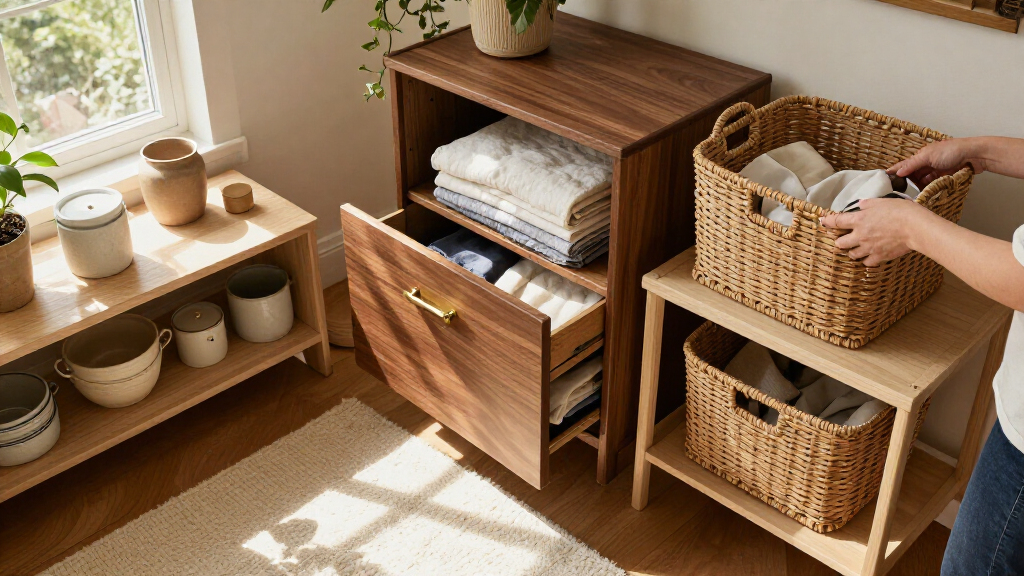
The cabinetry gives storage a decorative role. According to House Beautiful, Zajac paired fluted cabinet doors with classic wainscoted drawers. The fluted fronts conceal additional space for personal-care backstock and items used less often, keeping them out of sight while adding texture to the room.
The feature’s broader point is that storage affects how a room functions as well as how it looks. A countertop can be visually appealing, the report argues, but crowded surfaces may make it harder to use or appreciate. Its design example combines visible working space with hidden storage rather than treating cabinetry as a purely utilitarian afterthought.
More Room for Bathroom Routines
The feature connects a design choice—larger vanities and concealed storage—to the daily routines that take place in bathrooms. Clearer counters can give users space for the products they use regularly, while cabinets can hold supplies and less frequently used items. That is the practical case behind describing storage as part of self-care: the room is arranged to support routines, not just to look finished in photographs.
The cited Houzz figure suggests that larger vanities are appearing in a share of bathroom projects. It is a survey statistic, not proof that all homeowners are choosing bigger bathrooms or that the trend is accelerating. Still, it gives readers a specific indication that some projects are moving beyond the standard 60-inch vanity toward a 72-inch option, adding potential counter and cabinet capacity.
For homeowners planning a renovation, the example underscores a trade-off: a larger vanity can provide more surface and storage, but it also takes up more floor area. The House Beautiful report does not discuss costs, room-size constraints, or installation considerations. Its example is best understood as a design approach, not a universal recommendation.
Products Worth Considering

Sony BRAVIA 5 85-Inch Mini LED 4K HDR Smart TV (K-85XR50)

TCL QM64L 85-Inch QD-Mini LED 4K Smart Fire TV

Samsung 85-Inch QN70H Neo QLED 4K Smart TV (2026)
As an affiliate, we earn on qualifying purchases.
Inside the 2026 Whole Home Bathroom
House Beautiful’s 2026 Whole Home feature presents a series of interior design choices, including color, pattern, and texture. The bathroom is one part of that larger showcase. In the report, it becomes an example of how a room’s storage can be integrated into its overall appearance rather than added as an afterthought.
The article places the design in the setting of growing attention to bathroom routines and personal care, but does not provide separate data on how much time Americans spend in bathrooms or how spending on self-care is changing. Its numerical context is a 2026 Houzz survey: 21 percent of bathroom projects are moving from a standard 60-inch vanity to a 72-inch model. The report does not specify the survey’s sample size, methodology, or geographic scope.
Zajac’s design uses several visual elements—wallpaper, mixed-metal hardware, fluting, and wainscoting—alongside the storage plan. The feature’s argument is that practical capacity and decorative design can coexist, with concealed cabinetry helping keep personal products from dominating the visible counter.
““Our homes are only as beautiful as our storage solutions allow them to be.””
— House Beautiful
Survey and Project Details Missing
The source does not give the Houzz survey’s sample size, methods, or geographic scope, so readers cannot assess how broadly the 21 percent figure applies. It also does not state the total number of projects studied, whether the figure covers completed or planned renovations, or how the result compares with earlier years.
Other details about Zajac’s bathroom are not provided, including its dimensions, the vanity’s width, the renovation budget, and how much storage the cabinets offer. The report describes the design and its intended function, but it does not include user research or evidence that the arrangement improves well-being. The connection between storage and self-care is the feature’s design framing, not a measured health outcome.
Design Feature, No Further Milestone
The source presents the bathroom as part of House Beautiful’s 2026 Whole Home and does not announce a product launch, scheduled follow-up, or renovation project still underway. Readers can take the feature as a design example rather than a formal industry forecast. Further detail on the Houzz survey would be needed to judge how representative its vanity finding is or how it compares with previous years.
For now, the reported takeaway is specific: Zajac’s design combines ample counter space with concealed storage and decorative cabinetry. Whether that approach suits another home will depend on available floor space, household needs, and renovation plans—details the feature does not assess.
Key Questions
What is House Beautiful’s 2026 Whole Home feature about?
It showcases interior design choices, including a bathroom by Anissa Zajac that combines a spacious vanity, decorative finishes, and concealed storage.
What did the Houzz survey report?
House Beautiful says a 2026 Houzz survey found that 21 percent of bathroom projects are replacing standard 60-inch vanities with 72-inch models. The feature does not provide the survey’s sample size or methodology.
How does the bathroom design add storage?
The design includes a his-and-hers vanity and fluted cabinet fronts that conceal space for backstock and less frequently used personal-care products.
Does the report show that storage improves health or well-being?
No. The feature describes storage as part of a self-care-oriented design, but it provides no measured health or well-being outcomes.
Source: housebeautiful.com