
This guide walks you through installing and setting up smart water leak detectors in your home. It is suitable for beginners and takes about half an hour. By following these steps, you will be able to detect leaks early and receive alerts on your smartphone, helping prevent water damage and costly repairs.

GoveeLife Upgraded Smart Water Leak Detector 6 Pack
- ✔ Connectivity: Sub-1G wireless tech, up to 1804 ft
- ✔ Alarm Volume: 4 levels, up to 105 dB
- ✔ Battery Life: 5 years

GoveeLife Upgraded Smart Water Leak Detector 5-Pack
- ✔ Connectivity Range: 1804 feet
- ✔ Battery Life: 5 years
- ✔ Waterproof Rating: IP67

GoveeLife Upgraded Smart Water Leak Detector 4 Pack
- ✔ Connectivity: Sub-1G long-range wireless tech
- ✔ Range: 1804 feet
- ✔ Alarm Volume: up to 105 dB
Difficulty: Beginner | Time: 30-60 minutes
What You’ll Need
Tools & Materials:
- Smart water leak detectors (at least one)
- Smartphone with app installed
- Batteries (if detectors are battery-powered)
- Optional: small screwdriver or tools for mounting
Knowledge:
- Basic familiarity with smartphone apps
- Understanding of your home’s water sources (e.g., sump pump, under sinks, near water heaters)
Ensure your Wi-Fi network is active and has a stable internet connection. Verify compatibility of detectors with your smart home system or app before purchase.

GoveeLife Upgraded Smart Water Leak Detector 1s with High Alarm, 6 Pack
- Long-Range Connectivity: Up to 1804 feet through walls
- Multiple Alert Methods: SMS, app, email, and audible alarm
- User-Friendly App: Push notifications, device locator, multi-user alerts
As an affiliate, we earn on qualifying purchases.
GoveeLife Upgraded Smart Water Leak Detector 6 Pack
<p>This model stands out for its impressive <strong>wireless range of up to 1804 feet</strong>, making it ideal for covering large properties or multiple entry points. It supports <strong>SMS, email, and app notifications</strong> for instant alerts, ensuring you’re always informed of potential leaks. The waterproof IP67 rating and 5-year battery life mean less maintenance and reliable operation in harsh environments. Compared to smaller packs, this offers comprehensive coverage but may be overkill for small homes, and its dependence on 2.4G Wi-Fi could be a limitation in areas with unstable networks.</p>
Pros:
- Exceptional wireless range suitable for large properties
- Multiple notification methods including SMS, email, and app alerts
- Durable waterproof IP67 design
- Long-lasting 5-year battery life
Cons:
- Requires 2.4G Wi-Fi, not compatible with 5G networks
- Bulk pack may be unnecessary for small or simple setups
- Limited to specific Govee sensors, which could restrict flexibility
Best for: Large homes or properties with extensive plumbing where wide coverage and long-range alerts are necessary.
Not ideal for: Small apartments or users seeking a compact, discreet device, or those with limited Wi-Fi infrastructure.
Bottom line: Ideal for large properties needing extensive coverage and reliable alerts, but less suitable for small spaces or Wi-Fi-challenged environments.
“Ideal for large properties needing extensive coverage and reliable alerts, but less suitable for small spaces or Wi-Fi-challenged environments.”

GoveeLife Upgraded Smart Water Leak Detector 1s with High Alarm, 5 Pack
- Long-Range Connectivity: Up to 1804 feet through walls
- Multiple Alert Methods: SMS, app, email notifications
- High-Volume Alarm: 105 dB sound alert
As an affiliate, we earn on qualifying purchases.
GoveeLife Upgraded Smart Water Leak Detector 5-Pack
<p>This pick offers a <strong>long-range connectivity of 1804 feet</strong> and supports multiple alert methods, making it well-suited for monitoring larger homes or multiple vulnerable zones like basements and kitchens. Its 5-year battery life minimizes maintenance, while waterproof IP67 construction ensures durability. Compared with the 6-pack, this set balances coverage and cost, but the maximum alarm volume of 105 dB might be too loud for some and its reliance on 2.4G Wi-Fi could pose connectivity issues in some environments.</p>
Pros:
- Long wireless range supports extensive property coverage
- Supports multiple notification channels
- Waterproof and durable with 5-year battery life
- Cost-effective for multi-sensor setups
Cons:
- Limited to 2.4G Wi-Fi, not compatible with 5G networks
- Alarm volume maximum may be disruptive
- Restricted sensor compatibility to specific Govee models
Best for: Homeowners needing a cost-effective multi-sensor setup across various critical areas, especially in larger properties.
Not ideal for: Those seeking discreet sensors or who operate primarily on 5G Wi-Fi networks, as it only supports 2.4G.
Bottom line: A practical, budget-friendly option for multi-area leak detection in large homes, with some limitations on network compatibility and alert volume.
“A practical, budget-friendly option for multi-area leak detection in large homes, with some limitations on network compatibility and alert volume.”

GoveeLife Upgraded Smart Water Leak Detector 1s with High Alarm, 4 Pack
- Long-Range Connectivity: Up to 1804 feet through walls
- Multiple Alert Methods: SMS, app, email, loud alarm
- User-Friendly App: Instant notifications and device locator
As an affiliate, we earn on qualifying purchases.
GoveeLife Upgraded Smart Water Leak Detector 4 Pack
<p>This model emphasizes <strong>ultra-long-range wireless connectivity of up to 1804 feet</strong> combined with <strong>customizable alarm volume</strong> and multiple notification options, including SMS, email, and app alerts. It’s perfect for monitoring essential areas like basements, kitchens, or laundry rooms where early leak detection is vital. While its 5-year battery life reduces upkeep, some users might find the sensors bulkier and less discreet. Its dependency on 2.4G Wi-Fi could be a drawback in certain setups, but overall, it offers reliable, multi-channel alerting in high-risk zones.</p>
Pros:
- Extended wireless range up to 1804 feet
- Multiple alert channels including SMS, email, and app
- Customizable alarm volume for different environments
- Long-lasting 5-year battery life
Cons:
- Requires 2.4G Wi-Fi, limiting compatibility
- Bulkier sensors may be less discreet
- Limited to specific Govee sensors
Best for: Homeowners prioritizing critical monitoring zones with tailored alert settings and extensive coverage.
Not ideal for: People needing compact sensors or operating primarily on 5G Wi-Fi networks, as it’s limited to 2.4G.
Bottom line: Best suited for critical zones requiring customizable alerts and broad coverage, with some network compatibility considerations.
“Best suited for critical zones requiring customizable alerts and broad coverage, with some network compatibility considerations.”
As an Amazon Associate we earn from qualifying purchases.
Before You Start
Read all product instructions for your specific leak detector model. Turn off water supply to the areas where you’ll install detectors if necessary, and test your Wi-Fi connection to ensure reliable signal during setup.
Step-by-Step Instructions
Step 1: Choose installation locations
Select areas prone to leaks, such as under sinks, near water heaters, washing machines, or sump pumps. Avoid installing in areas with excessive humidity or where the detector could get submerged unless it’s waterproof.
Tip: Place detectors close enough to water sources for accurate detection but avoid obstructing airflow or access. Use the manufacturer’s recommended placement guidelines.
Check: The locations are visibly accessible, and detectors will be within range of your Wi-Fi network.
Step 2: Install the detectors
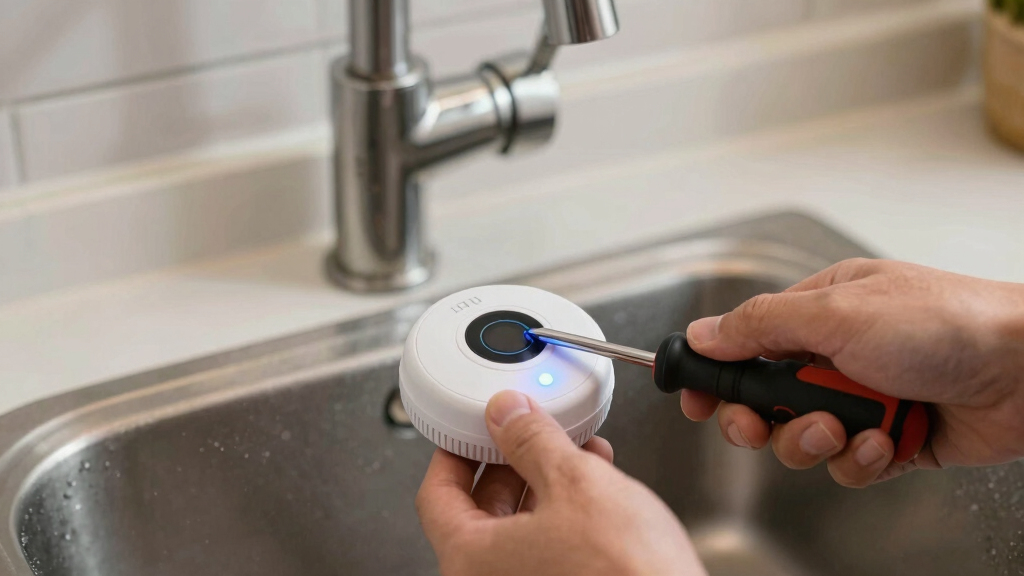
Mount the water leak detectors according to the manufacturer’s instructions. Use adhesive pads, screws, or stands provided. Ensure sensors are positioned close to potential leak points and on flat, stable surfaces.
Tip: Avoid installing on uneven or vibrating surfaces. Keep sensors dry and free of dust for optimal operation.
Check: Detectors are securely mounted, unobstructed, and in the correct locations.
Step 3: Connect detectors to Wi-Fi and app
Open the detector’s app on your smartphone. Follow prompts to add a new device. Ensure your phone is connected to the same Wi-Fi network as the detector. Complete the pairing process as instructed.
Tip: Keep your phone close to the detector during setup to avoid connection issues. Ensure your Wi-Fi password is ready if required during setup.
Check: The app recognizes the detector, and it appears online in your device list.
Step 4: Configure alert settings
Within the app, set your preferred alert notifications—push notifications, email alerts, or both. Test alerts to confirm delivery to your device.
Tip: Set quiet hours if needed to avoid nuisance alerts at night. Adjust sensitivity if adjustable, to reduce false alarms.
Check: Test alerts are received promptly on your smartphone, confirming configuration.
Step 5: Test the detectors
Pour a small amount of water near the sensor to simulate a leak. Confirm that the detector triggers an alert in the app and that you receive the notification.
Tip: Use a small cup or container to avoid water damage or mess. Wait a few seconds for the alert to arrive after pouring water.
Check: An alert appears on your device within a minute, indicating the detector is functioning properly.
Common Mistakes to Avoid
- Installing detectors too far from water sources or Wi-Fi routers — Place detectors close to leak-prone areas and ensure they are within Wi-Fi range for reliable communication.
- Using incompatible detectors with your smart home system — Verify compatibility before purchase and follow specific setup instructions for your device model.
- Failing to test detectors after installation — Always perform a water leak simulation test to confirm alerts are working before leaving the detectors unattended.
- Mounting detectors in areas prone to false alarms (e.g., very humid or dusty spots) — Choose dry, clean locations and avoid areas with steam or excessive dust that could trigger false alerts.
Troubleshooting
Problem: Detector does not connect to Wi-Fi or app
Solution: Ensure your Wi-Fi is active and within range. Restart your router and detector. Re-run the setup process, verifying Wi-Fi credentials are correct.
Problem: No alert received after water exposure
Solution: Check detector power and connection status. Re-test the detector by pouring water again, ensuring the sensor is dry and correctly mounted.
Problem: False alarms or frequent alerts
Solution: Adjust sensitivity settings if available. Clear debris or dust from sensors. Move detectors away from humid areas or vents causing false triggers.
What Success Looks Like
The detectors are installed securely in appropriate locations, paired successfully with your app, and trigger alerts when water is applied near sensors. You receive notifications promptly, confirming proper setup and operation.
Next Steps
Regularly test your detectors monthly by simulating leaks. Keep the detectors clean and check for firmware updates via the app. Consider installing additional detectors in other vulnerable areas as needed. Review alert logs periodically to confirm ongoing performance.
Frequently Asked Questions
Can I install water leak detectors myself?
Yes, most detectors are designed for easy DIY installation following manufacturer instructions. No special tools or plumbing skills are usually required.
Will the detectors work if my Wi-Fi goes out?
Most detectors require Wi-Fi to send alerts. If your internet is down, they cannot notify you until connectivity is restored.
How often should I replace the batteries?
Battery life varies by model and usage but typically ranges from 6 months to 1 year. Check the app for low battery alerts and replace batteries promptly.
Can multiple detectors communicate with each other?
Some systems support interconnectivity, triggering alarms across all detectors if one detects water. Verify your model’s features and set up accordingly.