Among these under-sink reverse osmosis systems, I’d put the Waterdrop G3P600 first for its tankless design and stated 600 GPD capacity, while the APEC ROES-50 stands out as a straightforward conventional option and the iSpring RCC7AK-UV adds alkaline treatment and UV. The main choice is between a space-saving, powered tankless unit and a tank-based system with a simpler layout but a storage tank beneath the sink. You’ll also need to weigh stated output, remineralization, installation demands, and the ongoing cost and availability of replacement filters. No single design suits every kitchen or water source. Read on for my ranking, buying advice, and answers to common decision questions.

Get home appliances delivered free with Prime
- Fast, free delivery on millions of items
- Prime Video, Amazon Music and more included
- Member-only deals all year
Complete the kit


Key Takeaways
- Tankless designs dominate the high-output choices: several Waterdrop models list 600–800 GPD, while the conventional APEC ROES-50 and Express Water RO5DX list 50 GPD; stated capacity alone does not describe real-world flow at your home’s pressure.
- Space and power are linked tradeoffs: tankless systems can free space otherwise used by a storage tank, but they need electricity and a compatible installation setup.
- Remineralization is a distinct preference, not an automatic upgrade: the roundup includes alkaline options from Waterdrop, iSpring, and APEC, alongside standard RO systems for buyers who prefer fewer treatment stages.
- The iSpring RCC7AK-UV is the most treatment-feature-heavy conventional pick: it combines alkaline treatment with UV, while the RCC7AK models offer alkaline treatment without that added component.
- Filter sourcing deserves equal attention to the initial system choice: the lineup spans familiar replaceable cartridge configurations and model-specific tankless systems, so ongoing availability and change intervals can shape long-term convenience.
| Waterdrop G5P500A Tankless Reverse Osmosis System with Alkaline Mineralization |  | Best Overall Tankless Pick | Filtration: 8-stage reverse osmosis | RO membrane pore size: 0.0001 μm | Capacity: 500 GPD | VIEW LATEST PRICE | See Our Full Breakdown |
| iSpring RCC7-BN 5-Stage Under-Sink Reverse Osmosis Water Filter System with Brushed Nickel Faucet |  | Best No-Power Value | Model: RCC7-BN | Filtration: 5-stage reverse osmosis | Capacity: 75 GPD | VIEW LATEST PRICE | See Our Full Breakdown |
| Waterdrop G3P600 Tankless Reverse Osmosis Water Filter System with Silver Faucet |  | Best for Filter-Life Monitoring | Filtration: 8-stage | Certifications: NSF/ANSI 42, 58, and 372; FCC | Daily capacity: 600 gallons | VIEW LATEST PRICE | See Our Full Breakdown |
| iSpring RCC7AK-BLK 6-Stage Alkaline Reverse Osmosis Water Filtration System with Black Faucet |  | Best for Alkaline Water and Easy Inspection | Model: RCC7AK-BLK | Filtration stages: 6 | Purification method: Reverse osmosis | VIEW LATEST PRICE | See Our Full Breakdown |
| iSpring RCC7AK-UV 7-Stage Reverse Osmosis Water Filter System with Alkaline and LED UV, Patented Top-Mounted Faucet Design |  | Best for Added UV Treatment | Filtration stages: 7 | Daily production capacity: 75 gallons per day | Tank capacity: 3.2 gallons | VIEW LATEST PRICE | See Our Full Breakdown |
| Waterdrop T4-A Tankless Alkaline Mineral Reverse Osmosis System |  | Best for Two Water Options | Filtration stages: 10 | Capacity: 450 gallons per day | Pure-to-drain ratio: 2:1 | VIEW LATEST PRICE | See Our Full Breakdown |
| Waterdrop G6A6 Compact Alkaline Mineral Reverse Osmosis System, 600 GPD |  | Best for Fast, Simple Filter Changes | Filtration stages: 8 | Daily capacity: Up to 600 gallons | RO membrane: 0.0001 μm | VIEW LATEST PRICE | See Our Full Breakdown |
| iSpring RCC7AK-BN 6-Stage Alkaline Reverse Osmosis Water Filtration System, 75 GPD |  | Best for Power-Free, Certified Filtration | Filtration stages: 6 | Maximum flow rate: 284 liters per day | Certification: NSF/ANSI 58 | VIEW LATEST PRICE | See Our Full Breakdown |
| Waterdrop T3-T Remineralization Reverse Osmosis System, 800 GPD |  | Best High-Capacity Pick Without a Power Cord | Filtration: 7-stage reverse osmosis | Flow rate: Up to 0.56 GPM; 800 GPD peak-flow equivalent | Pure-to-drain ratio: 2:1 | VIEW LATEST PRICE | See Our Full Breakdown |
| GLACIER FRESH GFU03 Electric-Free Reverse Osmosis Water Filter, 800 GPD |  | Best Electric-Free, Water-Saving Design | Filtration stages: 7 | Maximum flow rate: 0.6 gpm | Pure-to-drain ratio: 3:1 | VIEW LATEST PRICE | See Our Full Breakdown |
| Express Water RO5DX 5-Stage Under-Sink Reverse Osmosis System, 50 GPD |  | Best for a Ready-to-Install Tank System | Filtration stages: 5 | Production capacity: 50 gallons per day | Storage tank: 4 gallons; 3.2-gallon water capacity | VIEW LATEST PRICE | See Our Full Breakdown |
| APEC Water ROES-50 5-Stage Under-Sink Reverse Osmosis System, 50 GPD |  | Best for Broad Input-Water Tolerance | Filtration stages: 5 | Maximum output: 50 gallons per day | Operating pressure: 40–85 psi | VIEW LATEST PRICE | See Our Full Breakdown |
| Waterdrop G3P800 Tankless Reverse Osmosis Water Filter System, 800 GPD | 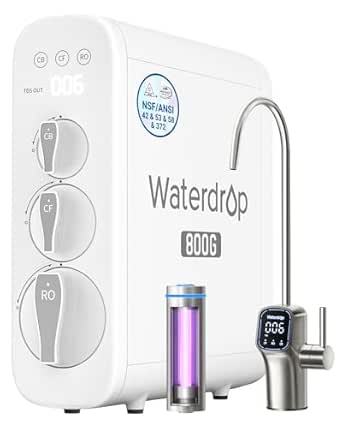 | Best for High Output and Water Efficiency | Filtration: 10-stage reverse osmosis | Capacity: 800 gallons per day | Pure-to-drain ratio: 3:1 | VIEW LATEST PRICE | See Our Full Breakdown |
| Waterdrop G2P600 Tankless Under-Sink Reverse Osmosis Water Filtration System, 600 GPD |  | Best for Straightforward Tankless Maintenance | Filtration: 7-stage reverse osmosis | Maximum flow rate: 25 milliliters per second | Pure-to-drain ratio: 2:1 | VIEW LATEST PRICE | See Our Full Breakdown |
| APEC Water ROES-PH75 6-Stage Alkaline Under-Sink Reverse Osmosis System |  | Best Tank-Based Pick for Remineralized Water | Filtration stages: 6 | Capacity: 75 gallons per day | Maximum flow rate: 0.05 gallons per minute | VIEW LATEST PRICE | See Our Full Breakdown |
| under sink reverse osmosis system | Dimensions | Filtration stages | Pure-to-drain ratio |
|---|---|---|---|
| Waterdrop G5P500A Tankless Rev | 16.69 × 5.69 × 13.9 in | — | 2:1 |
| iSpring RCC7-BN 5-Stage Under- | — | — | — |
| Waterdrop G3P600 Tankless Reve | 18.12 × 5.67 × 17.72 in | — | 2:1 |
| iSpring RCC7AK-BLK 6-Stage Alk | 15.5 × 16 × 18 in | 6 | — |
| iSpring RCC7AK-UV 7-Stage Reve | 15 × 8 × 18 in | 7 | — |
| Waterdrop T4-A Tankless Alkali | 16.54 × 6.22 × 17.95 inches | 10 | 2:1 |
| Waterdrop G6A6 Compact Alkalin | — | 8 | 2:1 |
| iSpring RCC7AK-BN 6-Stage Alka | 15.5 × 16 × 18 inches | 6 | — |
| Waterdrop T3-T Remineralizatio | 12.6 × 6.1 × 14.69 inches | — | 2:1 |
| GLACIER FRESH GFU03 Electric-F | 13.58 × 8.27 × 16.54 inches | 7 | 3:1 |
| Express Water RO5DX 5-Stage Un | 14 × 5 × 15 inches | 5 | — |
| APEC Water ROES-50 5-Stage Und | — | 5 | — |
| Waterdrop G3P800 Tankless Reve | 18.12 × 5.67 × 17.72 inches | — | 3:1 |
| Waterdrop G2P600 Tankless Unde | 17.3 × 5.9 × 14 inches | — | 2:1 |
| APEC Water ROES-PH75 6-Stage A | 15.5 × 5.25 × 17.5 inches | 6 | — |
More Details on Our Top Picks
Waterdrop G5P500A Tankless Reverse Osmosis System with Alkaline Mineralization
The G5P500A is a strong fit for buyers who want a tankless system without giving up remineralization. Its 500 GPD capacity and 2:1 pure-to-drain ratio pair everyday output with less wastewater than many conventional tank-style setups. The alkaline stage adds calcium, magnesium, sodium, and potassium, a useful distinction from the Waterdrop G3P600, which instead emphasizes a smart faucet with TDS and filter-life readings. This model also has a smaller listed footprint than the G3P600, though both need a powered connection under the sink. The tradeoff is installation flexibility: the included faucet requires countertop drilling, and a corded outlet is necessary. I’d choose it for a balanced tankless setup, but not for a kitchen where drilling or power access is a problem.
Pros:- Tankless design leaves more cabinet room than a system with a storage tank.
- Alkaline stage adds calcium, magnesium, sodium, and potassium.
- 500 GPD capacity and 2:1 pure-to-drain ratio support steady household use.
- Can connect to refrigerators and ice makers.
Cons:- Faucet installation requires drilling the countertop.
- Needs a corded electrical connection under the sink.
- A 1-year warranty offers less stated coverage than buyers seeking longer-term protection may prefer.
Best for: Households seeking a tankless RO system with added minerals, a compact under-sink footprint, and refrigerator or ice-maker connection capability.
Not ideal for: Renters or homeowners who cannot drill a faucet hole or provide a corded electrical connection under the sink.
- Filtration:8-stage reverse osmosis
- RO membrane pore size:0.0001 μm
- Capacity:500 GPD
- Pure-to-drain ratio:2:1
- Maximum flow rate:1.31 liters per minute
- Dimensions:16.69 × 5.69 × 13.9 in
- Certifications:NSF/ANSI 58 and 372
- Installation and power:Under sink; countertop faucet drilling required; corded electric
Our verdict“Choose the G5P500A for a space-conscious, remineralizing tankless system, provided you have power and can drill for its faucet.”
iSpring RCC7-BN 5-Stage Under-Sink Reverse Osmosis Water Filter System with Brushed Nickel Faucet
The RCC7-BN is the straightforward choice for kitchens where an electrical outlet under the sink is unavailable or unwanted. Its five-stage RO layout and NSF/ANSI 58 certification offer a conventional, tank-based alternative to powered tankless models such as the Waterdrop G3P600. A transparent first-stage housing makes it easier to check sediment buildup, while the brushed nickel faucet gives the installation a coordinated finish. The compromise is capacity: at 75 GPD, it has a much lower stated production rate than the Waterdrop systems, and the included tank takes up cabinet space. The plastic construction may also be less appealing to buyers seeking a more premium-feeling setup. I’d favor it for practical, no-power filtration rather than high output or a minimalist cabinet.
Pros:- Requires no power source.
- NSF/ANSI 58 certified.
- Transparent first-stage housing allows visual filter inspection.
- Includes a lead-free brushed nickel faucet.
Cons:- The included storage tank occupies additional under-sink space.
- 75 GPD capacity is lower than the tankless Waterdrop options in this roundup.
- Plastic construction may not suit buyers seeking more substantial materials.
Best for: Homeowners who want certified, conventional RO filtration and a matching faucet without needing an electrical connection.
Not ideal for: Buyers with limited cabinet space or households prioritizing high daily output and a tankless design.
- Model:RCC7-BN
- Filtration:5-stage reverse osmosis
- Capacity:75 GPD
- Certification:NSF/ANSI 58
- Contaminant reduction:Up to 99% of more than 1,000 listed contaminants
- TDS reduction:80–90%
- Faucet:100% lead-free, brushed nickel
- Power:No power source required
Our verdict“Pick the RCC7-BN if you want a certified, no-power RO system and have room for its storage tank.”
Waterdrop G3P600 Tankless Reverse Osmosis Water Filter System with Silver Faucet
The G3P600 makes the most sense for buyers who want system feedback at the faucet rather than a mineral boost. Its smart faucet displays TDS and filter life, giving users a quick way to check water readings and plan replacements. The tankless design and 600 GPD capacity also make it a higher-output option than the G5P500A, although the G5P500A adds alkaline minerals and has smaller listed dimensions. Compared with the tank-based iSpring RCC7-BN, the G3P600 saves the space a storage tank would use, but requires under-sink electricity and still needs room for its 18.12 × 5.67 × 17.72-inch body. Tool-free filter changes are a practical plus; the tradeoff is dependence on power and a larger cabinet footprint than its narrow width suggests.
Pros:- Smart faucet shows TDS and filter-life information.
- 600 GPD capacity exceeds the G5P500A’s stated 500 GPD.
- Tankless construction avoids a separate storage tank.
- Filters are designed for tool-free replacement.
Cons:- Requires a corded electrical connection under the sink.
- Its 17.72-inch height can be difficult to fit in some cabinets.
- Does not include the alkaline mineralization feature found on the G5P500A.
Best for: Households that want tankless high-capacity filtration with faucet-level TDS and filter-life information.
Not ideal for: People without an under-sink outlet or with a short cabinet that cannot accommodate the system’s 17.72-inch height.
- Filtration:8-stage
- Certifications:NSF/ANSI 42, 58, and 372; FCC
- Daily capacity:600 gallons
- Pure-to-drain ratio:2:1
- Maximum flow rate:0.42 gpm
- Dimensions:18.12 × 5.67 × 17.72 in
- Maximum supported water TDS:1500 ppm
- Power and filter replacement:Corded electric; tool-free replacement
Our verdict“Choose the G3P600 for tankless output and at-a-glance filter information, not for remineralization or an unpowered installation.”
iSpring RCC7AK-BLK 6-Stage Alkaline Reverse Osmosis Water Filtration System with Black Faucet
The RCC7AK-BLK suits buyers who prefer a familiar under-sink RO layout with an added alkalinity-restoring mineral stage. Its transparent first-stage housing provides a simple visual check on filter condition, unlike the G3P600’s faucet-based electronic monitoring. It also includes quick-fitting connectors, which may make plumbing connections more approachable for a capable DIY installer. Against the Waterdrop G5P500A, this iSpring is a traditional system rather than a high-capacity tankless unit, so it takes more cabinet space and has a stated 75-gallon capacity. The listing also calls for AC power, which limits its appeal where no outlet is available. I’d pick it for a mineralized-water preference and visible filter inspection, but skip it if cabinet space or a tankless form is the priority.
Pros:- Six-stage filtration includes an alkalinity-restoring mineral filter.
- NSF/ANSI 58 certified.
- Transparent first-stage housing makes filter condition easier to inspect.
- Quick-fitting connectors are designed to simplify installation.
Cons:- Requires under-sink cabinet space for the system.
- Requires an AC power source.
- Its stated 75-gallon capacity is far below the tankless Waterdrop options’ listed daily capacities.
Best for: DIY-minded households that want alkaline remineralization, a black faucet, and a visible first-stage filter housing.
Not ideal for: Buyers short on under-sink space or seeking the higher capacity and tankless layout of the Waterdrop G5P500A.
- Model:RCC7AK-BLK
- Filtration stages:6
- Purification method:Reverse osmosis
- Certification:NSF/ANSI 58
- Contaminant reduction:Up to 99% of more than 1,000 contaminants
- Capacity:75 gallons
- Dimensions:15.5 × 16 × 18 in
- Power source:AC
Our verdict“Choose the RCC7AK-BLK if alkaline remineralization and simple visual filter checks matter more than a compact tankless setup.”
iSpring RCC7AK-UV 7-Stage Reverse Osmosis Water Filter System with Alkaline and LED UV, Patented Top-Mounted Faucet Design
The RCC7AK-UV is the most layered choice here: it combines reverse osmosis, alkaline remineralization, and LED UV treatment in a tank-based system. The UV stage is its key distinction from the RCC7AK-BLK, which also restores alkalinity but does not list UV treatment. Its top-mounted faucet design is another practical difference, since it is intended to make countertop installation easier than reaching beneath the sink to secure a faucet. The added stages come with more constraints, though: it needs corded power and at least 45 psi of feed pressure for the recommended operating range. Low-pressure homes may need a booster pump. Like the iSpring RCC7-BN, it has a 75 GPD production rate and a storage tank, so it is a less space-efficient choice than either Waterdrop tankless model.
Pros:- Combines RO filtration, alkaline mineralization, and LED UV treatment.
- NSF/ANSI 58 and 372 certified as a whole system.
- Top-mounted faucet design is intended to simplify countertop installation.
- UV lamp activates when water flows, according to the product information.
Cons:- Recommended minimum feed pressure is 45 psi; lower-pressure homes may need a booster pump.
- Requires corded electricity for the UV stage.
- Its tank-based design takes more cabinet room than the Waterdrop G3P600 or G5P500A.
Best for: Households that specifically want RO filtration, alkaline mineralization, and an LED UV stage in one under-sink system.
Not ideal for: Homes with low water pressure, no under-sink power, or limited cabinet space for a system with a storage tank.
- Filtration stages:7
- Daily production capacity:75 gallons per day
- Tank capacity:3.2 gallons
- Certification:NSF/ANSI 58 and 372
- Feed water pressure:40–95 psi; recommended minimum 45 psi
- Supported water TDS maximum:750 ppm
- Dimensions:15 × 8 × 18 in
- UV lamp:11 W LED UV
Our verdict“Choose the RCC7AK-UV if UV treatment is a priority and your home has adequate pressure, power, and room for a tank-based system.”
Waterdrop T4-A Tankless Alkaline Mineral Reverse Osmosis System
The Waterdrop T4-A earns its place for households that want a choice between standard RO water and alkaline mineral-enhanced water, rather than a single treated-water profile. Its 10-stage filtration and 450 GPD capacity suit regular kitchen use, while the tankless body frees cabinet space compared with the tank-equipped iSpring RCC7AK-BN. The stated 2:1 pure-to-drain ratio also gives it a more water-conscious profile than many traditional tank systems.
The tradeoff is installation flexibility: this unit needs an electrical connection and a drilled countertop hole for its faucet. Its NSF/ANSI 372 certification covers lead-free materials, not the full contaminant-reduction performance. Choose it for its dual water options and compact format; skip it if you want a non-electric setup or already have no suitable faucet opening.
Pros:- Offers separate standard purified and alkaline mineral-enhanced water options.
- Tankless design preserves more cabinet space than the tank-equipped iSpring RCC7AK-BN.
- 450 GPD capacity and a 2:1 pure-to-drain ratio support regular household use.
- Filter-life indicators and a buzzer alert users when replacement is due.
Cons:- Requires a plug-in electrical connection.
- Faucet installation requires drilling the countertop.
- NSF/ANSI 372 certification concerns lead-free materials rather than full system filtration performance.
Best for: Households that want both standard RO water and mineral-enhanced water from a tankless system, and have power and faucet-drilling access.
Not ideal for: Renters or homeowners avoiding countertop modifications, and kitchens without a suitable under-sink electrical connection.
- Filtration stages:10
- Capacity:450 gallons per day
- Pure-to-drain ratio:2:1
- Filter life:CF: 6 months; RO membrane: 24 months; CB: 12 months; alkaline mineralizer: 12 months
- Dimensions:16.54 × 6.22 × 17.95 inches
- Electrical requirement:Plug-in required
- Certification:NSF/ANSI 372
Our verdict“Choose the T4-A if you want two water options in a space-saving system and can accommodate its power and drilled-faucet requirements.”
Waterdrop G6A6 Compact Alkaline Mineral Reverse Osmosis System, 600 GPD
The Waterdrop G6A6 is the maintenance-focused pick: its twist-and-pull filters are designed to change in seconds, and built-in light and beep reminders make upkeep harder to overlook. That is a more hands-off routine than the scheduled filter replacement on the tank-equipped iSpring RCC7AK-BN. Its compact tankless layout and stated 600 GPD capacity also suit kitchens where storage space and steady water access matter.
The eight-stage system adds calcium, magnesium, sodium, and potassium, with balanced pH stated around 7.5. Its SGS testing and NSF/ANSI/CAN 372 certification address different claims: the former is cited for contaminant reduction, while the latter covers lead-free materials. Unlike the electric-free GLACIER FRESH GFU03, the G6A6 needs an outlet and must stay plugged in. Skip it if power is unavailable or if you prefer a system that does not add minerals.
Pros:- Twist-and-pull filters are designed for quick replacement.
- Light and beep reminders help track filter changes.
- Tankless format and 600 GPD stated capacity suit frequent kitchen use.
- Mineral infusion adds calcium, magnesium, sodium, and potassium.
Cons:- Requires an electrical outlet and must remain plugged in during use.
- Different filters have 6- and 24-month stated lifespans, creating more than one replacement schedule.
- NSF/ANSI/CAN 372 certification covers lead-free materials; contaminant reduction is described as SGS-tested.
Best for: Busy households that want a compact tankless system with quick filter changes, maintenance reminders, and mineral-infused water.
Not ideal for: Kitchens without an under-sink outlet, or buyers who want an electricity-free system or standard RO water without mineral infusion.
- Filtration stages:8
- Daily capacity:Up to 600 gallons
- RO membrane:0.0001 μm
- Pure-to-drain ratio:2:1
- Mineral infusion:Adds calcium, magnesium, sodium, and potassium
- Filter lifespan:G6RO-600: 24 months; G6CFA: 6 months
- Power requirement:Electrical outlet required; must remain plugged in
Our verdict“Pick the G6A6 if quick maintenance and mineralized water matter more than avoiding an electrical connection.”
iSpring RCC7AK-BN 6-Stage Alkaline Reverse Osmosis Water Filtration System, 75 GPD
The iSpring RCC7AK-BN takes the conventional route: a six-stage RO system with a storage tank, alkaline remineralization, and no electrical requirement. That makes it a practical alternative to tankless models such as the Waterdrop T4-A when an under-sink outlet is unavailable. Its stated NSF/ANSI 58 certification is a meaningful distinction in this lineup, while the transparent first-stage housing gives a visible cue for sediment buildup.
The tradeoff is cabinet space and slower stated capacity: at 75 GPD, it is not aimed at buyers seeking the higher listed output of the 600 GPD G6A6 or 800 GPD T3-T. The included brushed-nickel faucet, top-mounted fastener, and quick fittings can simplify setup, but this remains a tank-based installation with routine filter changes. Choose it for a certified, power-free setup; skip it if cabinet room is tight.
Pros:- NSF/ANSI 58 certification is specified for the system.
- Operates without an electrical connection.
- Alkaline stage adds minerals after RO filtration.
- Transparent first-stage housing helps users monitor visible filter buildup.
Cons:- Storage tank takes up under-sink cabinet space.
- 75 GPD capacity is lower than the stated capacities of the tankless Waterdrop systems in this batch.
- Filters require periodic replacement, with the listed cycle given as 6 months.
Best for: Buyers seeking an NSF/ANSI 58-certified, no-power RO system with a storage tank and alkaline remineralization.
Not ideal for: Small-cabinet kitchens or households that want tankless space savings and higher stated daily capacity.
- Filtration stages:6
- Maximum flow rate:284 liters per day
- Certification:NSF/ANSI 58
- Operating pressure:70 psi
- Maximum supported water TDS:750 ppm
- Dimensions:15.5 × 16 × 18 inches
- Power source:No power needed
- Included components:RO system, brushed-nickel faucet, storage tank, extra tool set
Our verdict“Choose the RCC7AK-BN if you want certified, power-free RO with remineralization and have room for its storage tank.”
Waterdrop T3-T Remineralization Reverse Osmosis System, 800 GPD
The Waterdrop T3-T stands out for pairing a compact format with a stated 800 GPD peak-flow equivalent and no electrical requirement. That combination separates it from the plug-in Waterdrop G6A6, which offers a lower stated capacity, and from the tank-based iSpring RCC7AK-BN, which gives up cabinet space. Seven-stage filtration and remineralization add potassium, calcium, sodium, and magnesium; the 2:1 pure-to-drain ratio is also a useful efficiency detail.
Do not treat the 800 GPD figure as a guaranteed household output: the listing describes it as peak flow under specific conditions, and actual flow varies with tank water level. The faucet also requires countertop drilling, and the stated maximum TDS is 500 ppm. Quick-change filters and NFC reminders reduce maintenance friction, but this is a better fit for buyers who can work within its installation and water-condition limits.
Pros:- Operates without an electrical connection.
- Compact design pairs with a stated 800 GPD peak-flow equivalent.
- Remineralization adds potassium, calcium, sodium, and magnesium.
- Twist-replacement filters and NFC reminders simplify maintenance.
Cons:- Actual flow varies with tank water level, so peak-flow capacity is not a guaranteed output.
- Faucet installation requires countertop drilling.
- Maximum supported TDS is listed as 500 ppm.
Best for: Households wanting a compact, power-free RO system with remineralization and high stated peak flow, provided their water and installation conditions fit.
Not ideal for: Buyers who need a predictable flow rate regardless of tank level, cannot drill a countertop, or have source water above the stated 500 ppm TDS limit.
- Filtration:7-stage reverse osmosis
- Flow rate:Up to 0.56 GPM; 800 GPD peak-flow equivalent
- Pure-to-drain ratio:2:1
- Power source:No power needed
- Operating pressure:43.5–87 psi
- Maximum supported TDS:500 ppm
- Filter life:CF: up to 6 months; CBM: up to 12 months; TRO: up to 24 months
- Dimensions:12.6 × 6.1 × 14.69 inches
Our verdict“Choose the T3-T for a compact, power-free system with remineralization, but only if its variable flow and drilling requirements work for your kitchen.”
GLACIER FRESH GFU03 Electric-Free Reverse Osmosis Water Filter, 800 GPD
The GLACIER FRESH GFU03 is the clearest choice here for buyers who want a tankless RO system without electricity and place extra weight on water efficiency. Its listed 3:1 pure-to-drain ratio compares favorably with the 2:1 ratios on the Waterdrop T4-A and T3-T. Seven filtration stages, a 0.0001 μm membrane, and listed NSF/ANSI 58, 372, and 401 certifications give it a different emphasis from the T3-T, whose listed testing and certification claims are narrower.
The tradeoff is its dependence on inlet pressure: the recommended minimum is 40 PSI, and flow can fall below that. The built-in pressure gauge helps reveal this constraint, while pull-out cartridges and tool-free connectors simplify service. Faucet installation still requires drilling a 1/2–1 inch sink hole, and the cabinet needs clearance for tubing and filter changes. Pick it for electric-free operation and its stated drain ratio, not for low-pressure plumbing.
Pros:- Water-powered tankless design does not need an electrical connection.
- Listed 3:1 pure-to-drain ratio uses less water than the 2:1 systems in this batch.
- Pressure gauge provides a visible way to check operating pressure.
- Pull-out cartridges and tool-free connectors simplify filter replacement and installation.
Cons:- Performance can drop below the recommended 40 PSI inlet pressure.
- Faucet installation requires drilling a 1/2–1 inch hole in the sink.
- Requires cabinet clearance for connections, tubing, and filter replacement.
Best for: Households with at least 40 PSI inlet pressure that want a tankless, electricity-free system and a 3:1 pure-to-drain ratio.
Not ideal for: Homes with low or fluctuating water pressure, or buyers unwilling to drill a sink hole or reserve cabinet clearance for servicing.
- Filtration stages:7
- Maximum flow rate:0.6 gpm
- Pure-to-drain ratio:3:1
- RO membrane pore size:0.0001 μm
- Recommended minimum inlet pressure:40 PSI
- Operating pressure range:0.25–0.7 MPa
- Certifications:NSF/ANSI 58, 372, and 401
- Dimensions:13.58 × 8.27 × 16.54 inches
Our verdict“Choose the GFU03 if you have adequate water pressure and want electric-free operation with a 3:1 pure-to-drain ratio.”
Express Water RO5DX 5-Stage Under-Sink Reverse Osmosis System, 50 GPD
The Express Water RO5DX is a practical choice for buyers who want a conventional tank-based RO setup with key installation parts bundled. Its storage tank, brass faucet, leak detector, and first-year filters make it more of a complete starting kit than the tankless Waterdrop G2P600, which trades stored water for a slimmer under-sink footprint. Quick-connect tubing and no electrical requirement can also suit kitchens without a convenient outlet. The tradeoff is a modest 50 GPD capacity and wastewater discharge of one to three gallons per gallon produced, depending on water conditions. Check household pressure and cabinet space before buying: some installations may need a booster pump, pressure regulator, or extra tubing. This is a stronger fit for buyers who value included hardware over high output or lower water waste.
Pros:- Includes a storage tank, faucet, leak detector, and filters for setup and first-year use.
- Does not require electricity.
- Quick-connect tubing is intended to simplify installation.
- Brass faucet and steel tank provide sturdier components than an all-plastic setup.
Cons:- Produces up to 50 gallons per day, less than the tankless Waterdrop G2P600 and G3P800.
- Discharges one to three gallons per gallon produced, depending on water conditions.
- Some installations may require a booster pump, pressure regulator, or additional tubing.
Best for: Households wanting a traditional tank-based system with a faucet, leak detector, and setup filters included, especially where an electrical outlet is not available.
Not ideal for: Buyers seeking high daily output, reduced wastewater, or a simple fit in a cabinet with limited room for a storage tank.
- Filtration stages:5
- Production capacity:50 gallons per day
- Storage tank:4 gallons; 3.2-gallon water capacity
- Operating pressure:40–80 psi
- Maximum supported TDS:300 ppm
- Dimensions:14 × 5 × 15 inches
- Power:No power required
- Included accessories:Faucet, leak detector, tank stand, filter housing wrench, tubing, and filters
Our verdict“Choose the RO5DX if you want a no-power, tank-based kit with installation accessories included and can accommodate its wastewater and cabinet-space demands.”
APEC Water ROES-50 5-Stage Under-Sink Reverse Osmosis System, 50 GPD
The APEC Water ROES-50 stands out for buyers whose incoming water has a higher TDS level than many systems in this group support: its stated maximum is 2,000 ppm, compared with 300 ppm for the Express Water RO5DX. Five-stage RO and activated-carbon filtration target contaminants including lead, chlorine, fluoride, and arsenic, while the included tank, brushed-nickel faucet, and installation kit create a familiar under-sink package. Colored tubing and quick-connect fittings can make connections easier to follow, though this remains a plumbed installation and the supplied information lists an AC power requirement. The 50 GPD rating is modest beside the Waterdrop G2P600 and G3P800, and filter replacement timing varies with water quality. Pick it for input-water tolerance and a conventional tank, not for tankless speed or reduced cabinet bulk.
Pros:- Supports input water up to 2,000 ppm TDS, higher than the Express Water RO5DX’s stated 300 ppm limit.
- Five-stage RO and activated-carbon filtration targets several named contaminants.
- Includes a storage tank, brushed-nickel faucet, filter set, and installation kit.
- Quick-connect fittings and colored tubing help identify installation connections.
Cons:- The 50 GPD capacity is far below the Waterdrop G2P600 and G3P800 ratings.
- Requires under-sink installation and an AC power source.
- Filter replacement intervals vary with incoming water quality.
Best for: Homeowners with higher-TDS source water who want a conventional five-stage system with a tank, faucet, and installation kit.
Not ideal for: Renters or buyers who cannot make an under-sink plumbing and electrical connection, or households prioritizing tankless design and high output.
- Filtration stages:5
- Maximum output:50 gallons per day
- Operating pressure:40–85 psi
- Maximum supported TDS:2,000 ppm
- Operating temperature:40–100 °F
- Filter replacement:Every 6–24 months, depending on incoming water quality
- Certifications:NSF/ANSI 372 and 58
- Included components:RO system, tank, filter set, brushed-nickel faucet, installation kit, and instructions
Our verdict“Choose the ROES-50 if higher supported source-water TDS and a complete tank-based kit matter more than tankless capacity.”
Waterdrop G3P800 Tankless Reverse Osmosis Water Filter System, 800 GPD
Among these five picks, the Waterdrop G3P800 is the clearest choice for households that want fast, tankless dispensing and a stated 3:1 pure-water-to-drain ratio. Its 800 GPD capacity is well above the 600 GPD Waterdrop G2P600 and the 50 GPD tank-based Express Water and APEC systems. That higher output can suit a busy kitchen without waiting for a storage tank to refill, while the smart faucet displays TDS and water-quality information at the point of use. The system also lists NSF/ANSI 42, 53, 58, and 372 certifications. Those advantages come with an electrical requirement and a larger listed footprint than the G2P600. Its maximum supported TDS is 500 ppm, so the APEC ROES-50 may be a better match for source water above that level.
Pros:- 800 GPD capacity exceeds the Waterdrop G2P600’s 600 GPD rating.
- Tankless design avoids reserving cabinet space for a storage tank.
- 3:1 pure-water-to-drain ratio is more water-efficient than the ratios listed for the tank-based Express Water RO5DX.
- Smart faucet shows TDS and water-quality information.
Cons:- Requires a corded electrical connection.
- Maximum supported TDS is 500 ppm, below the APEC ROES-50’s stated 2,000 ppm limit.
- Listed dimensions are larger than the Waterdrop G2P600’s, so cabinet measurements matter.
Best for: Busy households that want high dispensing capacity, a tankless cabinet layout, water-use efficiency, and TDS information at the faucet.
Not ideal for: Buyers without an under-sink outlet, those with source water above 500 ppm TDS, or kitchens where the listed system dimensions will not fit.
- Filtration:10-stage reverse osmosis
- Capacity:800 gallons per day
- Pure-to-drain ratio:3:1
- Certifications:NSF/ANSI 42, 53, 58, and 372
- Maximum supported TDS:500 ppm
- Faucet:Smart faucet with TDS display and LED
- Dimensions:18.12 × 5.67 × 17.72 inches
- Power:Corded electric
Our verdict“Choose the G3P800 for high-output tankless dispensing and a more favorable stated water ratio, provided your cabinet and electrical setup suit it.”
Waterdrop G2P600 Tankless Under-Sink Reverse Osmosis Water Filtration System, 600 GPD
The Waterdrop G2P600 offers a useful middle ground: it removes the storage tank and provides up to 600 GPD, but avoids the G3P800’s more elaborate smart faucet and higher stated capacity. Its twist-and-pull filters and replacement indicators are the differentiator for buyers who want routine maintenance to be more guided and less fiddly. The stated 2:1 pure-to-drain ratio is less favorable than the G3P800’s 3:1 ratio, yet it compares well with the Express Water RO5DX’s stated one-to-three-gallon discharge per gallon produced. The G2P600 also has NSF/ANSI 372 certification for lead-free materials, which is not the same as a broad contaminant-reduction certification. It needs electricity, supports up to 500 ppm TDS, and has a maximum water temperature of 87 °F.
Pros:- Tankless construction saves space compared with the Express Water RO5DX’s storage-tank arrangement.
- 600 GPD capacity is substantial for a household kitchen.
- Twist-and-pull filters and replacement indicators simplify upkeep.
- 2:1 pure-to-drain ratio is clearly stated and compares favorably with the Express Water RO5DX’s variable discharge description.
Cons:- Requires a corded electrical connection.
- Maximum supported TDS is 500 ppm, below the APEC ROES-50’s stated 2,000 ppm limit.
- Maximum water temperature is 87 °F, and the listed certification is NSF/ANSI 372 for lead-free materials.
Best for: People who want a tankless system with guided filter changes and substantial capacity but do not need the G3P800’s 800 GPD rating or smart TDS faucet.
Not ideal for: Households needing a system certified to a broader set of contaminant standards, a higher supported TDS limit, or operation above 87 °F.
- Filtration:7-stage reverse osmosis
- Maximum flow rate:25 milliliters per second
- Pure-to-drain ratio:2:1
- Maximum supported TDS:500 ppm
- Maximum water temperature:87 °F
- Certification:NSF/ANSI 372
- Dimensions:17.3 × 5.9 × 14 inches
- Power:Corded electric
Our verdict“Choose the G2P600 if you want tankless capacity and easy-to-manage filter changes without paying for the G3P800’s higher output and smart faucet features.”
APEC Water ROES-PH75 6-Stage Alkaline Under-Sink Reverse Osmosis System
The APEC Water ROES-PH75 is the tank-based choice here for buyers who want a mineral cartridge after reverse osmosis. Its sixth-stage calcium cartridge adds minerals and is designed to enhance alkalinity, a feature absent from the five-stage APEC ROES-50 and Express Water RO5DX. With a stated 75 GPD capacity, it also offers more daily production than those 50 GPD systems, although it remains far below the tankless Waterdrop G2P600 and G3P800 ratings. The package includes the tank, faucet, tubing, and installation accessories, and its listed certifications include WQA certification and NSF 372 and 58. The compromises are a conventional under-sink tank footprint, a required 40–85 psi feed pressure, and a maximum flow rate of just 0.05 gpm. Choose it for remineralization, not rapid dispensing.
Pros:- Six-stage design includes a calcium mineral cartridge for added minerals and enhanced alkalinity.
- 75 GPD capacity exceeds the 50 GPD Express Water RO5DX and APEC ROES-50.
- Includes a tank, faucet, tubing, drain saddle, feed-water adapter, and wrenches.
- Lists WQA certification and NSF 372 and 58.
Cons:- Maximum flow rate is 0.05 gpm, below the tankless Waterdrop systems’ stated flow rates.
- Requires 40–85 psi feed-water pressure.
- Tank-based design takes more under-sink room than the Waterdrop G2P600 or G3P800.
Best for: Buyers who prefer a conventional tank-based RO system and want a calcium mineral stage to add minerals and enhance alkalinity.
Not ideal for: Households prioritizing fast faucet flow, tankless storage savings, or installation where feed pressure falls outside 40–85 psi.
- Filtration stages:6
- Capacity:75 gallons per day
- Maximum flow rate:0.05 gallons per minute
- Operating pressure:40–85 psi
- Maximum supported TDS:2,000 ppm
- Dimensions:15.5 × 5.25 × 17.5 inches
- Certifications:WQA certified; NSF 372 and 58
- Included components:Filter set, tank, faucet, tubing, drain saddle, feed-water adapter, and wrenches
Our verdict“Choose the ROES-PH75 if a mineral stage and included tank-based installation hardware matter more than quick flow or a compact tankless layout.”
How We Picked
I compared these 15 under-sink RO systems by how well their designs fit common kitchen needs: stated production capacity, tankless versus tank-based layout, treatment stages, remineralization or UV additions, and the practical demands of installation and upkeep. I also looked at whether a model’s stated features solve a clear buyer problem, such as limited cabinet space, a preference for remineralized water, or a desire for a conventional setup.
The ranking favors options with a clear use case and a useful balance of performance claims, installation footprint, and treatment features—not the longest feature list. Tankless models rank well for capacity and saved cabinet space, but their power needs and model-specific parts count against them for some households. Conventional systems remain strong picks for buyers who want established tank-and-filter layouts, though their lower stated output and storage footprint make them less suited to every kitchen. Because the product list does not provide independent test results, I treat advertised capacities as specifications rather than verified household output.
Factors to Consider When Choosing Under Sink Reverse Osmosis Systems
Choosing an RO system is as much a fit-and-maintenance decision as a filtration decision. I’d start with your sink cabinet, water use, and willingness to manage replacement parts; then compare treatment add-ons only if they address a preference you actually have.
Tankless or Tank-Based: Start With Cabinet Space and Power
A tankless system can leave more room beneath the sink, which matters if the cabinet already holds a disposal, cleaning supplies, or a pull-out bin. That space saving comes with a requirement: powered units need an electrical connection, so check outlet access before buying. Tank-based systems occupy more room but store treated water, which can suit kitchens where a powered unit is awkward to install. Don’t compare tankless and tank-based models by GPD alone; the figure is a rated daily capacity, not a promise of a particular glass-filling speed. Water pressure, temperature, and household demand affect what you get at the tap. Measure the cabinet and trace the route from water supply to drain before choosing a format.
Read Capacity as a Comparison Point, Not a Guarantee
The product list ranges from systems stating 50 GPD to tankless models listing 800 GPD, but those numbers come from differing designs and rating conditions. A larger figure can be useful for a busy household or frequent cooking, yet it does not by itself establish better filtration or better-tasting water. Ask whether the manufacturer specifies operating pressure and other conditions behind the rated output, and compare those details across models when available. A smaller household may value a compact setup or familiar maintenance more than maximum rated production. If your water pressure is low, find out whether the system needs a booster pump or has pressure requirements that your plumbing can meet. Avoid paying extra for capacity you are unlikely to use.
Choose Remineralization and UV for a Reason
Reverse osmosis removes many dissolved substances, and some buyers prefer a system that adds minerals back to the treated water for taste. The lineup includes alkaline or remineralization stages from Waterdrop, iSpring, and APEC, but those additions bring another component to maintain. Taste is personal, so an alkaline stage should be a preference-based choice rather than an assumed improvement. UV treatment is a separate feature: it may appeal to buyers with a specific concern about microbial treatment, but it does not replace an RO membrane or good installation practices. Check what the manufacturer says each stage targets and how often its cartridge or lamp needs replacement. A simpler system can be the better fit if you do not want extra parts or upkeep.
Check Filters, Replacement Intervals, and Long-Term Availability
Before choosing a system, identify every replacement filter and confirm that the correct parts are available for the exact model number. Some systems use more specialized cartridges, while conventional multi-stage designs may be easier for buyers to understand and maintain. Compare the stated replacement schedule and required components, including the membrane, post-filters, and any UV lamp or mineral cartridge. A low-maintenance claim is only useful if the parts are easy for you to source and change. Also check whether replacing a filter requires shutting off the water, depressurizing a tank, or accessing a tight cabinet. Build the maintenance routine into your decision, rather than treating it as an afterthought.
Plan the Installation Before Ordering
Under-sink systems need more than an open patch of cabinet floor: they connect to a cold-water line, a drain, and a dedicated drinking-water faucet or compatible fixture. Tankless electric units add an outlet requirement, while some traditional systems need room for both the filter assembly and storage tank. Faucet finishes in this roundup can help with kitchen coordination, but confirm the faucet-hole size and whether your sink already has an available opening. Renters should check whether drilling or plumbing changes are allowed. If you plan to hire an installer, ask in advance whether the chosen model requires any special fittings or electrical work. A quick measurement and installation check can prevent a mismatch that product specifications alone won’t reveal.
Match the Treatment Claim to Your Water and Household
RO systems are not all-purpose answers to every water concern, and stage count alone does not prove that a model addresses a particular contaminant. Start with a recent water report or, for a private well, a suitable lab test; then check the system’s documentation for the specific substances it is certified or designed to reduce. Don’t assume that alkaline, UV, or an extra filter stage covers a concern unless the manufacturer’s performance information supports that claim. Households with changing water conditions may need more frequent testing and filter attention. If your main goal is taste, a standard RO system may be enough; if you have a defined treatment concern, choose based on documented performance for that concern. This approach avoids buying add-ons that do not match your actual water.
Frequently Asked Questions
Should I choose a tankless RO system or a tank-based one?
Choose tankless if saving cabinet space and having a high stated production capacity matter, and if you have a nearby electrical outlet. A tank-based model may suit you better if you want a conventional layout or cannot power a unit beneath the sink. The Waterdrop G-series options represent the tankless side of this roundup, while the APEC ROES-50 and iSpring RCC7 models are conventional choices. Compare the complete installation requirements, not just the unit dimensions. Your water pressure and household demand also affect how well either format fits your routine.
Does a higher GPD rating mean water will come out of the faucet faster?
Not necessarily: GPD is a rated daily production figure, not a direct measurement of faucet flow in your kitchen. Actual output can vary with water pressure, temperature, and the system’s operating conditions. The lineup’s 600–800 GPD tankless models have higher stated capacity than the 50 GPD APEC ROES-50 and Express Water RO5DX, but those figures should be compared alongside each model’s rating conditions. If quick access to water is a priority, check whether a tank stores treated water or whether a tankless model has a specified flow rate. Avoid choosing by GPD alone.
Is remineralization worth choosing if I mainly care about taste?
It may be, if you prefer the taste of water after minerals are added back, but taste is subjective and the feature is not required for every buyer. This roundup includes alkaline options such as the iSpring RCC7AK models, APEC ROES-PH75, and several Waterdrop systems, alongside standard RO choices. A remineralization stage adds a cartridge and a replacement task, so factor that into upkeep. If you have not tried remineralized RO water, consider whether the taste preference is strong enough to justify the extra stage. Check the product documentation for exactly what the stage adds and how it is maintained.
Can I install an under-sink RO system without an electrician or plumber?
Some homeowners can install a conventional system with basic plumbing skills, but the task still involves a water connection, drain connection, and faucet. Tankless models in this roundup require electricity, so an outlet must be available or installed appropriately. A system that needs drilling, unusual fittings, or work on a difficult-to-reach water line may call for professional help. Renters should get permission before modifying a sink or cabinet. Read the exact installation instructions for the model you select before deciding whether a do-it-yourself installation is realistic.
How do I choose an RO system for a private well or a specific contaminant concern?
Start with a current lab test of the well water rather than selecting a system based on stage count or broad marketing language. Then match the test results to the manufacturer’s documented reduction claims or certifications for the exact model. UV or alkaline treatment should not be treated as a substitute for evidence that the system addresses your particular concern. Private wells may also need pretreatment if sediment or other conditions could affect the RO membrane. Ask the manufacturer or a qualified water professional about compatibility before purchase, and plan to retest the water as recommended for your well.
Conclusion
For a balanced pick, I’d start with the Waterdrop G3P600 as best overall among the listed models, particularly for buyers who want a tankless design and a stated 600 GPD capacity. The APEC ROES-50 is my best value-style choice for shoppers who prefer a straightforward, tank-based five-stage system, while the Waterdrop G3P800 is the premium-leaning option for buyers prioritizing a higher stated tankless capacity. Beginners may find the conventional iSpring RCC7-BN easier to evaluate because it avoids alkaline and UV add-ons. For specific needs, choose the iSpring RCC7AK-UV if you want alkaline treatment plus UV, or a Waterdrop compact alkaline model if cabinet space and remineralization guide your choice. Before ordering, confirm fit, power access, replacement-filter availability, and suitability for your water.