
TL;DR

Get home appliances delivered free with Prime
- Fast, free delivery on millions of items
- Prime Video, Amazon Music and more included
- Member-only deals all year
Apple and Amazon have introduced smart displays that, based on a brief hands-on review, may work better as shared household screens than earlier models. The HomeView costs $299 and is closely tied to the iPhone, while Amazon’s $499.99 Echo Show 16 is designed to serve a household without requiring a phone. Their everyday performance and the strength of their shared-use features remain untested.
Apple and Amazon have launched new smart displays that could serve as shared household screens, according to a hands-on report by The Verge, which found that the $299 Apple HomeView and $499.99 Amazon Echo Show 16 pair stronger hardware with features for calendars, smart-home controls and family routines. The reviewer said the devices may give the category a clearer purpose, but stressed that both need proper testing before their everyday usefulness is established.
The two launches address a weakness the reviewer says has held smart displays back: earlier products combined a touchscreen with a smart speaker but often had underpowered hardware and software that tried to do too much. The new models bring more capable components to the category. Apple’s HomeView uses an A18 chip and Liquid Retina display; Amazon’s Echo Show 16 has a MediaTek processor and the Nanomatte display used in its new Alexa Tablet.
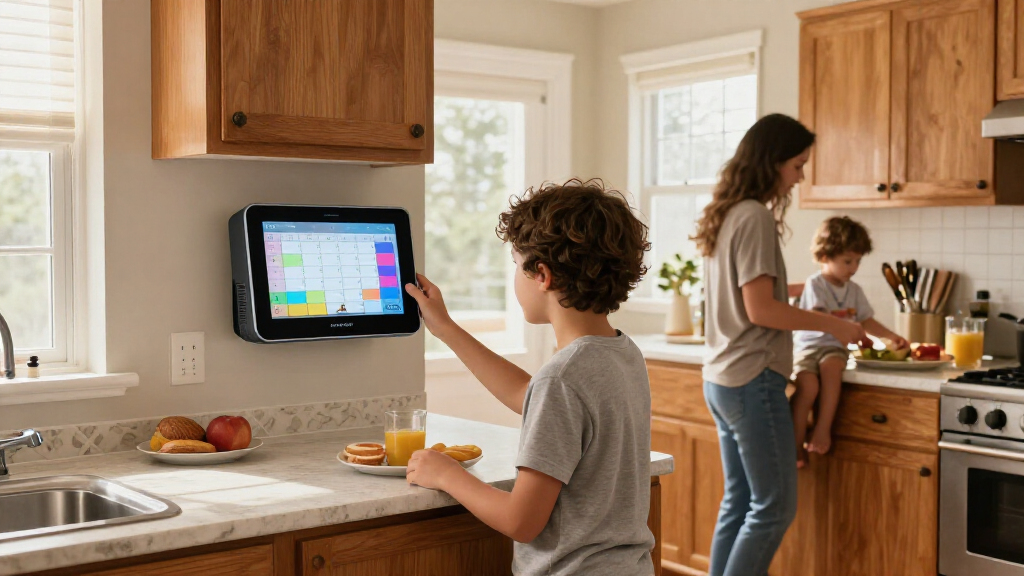
Their intended role is not to replace a laptop for homework or bill payments. Instead, the reviewer describes them as communal household devices for checking a calendar, viewing a doorbell camera, managing lights or working out dinner plans. Both are designed to remain accessible as shared screens rather than tablets that need to be picked up, unlocked and returned to a charger.
The main difference is how they connect household information. Amazon’s Echo Show 16 is presented as a device that can work for the household without a phone, although a phone can help with setup. Apple’s HomeView is more dependent on the iPhone: its communal functions exist, but the report says some of its more personalized features rely on a nearby phone and facial recognition. Those observations come from a brief hands-on session, not a full review.
A household screen could bring calendars, shopping lists, meal planning and smart-home controls into a shared place, rather than leaving them scattered across one family member’s phone. That matters because daily household coordination often depends on information that everyone needs but may be stored on just one person’s device.
The launch also tests whether buyers will pay more for a display with a defined family role. The HomeView starts at $299, and the Echo Show 16 at $499.99. The report compares those prices with 2023 entry models: an Echo Show 5 at $85 and a Nest Hub at $99. The new devices cost substantially more, so their value depends on whether their hardware and software prove useful beyond voice-assistant tasks.
Products Worth Considering

Samsung 85-Inch QN70H Neo QLED 4K Smart TV (2026)

TCL QM64L 85-Inch QD-Mini LED 4K Smart Fire TV

Sony BRAVIA 5 85-Inch Mini LED 4K HDR Smart TV (K-85XR50)
As an affiliate, we earn on qualifying purchases.
From Smart Speaker to Family Hub
The reviewer says that three years ago they argued the smart-display category had stalled, with products that struggled to deliver a useful combination of screen, assistant and household functions. Their earlier assessment set out improvements they wanted: stronger hardware, an interface suited to multiple users and a screen that stays ready for quick interaction.
Tablets have offered one alternative, but the report points to two practical drawbacks: limited multiuser support and the risk that a portable, battery-powered device will be moved away from its shared location. The reviewer says a Google Pixel Tablet used as a smart display also had limited smart-home support in their home; Google reportedly canceled its successor 18 months later. The report cites the popularity of Skylight Calendar devices as evidence of demand for shared household screens, without claiming that the new products have already proved successful.
“These could finally turn the smart display into what it should have been all along: the family computer.”
— The Verge reviewer
Everyday Performance Still Untested
The source report does not establish how reliably either device will work in daily use. The reviewer had only brief hands-on time and says full testing is needed, leaving questions about performance, multiuser access and whether the interfaces are genuinely easy for everyone in a household.
It is also unclear how much of HomeView’s most useful functionality will require an iPhone nearby, or whether Amazon’s household-focused approach will provide enough personalization without the same personal context. The report describes demonstrations, including Apple’s use of messages to anticipate a visitor and Amazon’s Ring-camera view of someone approaching a home; these are demonstrated capabilities, not independent confirmation of how they will perform across real homes. Long-term value at the listed prices has not been established.
Full Reviews Will Test the Promise
The next useful measure will be full testing of both devices in ordinary homes. That can show whether their shared screens and household features are easy to use day after day, how their personalization and phone requirements work in practice, and whether their displays remain useful when no one is actively asking a voice assistant for help.
Until those tests are available, the confirmed development is the launch of two higher-priced smart displays with more capable hardware and distinct approaches to household use. Whether either becomes a dependable family hub, rather than another screen with features that are rarely used, remains an open question.
Key Questions
What are the Apple HomeView and Amazon Echo Show 16?
They are newly launched smart displays intended to combine a screen and voice assistant with household functions such as calendars, smart-home controls and camera access.
How much do the two devices cost?
The HomeView is listed at $299. The Echo Show 16 is listed at $499.99, according to the source report.
Do they work the same way?
No. The report describes Amazon’s device as designed for household use without requiring a phone. Apple’s HomeView is more closely tied to the iPhone, and some personalized functions appear to rely on a nearby phone and facial recognition.
Have reviewers confirmed that they work well as family computers?
No. The reviewer had brief hands-on access and said full testing was still needed. The phrase “family computer” refers to a shared screen for household coordination, not a substitute for a laptop used for schoolwork or bills.
Source: theverge.com