
The right smart water leak detector can mean the difference between a $50 cleanup and a flooded basement, but the category splits into two very different approaches: affordable sensor packs that alert you, and premium systems like the Moen Flo Shutoff that automatically cut your water supply. My overall pick is the GoveeLife Upgraded 6-Pack, which balances Wi-Fi alerts, a loud local alarm, and broad coverage for multi-room protection at a sensible cost. For serious protection, the Moen Flo 900-001 is the only option here that stops the leak, not just reports it, while the YoLink 6-Pack + Hub stands out for long-range coverage in larger homes. The main tradeoff you’ll face is cost and installation complexity versus how much damage the system can actually prevent. Keep reading for the full breakdown of all fifteen detectors.

Get home appliances delivered free with Prime
- Fast, free delivery on millions of items
- Prime Video, Amazon Music and more included
- Member-only deals all year
Complete the kit


Key Takeaways
- The roundup revealed a clear two-tier market: sub-$50 sensor packs from GoveeLife, TECKNET, and X-Sense handle alerts well, but only the Moen Flo 900-001 can physically shut off water — a feature no other product in this lineup offers.
- Hub-based systems (YoLink, Tapo, X-Sense, SwitchBot) consistently delivered longer range and better battery life than direct Wi-Fi sensors like the D-Link and Kidde, making them the better pick for large or multi-floor homes.
- GoveeLife dominates on variety, with four different pack sizes reviewed — the 6-Pack emerged as the sweet spot because leak-prone spots (water heater, washer, sinks, toilets) rarely number fewer than four.
- Add-on-only products like the X-Sense 3-Pack (no base station) are traps for first-time buyers unless you already own the matching ecosystem — check compatibility before assuming a kit is complete.
- The Kidde and SwitchBot models add freeze detection and extended cable probes respectively, features that matter in cold climates or under appliances where a puck sensor can’t reach the drip point.
| GoveeLife Upgraded Smart Water Leak Detector 3 Pack |  | Best Overall | Connectivity: Sub-1G long-range wireless, up to 1,804 feet | Alarm Volume: Up to 105 dB, 4 adjustable levels | Battery Life: Up to 5 years | VIEW LATEST PRICE | See Our Full Breakdown |
| GoveeLife Upgraded Smart Water Leak Detector 6 Pack |  | Best for Whole-Home Coverage | Connectivity: Sub-1G wireless, up to 1,804 ft | Alarm Volume: Up to 105 dB, 4 levels plus silent mode | Battery Life: 5 years | VIEW LATEST PRICE | See Our Full Breakdown |
| Moen Flo Shutoff, 3/4″ Automatic Water Leak Detector & Shutoff, 900-001 |  | Best Premium / Active Protection | Model Number: 900-001 | Connection Size: 3/4 inch | Installation: In-line on main water line (professional recommended) | VIEW LATEST PRICE | See Our Full Breakdown |
| TECKNET Wi-Fi Water Leak Detector Kit with 5 Sensors and Gateway |  | Best Value Multi-Sensor Kit | Connectivity: Wi-Fi 2.4 GHz via included gateway | Sensors Included: 5 | Sensor Probes: 2 top, 4 bottom per sensor | VIEW LATEST PRICE | See Our Full Breakdown |
| X-Sense Wi-Fi Water Leak Detector 3-Pack Add-On (Base Station Not Included) |  | Best for Expanding an Existing System | Includes: 3 sensors (base station not included) | Compatibility: Requires X-Sense base station, sold separately | Wi-Fi Frequency: 2.4 GHz only | VIEW LATEST PRICE | See Our Full Breakdown |
| YoLink Water Leak Sensor 4, 105 dB Alarm Kit: 6-Pack + Hub |  | Best for Large Properties | Number of Sensors: 6 | Alarm Volume: 105 dB | Connectivity: LoRa (long-range) | VIEW LATEST PRICE | See Our Full Breakdown |
| GoveeLife Upgraded Smart Water Leak Detector 1s (5 Pack) |  | Best Multi-Channel Alerts | Number of Sensors: 5 | Connectivity: Long-range wireless via gateway | Maximum Range: 1,804 ft (550 m) | VIEW LATEST PRICE | See Our Full Breakdown |
| SwitchBot WiFi Water Leak Detector for Home, 1m Cable |  | Best No-Hub Single Sensor | Hub Required: No | Probe Length: 1 m water level probe | Alarm Volume: 100 dB | VIEW LATEST PRICE | See Our Full Breakdown |
| D-Link WiFi Water Leak Detector Starter Kit with 2 Flood & Leak Sensors |  | Best Starter Kit for Beginners | Includes: 1 master unit, 2 sensors | Sensor Cable: 1.5 ft with 3 ft extension | Expandability: Up to 17 zones | VIEW LATEST PRICE | See Our Full Breakdown |
| X-Sense Wi-Fi Water Leak Detector Kit, 3 Sensors + Base, SWS54 | 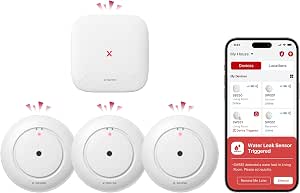 | Loudest Alarm | Detection Probes: 6 (2 upper, 4 bottom) | Alarm Volume: 120 dB (dual alarms) | Number of Sensors: 3 plus base station | VIEW LATEST PRICE | See Our Full Breakdown |
| Kidde WiFi Water Leak Detector & Freeze Alarm with App Alerts |  | Best for Freeze + Leak Combo Protection | Power: 2 AA batteries (included) | Detection: Water leaks and freezing at 37°F or rapid temperature drops | Connectivity: WiFi, no hub required | VIEW LATEST PRICE | See Our Full Breakdown |
| Tapo Smart Water Leak Detector with Hub |  | Best Hub-Based Pick for Speed | Sensor Probes: Dual-side detection | Detection Speed: Within 1 second | Alarm Volume: 90 dB | VIEW LATEST PRICE | See Our Full Breakdown |
| TECKNET WiFi Water Leak Detector with App Alerts |  | Loudest Standalone Pick | Detection Method: Multiple sensors (2 top, 4 bottom) | Alarm Volume: 120dB adjustable | Connectivity: 2.4GHz WiFi only, no hub | VIEW LATEST PRICE | See Our Full Breakdown |
| GoveeLife Upgraded Smart Water Leak Detector 4 Pack |  | Best Whole-Home Coverage Value | Connectivity: Sub-1G long-range wireless to gateway | Range: Up to 1804 feet | Alarm Volume: Up to 105 dB, adjustable | VIEW LATEST PRICE | See Our Full Breakdown |
| Aqara Water Leak Sensor 3 Pack |  | Best for Smart Home Integrators | Detection Sensitivity: 0.5mm water level | Connectivity: Zigbee | Power: Battery (remove tab before use) | VIEW LATEST PRICE | See Our Full Breakdown |
| smart water leak detector | Connectivity | Alarm Volume | Battery Life |
|---|---|---|---|
| GoveeLife Upgraded Smart Water | Sub-1G long-range wireless, up to 1,804 feet | Up to 105 dB, 4 adjustable levels | Up to 5 years |
| GoveeLife Upgraded Smart Water | Sub-1G wireless, up to 1,804 ft | Up to 105 dB, 4 levels plus silent mode | 5 years |
| Moen Flo Shutoff | Wi-Fi required | — | — |
| TECKNET Wi-Fi Water Leak Detec | Wi-Fi 2.4 GHz via included gateway | Up to 120 dB | Over 2 years |
| X-Sense Wi-Fi Water Leak Detec | — | Up to 120 dB | — |
| YoLink Water Leak Sensor 4 | LoRa (long-range) | 105 dB | Up to 5 years |
| GoveeLife Upgraded Smart Water | Long-range wireless via gateway | Up to 105 dB | 5 years |
| SwitchBot WiFi Water Leak Dete | — | 100 dB | Up to 2 years (1 A battery, included) |
| D-Link WiFi Water Leak Detecto | Wi-Fi, Bluetooth | — | — |
| X-Sense Wi-Fi Water Leak Detec | — | 120 dB (dual alarms) | — |
| Kidde WiFi Water Leak Detector | WiFi, no hub required | — | — |
| Tapo Smart Water Leak Detector | — | 90 dB | Up to 3 years |
| TECKNET WiFi Water Leak Detect | 2.4GHz WiFi only, no hub | 120dB adjustable | Up to 2 years |
| GoveeLife Upgraded Smart Water | Sub-1G long-range wireless to gateway | Up to 105 dB, adjustable | 5 years |
| Aqara Water Leak Sensor 3 Pack | Zigbee | — | — |
More Details on Our Top Picks
GoveeLife Upgraded Smart Water Leak Detector 3 Pack
This three-pack stands out as the most balanced option in the lineup because it solves the two biggest pain points of budget leak sensors: weak wireless range and constant battery swaps. With Sub-1G connectivity reaching up to 1,804 feet, these sensors keep a reliable signal from basements and crawl spaces where the TECKNET kit’s standard Wi-Fi can struggle, and the 5-year battery life means placement is essentially set-and-forget. Compared with the X-Sense add-on pack, this set works out of the box with no separate hub purchase. The tradeoff is a 2.4G-only Wi-Fi requirement, which will frustrate households running mesh networks on a single 5G SSID, and its integration stops at app, SMS, and email alerts rather than extending into broader smart home platforms.
Pros:- Long-range Sub-1G signal penetrates basements and distant rooms where standard Wi-Fi sensors drop off
- Alerts arrive through three channels — app push, SMS, and a loud 105 dB alarm — so a missed notification doesn’t mean a missed leak
- IP67 waterproof housing survives direct splashes, not just ambient dampness
- 5-year battery life eliminates the annual battery-changing chore of cheaper sensors
Cons:- Requires a 2.4G Wi-Fi network, which can complicate setup on modern dual-band mesh routers
- No smart home ecosystem integration — alerts stay siloed in the Govee app
- Gateway pairing only works with specific GoveeLife sensor models, limiting future expansion flexibility
Best for: Homeowners who want reliable multi-room coverage in a large house without worrying about hub hardware or battery maintenance
Not ideal for: Smart home enthusiasts who want leak detection tied into routines with Alexa, Google Home, or Home Assistant — this system stays inside its own app
- Connectivity:Sub-1G long-range wireless, up to 1,804 feet
- Alarm Volume:Up to 105 dB, 4 adjustable levels
- Battery Life:Up to 5 years
- Notifications:App push, SMS, audible alarm
- App Features:Push notifications, find device, alarm silence
- Supported Wi-Fi:2.4G only
- Sensors Included:3
Our verdict“If you want dependable, whole-house leak coverage with the least maintenance and fuss, this is the set to buy first.”
GoveeLife Upgraded Smart Water Leak Detector 6 Pack
This is the same strong platform as the GoveeLife 3 Pack — 1,804-foot range, IP67 housing, 5-year batteries — but doubled, and that changes who it’s for. Six sensors cover the full checklist of leak hotspots: water heater, washing machine, dishwasher, refrigerator line, basement floor drain, and a toilet supply. Buying the larger kit this way costs less per sensor than piecing together two 3-packs or mixing in the GoveeLife 4 Pack, and everything pairs to one gateway under a single app. The drawbacks carry over unchanged: 2.4G-only Wi-Fi, no smart home platform support, and app-based silencing that some users may find less immediate than a physical mute button. Compared with the TECKNET 5-sensor kit, you get one more sensor and far better range, but TECKNET pulls ahead on raw alarm loudness.
Pros:- Six sensors cover every common leak point in a typical home from a single app dashboard
- Sub-1G long-range connectivity outperforms standard Wi-Fi kits in multi-story or spread-out homes
- 5-year battery life across all six units means no rotating battery schedule
- Better per-sensor value than buying multiple smaller GoveeLife packs separately
Cons:- Requires 2.4G Wi-Fi, with no support for 5G networks
- Only compatible with GoveeLife H5059/H5830 sensors when expanding the system
- No integration with Alexa, Google Home, or other smart home ecosystems
Best for: Owners of larger homes or rental properties who need to blanket every major appliance and water line at once
Not ideal for: Apartment dwellers with only one or two risk points — six sensors is overkill and the smaller 3-pack makes more financial sense
- Connectivity:Sub-1G wireless, up to 1,804 ft
- Alarm Volume:Up to 105 dB, 4 levels plus silent mode
- Battery Life:5 years
- Notifications:App push, SMS, email
- App Features:Push notifications, find device, alarm silence
- Supported Wi-Fi:2.4G only
- Sensors Included:6
Our verdict“The right pick when three sensors simply won’t reach every corner of your home and you’d rather buy once than expand later.”
Moen Flo Shutoff, 3/4″ Automatic Water Leak Detector & Shutoff, 900-001
Every other product in this roundup tells you about a leak. The Moen Flo stops it. Installed in-line on your main water line, it monitors flow, pressure, and temperature around the clock, runs MicroLeak tests that can catch pinhole drips invisible to floor sensors, and automatically closes the valve when it detects a problem — even while you’re on vacation. The GoveeLife 6 Pack gives you more detection points for far less money, but a sensor under a burst washing machine hose can only watch the flood happen. The real costs here are practical: professional installation is recommended, the 3/4-inch fitting won’t suit every home’s plumbing, and you’re paying a premium for a single device rather than a fleet of sensors.
Pros:- Automatic whole-home shutoff acts on leaks instantly, whether or not you see the alert
- MicroLeak technology detects tiny pinhole leaks that floor sensors physically cannot reach
- Monitors flow, pressure, and temperature 24/7 for early warning of frozen pipe risk
- Remote control via the Moen Flo app lets you close your water main from anywhere
Cons:- Professional installation on the main line adds meaningful setup cost and complexity
- Fitting is limited to 3/4-inch connections, which may not match your plumbing
- Doesn’t pinpoint where a leak is — it protects the whole house but localizes nothing
Best for: Homeowners who travel frequently or own high-value properties and want leaks stopped automatically, not just reported
Not ideal for: Renters or anyone on a tight budget — the installation cost and single-device price outweigh the benefit if you can’t modify the plumbing
- Model Number:900-001
- Connection Size:3/4 inch
- Installation:In-line on main water line (professional recommended)
- Shutoff:Automatic whole-home valve
- Monitoring:Flow, pressure, and temperature, 24/7
- Detection Features:MicroLeak tests, FloSense technology
- App Control:Moen Flo app, remote monitoring and shutoff
- Connectivity:Wi-Fi required
Our verdict“Worth the investment if a leak that goes unnoticed for hours would mean catastrophic damage; skip it if you just want to know when the water heater drips.”
TECKNET Wi-Fi Water Leak Detector Kit with 5 Sensors and Gateway
For buyers who want maximum coverage per dollar, this kit undercuts most name-brand alternatives while including five sensors, a gateway, and 10 AAA batteries in the box — nothing to buy separately, unlike the X-Sense add-on pack that assumes you already own a base station. Each sensor carries six probe points (two top, four bottom), so it catches water pooling underneath and splashing on top, and the 120 dB alarm is louder than anything GoveeLife offers, which matters if you want to hear it from an upstairs bedroom. The compromises are real, though: standard 2.4 GHz Wi-Fi means weaker range than GoveeLife’s Sub-1G system, battery life is measured in two years rather than five, and high-humidity spots like near a sump pump can trigger false alarms.
Pros:- Complete out-of-box kit with 5 sensors, gateway, and all 10 AAA batteries included
- 120 dB alarm is among the loudest in this roundup and audible across a large house
- Six detection probes per sensor catch both pooling water from below and drips from above
- IP67 waterproof housing with 2+ year battery life keeps maintenance low
Cons:- Standard 2.4 GHz Wi-Fi range falls well short of GoveeLife’s 1,804-foot Sub-1G reach
- Prone to false alarms in high-humidity environments like bathrooms or sump areas
- No USB charger adapter included for the gateway
Best for: Budget-conscious homeowners who want complete multi-room coverage with everything included in one purchase
Not ideal for: Homes with far-flung basements or thick walls — the shorter Wi-Fi range and humidity-triggered false alarms make it less dependable in tough layouts
- Connectivity:Wi-Fi 2.4 GHz via included gateway
- Sensors Included:5
- Sensor Probes:2 top, 4 bottom per sensor
- Alarm Volume:Up to 120 dB
- Battery Life:Over 2 years
- Batteries Included:Yes, 10 AAA
- App Compatibility:Tuya Smart
Our verdict“The smart choice if you’re covering an average-sized home on a budget and can live with occasional over-sensitivity.”
X-Sense Wi-Fi Water Leak Detector 3-Pack Add-On (Base Station Not Included)
This is a specialist pick, not a starter kit. The three sensors here are slim enough — 0.7 inches thick and 3 inches across — to slide under a washing machine, behind a toilet, or inside a cramped water heater pan, places where the taller TECKNET sensors simply won’t fit. Sensitivity is also excellent, detecting water just 0.4 mm deep, so a slow drip registers before it spreads. But the catch is baked into the name: this is an add-on, and the base station is sold separately. If you already own the X-Sense SWS54 kit, adding these is cheap and seamless. If you’re starting from zero, buying this pack alone leaves you with three sensors and no way to connect them, and the full X-Sense starter kit is the better entry point.
Pros:- Ultra-low 0.7-inch profile fits under appliances and inside tight floor pans where standard sensors can’t go
- Detects water as shallow as 0.4 mm, catching slow drips before they spread
- Dual probes plus flashing lights, 120 dB alarm, and app alerts give layered notification
- Adding sensors to an existing base station is genuinely plug-and-play
Cons:- Base station sold separately, so it is not a standalone product in any sense
- Limited to 2.4 GHz Wi-Fi networks
- Total system cost climbs quickly once the required hub is factored in
Best for: Owners of an existing X-Sense base station who want to extend coverage into tight, awkward spaces their original sensors can’t reach
Not ideal for: First-time buyers starting a leak detection system from scratch — without the separately sold base station, these sensors are non-functional
- Includes:3 sensors (base station not included)
- Compatibility:Requires X-Sense base station, sold separately
- Wi-Fi Frequency:2.4 GHz only
- Alarm Volume:Up to 120 dB
- Sensor Sensitivity:Detects water 0.4 mm deep
- Probes:Dual probes per sensor
- Dimensions:0.7 in thick, 3 in diameter
- Alerts:Flashing light, alarm, real-time app notifications
Our verdict“A no-brainer add-on for existing X-Sense owners, and a trap for anyone who doesn’t read the ‘hub required’ fine print.”
YoLink Water Leak Sensor 4, 105 dB Alarm Kit: 6-Pack + Hub
This kit stands out for whole-property coverage, pairing six sensors with a hub and LoRa wireless that reaches far beyond what standard Wi-Fi detectors can manage. Where the SwitchBot detector depends on your router’s reach, YoLink’s long-range signal penetrates walls and outbuildings, which makes it a better fit for basements, crawlspaces, and detached garages. The works-without-internet design means the 105 dB alarms still fire locally if your Wi-Fi drops — a genuine safety advantage over internet-dependent rivals like the GoveeLife 5 Pack. The tradeoff is that the hub is mandatory, so this is a system commitment rather than a drop-in gadget, and setup takes more patience than a plug-and-play option like the D-Link kit.
Pros:- Long-range LoRa connectivity penetrates walls and covers outbuildings
- Local alarms work even without internet
- Up to 5-year battery life keeps maintenance minimal
- Scalable system that integrates with other YoLink devices
Cons:- Hub is required, adding cost and setup steps
- Single-purpose sensors can’t detect freeze or temperature issues
Best for: Homeowners with large or multi-floor properties who want six-zone coverage that keeps working during internet outages
Not ideal for: Renters or anyone wanting to monitor a single spot under a sink — the hub and six-sensor bundle is overkill and adds setup complexity
- Number of Sensors:6
- Alarm Volume:105 dB
- Connectivity:LoRa (long-range)
- Battery Life:Up to 5 years
- Batteries:2 AAA per sensor
- Included Items:1 Hub, 6 Sensors
- Internet Required:No — local alerts and control
Our verdict“Buy this if you need to blanket a big property in leak protection that survives Wi-Fi outages; skip it for small single-room jobs.”
GoveeLife Upgraded Smart Water Leak Detector 1s (5 Pack)
Where most detectors in this roundup lean on app notifications alone, this GoveeLife set covers its bases with SMS, email, and app alerts, so a missed push notification doesn’t mean a missed flood. The five-sensor layout matches the coverage of bulkier kits while the IP67 waterproof housing outclasses the IP66 rating on the X-Sense SWS54 — useful if a sensor sits somewhere that floods repeatedly. Compared with the YoLink 6-Pack, range is comparable at 1,804 feet, but this system rides on 2.4 GHz Wi-Fi through a gateway rather than LoRa, which means internet dependence for remote alerts. Adjustable alarm volume is a nice touch the X-Sense kit lacks.
Pros:- Three separate alert channels (SMS, email, app) reduce missed warnings
- IP67 waterproofing survives repeated flooding
- 5-year battery life on included AAA cells
- 1,804 ft range suits multi-room placement
Cons:- Requires a 2.4 GHz Wi-Fi network
- Sensors are locked to the bundled gateway ecosystem
Best for: Owners of finished basements and kitchens who want redundant alert channels so a leak never goes unnoticed
Not ideal for: Homes with only 5 GHz Wi-Fi or unreliable internet, since remote notifications depend entirely on the connection
- Number of Sensors:5
- Connectivity:Long-range wireless via gateway
- Maximum Range:1,804 ft (550 m)
- Alarm Volume:Up to 105 dB
- Battery Life:5 years
- Power Source:10 AAA batteries (included)
Our verdict“This pick makes the most sense for buyers who want belt-and-suspenders alerting across five zones without a hub-heavy ecosystem.”
SwitchBot WiFi Water Leak Detector for Home, 1m Cable
This model is better suited to buyers who want one sensor, no hub, no gateway — a simplicity no other entry here matches, since even the D-Link kit needs its master unit. The real differentiator is the 1-meter water level probe, which lets you monitor a specific low point (behind a water heater, inside a sump pit) from a distance, something the puck-style GoveeLife sensors can’t do. Sensitivity is strong enough to catch small drips before they spread. The compromises are real, though: 2-year battery life is the shortest in this batch, and it’s tied to 2.4 GHz Wi-Fi plus a specific ecosystem, so mixing it into a YoLink or X-Sense setup won’t work.
Pros:- No hub or gateway required — connects straight to Wi-Fi
- 1 m probe reaches tight or low spaces ordinary sensors can’t
- 100 dB alarm is audible across a floor
- IP67 waterproof housing handles humid environments
Cons:- 2-year battery life is the shortest among these picks
- Locked to 2.4 GHz Wi-Fi and specific smart home ecosystems
Best for: Apartment dwellers and single-appliance watchdogs who want direct-to-Wi-Fi monitoring of one trouble spot like a water heater or sump
Not ideal for: Whole-home coverage seekers — one sensor and a short battery life make multi-room scaling impractical
- Hub Required:No
- Probe Length:1 m water level probe
- Alarm Volume:100 dB
- Battery Life:Up to 2 years (1 A battery, included)
- Maximum Range:1,700 ft
- Control Method:App, Voice
Our verdict“The cleanest choice for a one-spot, hub-free installation — just expect more frequent battery swaps than rivals.”
D-Link WiFi Water Leak Detector Starter Kit with 2 Flood & Leak Sensors
If the YoLink kit feels like a project and the GoveeLife five-pack feels like overbuying, this D-Link starter kit hits a friendlier middle ground: two sensors, no hub, straightforward app setup. Its alert strategy is the most varied here — phone, siren, and LED strobe — and the strobe is a genuinely thoughtful touch for noisy laundry rooms where a siren alone gets lost, or for hearing-impaired households. The kicker is expandability to 17 zones, far beyond the six-sensor ceiling of the YoLink bundle, so it can grow with a house. Tradeoffs: only two sensors ship in the box, it won’t accept older D-Link sensors if you’re upgrading, and it’s Wi-Fi dependent unlike YoLink’s offline-capable alarms.
Pros:- Hub-free setup most beginners can finish in minutes
- Expands to 17 zones, outgrowing any kit in this lineup
- Siren plus LED strobe covers noisy rooms and hearing-impaired households
- Google Assistant integration for voice alerts
Cons:- Only two sensors included, so multi-room coverage costs extra
- Incompatible with legacy D-Link sensors
Best for: First-time buyers who want an easy entry point covering two key spots with room to expand later
Not ideal for: Existing D-Link owners hoping to reuse legacy sensors, and anyone wanting large coverage out of the box — you start with just two sensors
- Includes:1 master unit, 2 sensors
- Sensor Cable:1.5 ft with 3 ft extension
- Expandability:Up to 17 zones
- Power Source:Battery-powered sensors (up to 2 years, AAA)
- Connectivity:Wi-Fi, Bluetooth
- Voice Compatibility:Google Assistant
- Hub Required:No
Our verdict“The most approachable starting point in the roundup — begin with two zones and scale up as needs grow.”
X-Sense Wi-Fi Water Leak Detector Kit, 3 Sensors + Base, SWS54
At 120 dB, this kit out-bells everything here — the YoLink and GoveeLife sensors top out around 105 dB — which matters if a leak starts while you’re upstairs with the TV on. The clever bit is the six-probe layout (two upper, four bottom): sensors detect water arriving from above, like a pipe drip, or pooling from below, a dual approach none of the single-contact rivals offer. Sharing with up to 12 users is a standout for households or small landlords who want everyone notified, not just one phone. Against the GoveeLife 5 Pack, you get fewer sensors and an IP66 rather than IP67 rating, and the app is mandatory for remote alerts — there’s no SMS or email fallback here.
Pros:- 120 dB dual alarms are the loudest in this lineup
- Six detection probes catch leaks from above and below
- Up to 12 users can share alerts — ideal for families and tenants
- IP66 rating handles damp environments
Cons:- 2.4 GHz Wi-Fi only, no 5 GHz support
- App is required for full functionality with no alternate alert channels
Best for: Busy households and small landlords who need maximum alarm volume and shared alerts across multiple people
Not ideal for: Buyers wanting off-app notification channels — there’s no SMS or email backup if app notifications fail
- Detection Probes:6 (2 upper, 4 bottom)
- Alarm Volume:120 dB (dual alarms)
- Number of Sensors:3 plus base station
- Wireless Range:1,804 ft (550 m)
- App Notifications:Yes
- User Sharing:Up to 12 users
- Wi-Fi Compatibility:2.4 GHz only
Our verdict“Choose this when sheer alarm volume and multi-user sharing matter more than sensor count or redundant alert methods.”
Kidde WiFi Water Leak Detector & Freeze Alarm with App Alerts
Most water leak detectors in this roundup do one job, but the Kidde WiFi detector adds a second layer of protection by monitoring freezing conditions at 37°F and rapid temperature drops. That matters if you live somewhere pipes can burst before any water appears, a scenario the Tapo T300 or Aqara sensor simply won’t warn you about. Setup is straightforward, and Alexa and Google Home support mean it slots into an existing smart home without extra hardware — no hub, unlike Tapo and Aqara.
The tradeoff is maturity: a 1-year limited warranty is shorter than what competitors like GoveeLife typically offer, and the alarm won’t reach the volume of the TECKNET’s 120dB siren. This model makes the most sense for cold-climate homeowners; skip it if you only need basic drip detection under a sink.
Pros:- Detects freezing conditions in addition to water leaks
- No hub required — connects directly to WiFi
- Works with Alexa and Google Home
- Compact enough to tuck behind toilets or under sinks
Cons:- Only a 1-year limited warranty
- Alarm volume is modest compared with 120dB rivals like TECKNET
- Setup involves app registration and QR code scanning
Best for: Homeowners in cold climates who need pipe-freeze warnings alongside leak alerts
Not ideal for: Buyers wanting maximum alarm volume or multi-room coverage, since this is a single sensor with moderate siren output
- Power:2 AA batteries (included)
- Detection:Water leaks and freezing at 37°F or rapid temperature drops
- Connectivity:WiFi, no hub required
- Smart Home Compatibility:Alexa, Google Home, iPhone, Android
- Alerts:Smartphone push notifications
- Warranty:1-year limited manufacturer warranty
Our verdict“Buy this if frozen pipes are as big a risk in your home as leaks; choose a louder, multi-sensor kit if freeze warnings aren’t relevant.”
Tapo Smart Water Leak Detector with Hub
The Tapo T300 stands out for raw detection speed: its dual-side sensor probes register a leak within 1 second, faster than most WiFi-native options like the Kidde detector, which has to negotiate with a cloud server before alerting you. The IP67 waterproof housing means it survives the very flooding it’s designed to report, and a 3-year battery life on replaceable AAA cells beats the 2-year runtime of the TECKNET.
The catch is architecture. Like the Aqara 3-pack, this sensor is useless without its hub, so your upfront cost and ecosystem commitment are higher than a standalone WiFi unit. You’re also locked into the TP-Link/Tapo family for any future expansion. Compared with the GoveeLife 4-pack, you get fewer sensors for the money but a tighter, more responsive system — a fair trade for buyers who value speed over coverage density.
Pros:- 1-second leak detection from dual-side probes
- IP67 waterproof rating survives immersion
- Over 3 years of battery life on standard AAA cells
- 90dB local alarm works even if WiFi drops
Cons:- Requires a separate Tapo Hub to function
- Locked to the TP-Link ecosystem for expansion
- Single sensor per hub purchase limits coverage value
Best for: Buyers already in the TP-Link ecosystem who want the fastest possible leak alerts with hub reliability
Not ideal for: Anyone wanting plug-and-play simplicity without buying or managing a hub
- Sensor Probes:Dual-side detection
- Detection Speed:Within 1 second
- Alarm Volume:90 dB
- Battery Life:Up to 3 years
- Batteries:2 x AAA (replaceable)
- Hub Requirement:Tapo Hub required
Our verdict“This is the pick when reaction speed matters most and you don’t mind building around a Tapo hub.”
TECKNET WiFi Water Leak Detector with App Alerts
If the whole point of a leak detector is getting your attention, the TECKNET’s 120dB adjustable alarm is the loudest voice in this lineup — noticeably stronger than the Tapo’s 90dB and the GoveeLife’s 105dB. Its six-sensor array (2 top, 4 bottom) also catches water from directions single-probe units miss, useful under a water heater where drips can land from above.
Unlike the Tapo or Aqara sensors, this one connects directly to 2.4GHz WiFi with no hub, which keeps things simple — but that’s also its main limitation: if your router is 5GHz-only, it won’t connect at all. And while app notifications are free, SMS and phone-call alerts require a third-party subscription, a cost the GoveeLife bundles for free. I’d position this as a high-volume standalone alarm rather than a whole-home monitoring system.
Pros:- 120dB adjustable alarm is the loudest in this batch
- Six sensors (2 top, 4 bottom) catch leaks from multiple angles
- IP67 waterproof build for humid environments
- Direct WiFi connection — no hub needed
Cons:- 2.4GHz WiFi only, no 5GHz support
- SMS and call alerts require a paid third-party subscription
- Battery replacement needed roughly every 2 years
Best for: Homeowners who want a deafening local alarm and multi-angle sensing without buying a hub
Not ideal for: Buyers on 5GHz-only networks or those expecting free SMS alerts without a subscription
- Detection Method:Multiple sensors (2 top, 4 bottom)
- Alarm Volume:120dB adjustable
- Connectivity:2.4GHz WiFi only, no hub
- Power Source:2 AAA batteries
- Battery Life:Up to 2 years
Our verdict“Choose this for maximum in-home alarm volume on a hub-free setup; pass if you need cellular-tier alerts included.”
GoveeLife Upgraded Smart Water Leak Detector 4 Pack
Where the TECKNET and Kidde units cover one spot, the GoveeLife 4-pack is built to blanket a house: sensor, water heater, washing machine, and a basement corner, all reporting through sub-1G wireless with an 1804-foot range that easily outdistances WiFi-only detectors struggling through concrete walls. The 5-year battery life is also the longest in this batch, beating the Tapo’s 3 years and TECKNET’s 2.
Alerting is the real differentiator: SMS, email, and app notifications are included, while TECKNET hides texts behind a subscription. The tradeoffs are real, though — the system leans on 2.4GHz WiFi, and gateway pairing only works with specific GoveeLife sensor models (H5059/H5830), so mixing in older Govee gear may not work. Compared with the Aqara 3-pack, you get one more sensor and longer range for similar money, but a less polished smart-home integration story.
Pros:- 1804-foot sub-1G range penetrates basements and distant rooms
- SMS, email, and app alerts all included with no subscription
- 5-year battery life is the longest here
- Four sensors cover a whole home in one purchase
Cons:- Requires a 2.4GHz WiFi network for the gateway
- Only pairs with specific GoveeLife sensor models
- Real-world battery life varies with usage and environment
Best for: Homeowners covering multiple leak points at once who want free SMS alerts included
Not ideal for: Smart-home tinkerers wanting deep HomeKit or third-party hub integration
- Connectivity:Sub-1G long-range wireless to gateway
- Range:Up to 1804 feet
- Alarm Volume:Up to 105 dB, adjustable
- Battery Life:5 years
- Alerts:Push, SMS, and email notifications
- App Features:Push notifications, device find, alarm silence
- Wi-Fi Requirement:2.4GHz
- Gateway Compatibility:GoveeLife H5059/H5830 sensors
Our verdict“The most sensible buy for multi-room coverage with long-range reach and free multi-channel alerts out of the box.”
Aqara Water Leak Sensor 3 Pack
The Aqara 3-pack earns its spot through sensitivity and integration. Its probes detect water just 0.5mm deep, catching slow seeps before rivals like the TECKNET would notice a trickle, and its Zigbee connection with Apple HomeKit support opens automation possibilities the WiFi-only options here can’t touch — imagine a leak triggering an automatic water shutoff or lights flashing at 3am.
But Zigbee is a double-edged sword. The sensors must sit within about 10 meters of an Aqara Hub, so sprawling homes or far-flung basements are better served by the GoveeLife’s 1804-foot range. And unlike the hub-free TECKNET or Kidde, the hub is a mandatory extra purchase. For Apple-centric households or anyone already running an Aqara setup, that’s a small price; for everyone else, the ecosystem lock-in is the reason to look elsewhere.
Pros:- Detects water as shallow as 0.5mm for early warning
- Works with Apple HomeKit, Google Home, and Alexa
- Tool-free installation — no wiring or screws
- IP67 waterproof housing
Cons:- Requires an Aqara Hub, sold separately
- Placement limited to roughly 10 meters from the hub
- Poor compatibility with non-Aqara Zigbee hubs
Best for: Apple HomeKit users and smart-home enthusiasts who want leak events to trigger automations
Not ideal for: Large homes or distant basements where sensors can’t stay within 10 meters of the hub
- Detection Sensitivity:0.5mm water level
- Connectivity:Zigbee
- Power:Battery (remove tab before use)
- Hub Requirement:Aqara Hub required
- Compatibility:Apple HomeKit, Google Home, Alexa
- Placement Range:Within 10 meters of Aqara Hub
Our verdict“The right pick if you live inside the Aqara or HomeKit world and want leaks wired into automations; skip it for big or hub-less setups.”

How We Picked
I ranked these smart water leak detectors on four buyer-relevant criteria. First, alert reliability: how the detector notifies you (app push, local siren, hub relay), how fast notifications arrive, and whether alerts work when you’re away from home. Second, coverage scalability — a single sensor protects one corner of one room, so multi-packs and expandable hub systems ranked higher for whole-home protection. Third, response capability: detectors that only alert were measured against the one system that actively shuts off the water, which justified the Moen Flo’s premium position despite its higher cost and professional-install demands. Fourth, power and maintenance: battery life, replaceable versus sealed batteries, and whether the hub or gateway adds an extra failure point.
The ranking also reflects ecosystem fit. Products requiring a separate hub (YoLink, Tapo, X-Sense) were judged on the strength of that hub’s range and stability, while standalone Wi-Fi units (D-Link, Kidde, TECKNET single-sensor) were judged on connectivity robustness alone. Add-on packs that assume existing hardware were placed lower by default, since they aren’t complete solutions for most buyers — but they earned spots for households already invested in that platform.
Factors to Consider When Choosing Smart Water Leak Detectors
Before picking a specific detector, it helps to understand what actually separates a useful leak-detection setup from a gadget that buzzes too late. These are the factors that shaped my rankings and the mistakes I see buyers make most often.Alerts vs. Automatic Shutoff: Know What You’re Buying
The single biggest mistake in this category is assuming every smart leak detector stops water — almost none do. Sensor-only products tell you a leak is happening; unless you’re home or near your phone, water keeps flowing until you act. An automatic shutoff valve like the Moen Flo physically closes your main water line within seconds of detecting a problem, which is the only way to prevent damage while you’re on vacation. The tradeoff is cost and complexity: shutoff systems need plumbing work, a powered connection, and a subscription for full monitoring features. A sensible middle path many households take is starting with sensor packs in high-risk spots, then upgrading to shutoff if your risk tolerance or history of leaks justifies it. Ask yourself honestly: if a pipe burst at 2 p.m. on a workday, would an alert arrive in time to matter?
Hub or Direct Wi-Fi: The Connectivity Tradeoff
Detectors connect one of two ways, and the choice affects range, battery life, and cost. Direct Wi-Fi sensors like the D-Link and Kidde talk straight to your router — simpler to set up, but Wi-Fi radios drain batteries faster and struggle through concrete floors and distant rooms. Hub-based systems like YoLink’s LoRa-based kit and the Tapo use low-power radio to a central base station, which typically means longer battery life (often 2+ years) and far better range across large homes. The catch: hubs add an upfront cost and a single point of failure, and add-on sensors are useless without the matching base. If your home is small with strong Wi-Fi coverage, direct Wi-Fi is fine. If you’re protecting a basement, a detached garage, or a three-story house, a hub system is almost always the stronger choice.
How Many Sensors Do You Actually Need?
Buyers routinely underestimate sensor count. The standard high-risk locations are the water heater, washing machine, dishwasher, refrigerator ice-maker line, under every sink, behind toilets, and near the sump pump — that’s eight to ten spots in an average home before you even consider a finished basement. This is why multi-packs dominate my rankings: a single-sensor detector protects one appliance, not a home. A common mistake is buying a 3-pack, placing all three sensors in one room, and considering the job done. Water travels along pipe runs, so the highest-value placements are wherever pipes terminate or connect, not just where leaks are visible. Plan your placement map before you buy, then choose the pack size that covers it — upgrading later is possible, but only within the same ecosystem.
Alarm Loudness and Away-From-Home Behavior
Every detector here offers app notifications, but the built-in siren is what saves you when notifications fail — a dead phone battery, a silenced device, or a Wi-Fi outage. YoLink’s 105 dB alarm is loud enough to hear through floors; some budget models produce chirps you’d miss from the next room. Equally important is what happens during an internet or power outage: hub-based systems often keep the local alarm functioning, while some cheap Wi-Fi sensors go silent entirely if the router drops. If you sleep in a house with a basement water heater, prioritize loud local alarms over slick app features. Also check whether the app supports multiple users — a leak alert to one phone is far less useful than one that reaches every adult in the household.
Battery Life, Access, and Maintenance Reality
Most sensors in this roundup run on replaceable batteries, and lifespans range from roughly one year on Wi-Fi models to several years on low-power hub sensors. The difference matters because leak sensors live in dark, awkward places — under a washer, behind a toilet — and batteries that die yearly become a chore you’ll eventually skip. Check whether the battery is replaceable or sealed; a sealed unit is e-waste when it dies. Some apps report battery levels, which sounds minor but is genuinely the difference between a maintained system and three dead sensors you forgot about. Also consider probe-style sensors with extension cables, like the SwitchBot, which let the sensor body sit in an accessible spot while the probe sits at the lowest point where water actually collects.
Ecosystem Compatibility and Smart Home Integration
If you already run a smart home, the hub decision gets easier: the Tapo integrates naturally with TP-Link smart plugs and cameras, Aqara sensors pair with Apple HomeKit and Aqara automations, and SwitchBot fits its own ecosystem. Match the detector to what you already own rather than adding a third or fourth app to your phone. Beyond convenience, integration enables real automation — for example, a leak alert that triggers a smart plug to cut power to the washing machine. One caution: avoid mixing ecosystems across your leak coverage. Managing GoveeLife sensors in one room, YoLink in another, and X-Sense in a third means three apps, three hubs, and three things to check when an alert fires. Pick one platform per home.
Frequently Asked Questions
Do smart water leak detectors work without an internet connection?
The local alarm on most detectors keeps working during an internet outage — if water touches the sensors, the siren still sounds. What you lose is the remote notification: app alerts and push messages require the sensor (or its hub) to reach the internet, so a router or ISP outage silences your phone notifications even if the siren works. Hub-based systems like YoLink and X-Sense generally handle this better, because the hub maintains the local sensor network even when its own internet uplink fails. If you travel often or have a vacation property, check the outage behavior carefully before buying, since that’s exactly the scenario where a leak detection system earns its keep. Some hubs also support local sirens or backup batteries that extend protection during power cuts.
Is the Moen Flo shutoff worth it compared to much cheaper sensor packs?
It depends entirely on whether you can act on an alert. Sensor packs costing a fraction of the Moen Flo tell you about a leak in seconds — but if you’re on a flight, at work, or asleep, the water keeps running. The Moen Flo 900-001 installs on your main water line and closes the valve automatically the moment it detects a leak or abnormal flow, meaning damage prevention happens whether or not you see the notification. That capability requires plumbing installation, and some features sit behind a subscription, so the true cost is higher than the sticker. Homeowners with a history of leaks, older pipe systems, or vacation homes usually find it pays for itself after one prevented incident. Renters, apartment dwellers, and anyone who’s home most of the day can get strong protection from a good sensor pack alone.
Where should I place leak sensors for the best coverage?
Prioritize wherever pressurized water terminates or bends: under the water heater, behind the washing machine, beneath the dishwasher, next to the refrigerator’s ice-maker line, under every sink cabinet, and at the base of each toilet. If you have a finished basement or a sump pump, add sensors near the pump and at the lowest floor point, since water migrates there from anywhere upstairs. Sensors detect water only where it pools, so place them at the low spot, not on a raised shelf or pipe — this is where cable-probe models like the SwitchBot shine, letting you position the probe exactly where drips land while keeping the sensor body accessible. A practical approach with a 6-pack: water heater, washer, kitchen sink, two bathrooms, and one spare for wherever your risk history points.
Can I mix brands, or should I stick to one ecosystem?
You can technically mix brands, but I’d advise against it for whole-home coverage. Each brand brings its own app, its own hub if it needs one, and its own battery-replacement schedule — and when an alert fires at 3 a.m., fumbling through three apps to find which sensor triggered is a bad experience. Consolidating on one platform like GoveeLife or YoLink means one dashboard, one notification system, and consistent behavior across every sensor. The main exception is a layered setup: a shutoff system on the main line plus a different brand’s sensors in rooms, since those serve different roles. One more trap: add-on packs like the X-Sense 3-Pack without a base station only make sense if you already own the matching hub — verify compatibility before assuming a kit is complete.
Do these detectors sense slow drips or only major floods?
Most smart leak detectors use conductive contact probes that trigger when even a thin film of water bridges the contacts — so a slow drip directly onto the sensor will be caught quickly. The limitation is placement, not sensitivity: a slow leak inside a wall, under a sealed appliance pan, or dripping onto a surface that channels water away from the sensor can go unnoticed for weeks. That’s why the Moen Flo’s flow-monitoring approach is different — it detects continuous low-level flow anomalies in your plumbing that no contact sensor would ever see, catching leaks that never reach a floor. For sensor-based systems, cable-probe models help you position the sensing tip exactly at the drip line. If hidden slow leaks are your concern, flow-based monitoring beats contact sensors; for appliance and fixture leaks, contact sensors perform well.
Conclusion
Choosing among these smart water leak detectors comes down to your home size, budget, and how much damage you’re trying to prevent. For best overall, the GoveeLife Upgraded 6-Pack covers the most common leak-prone locations with reliable Wi-Fi alerts and a solid local alarm — the right fit for the widest range of homeowners. The best value pick is the TECKNET kit with 5 sensors and gateway, which stretches coverage furthest per dollar for small to mid-size homes. For best premium protection, nothing else here competes with the Moen Flo 900-001, the only system that shuts your water off automatically — worth it for vacation homes, older plumbing, or anyone who’s already paid for one flood. Beginners should start with the GoveeLife 3-Pack: simple setup, no hub to configure, and easy expansion later. For large or multi-floor homes, the YoLink 6-Pack + Hub and its long-range connectivity wins, while the SwitchBot suits tight spots under appliances thanks to its cable probe, and Aqara’s 3-Pack fits Apple HomeKit households. Whatever you pick, place sensors at every water termination point — a detector in a drawer protects nothing.
Fall yard work Picks
leaf blowers
As an affiliate, we earn on qualifying purchases.