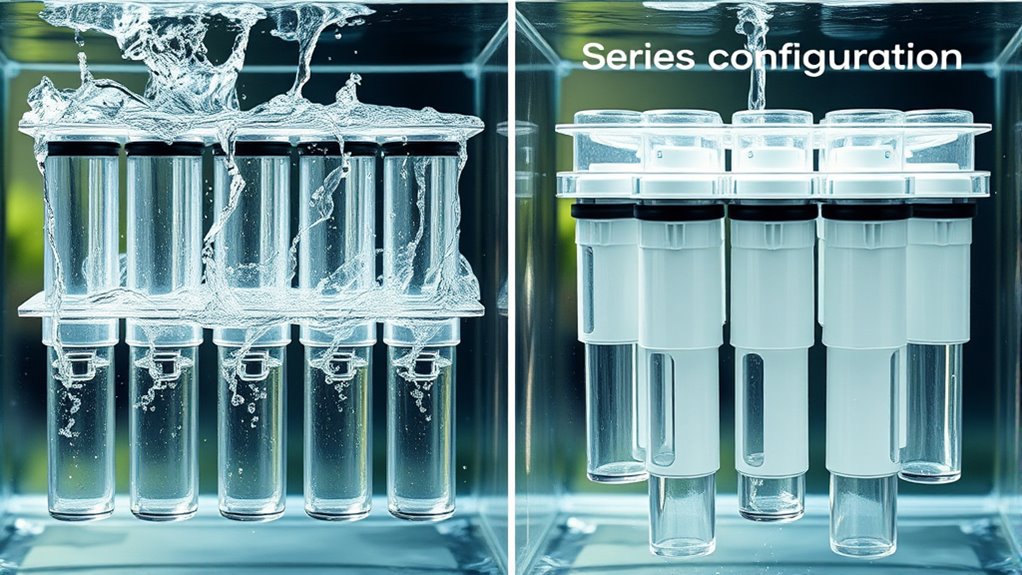
When choosing between parallel and series flow configurations for multi-filter systems, consider your priorities: parallel setups distribute flow evenly, minimize pressure drop, and simplify maintenance, making them ideal for higher flow demands and consistent pressure. Series arrangements increase pressure drop and are better suited for staged filtration or longer filter life, but may raise energy costs. To optimize system performance and efficiency, understanding these differences helps you select the best fit—more details reveal how to tailor your setup effectively.
Key Takeaways
- Parallel flow distributes fluid evenly across filters, reducing pressure drop and enhancing system efficiency.
- Series flow causes cumulative pressure drops, suitable for staged filtration or extending filter life.
- Parallel configurations simplify maintenance and allow higher flow capacity with consistent pressure distribution.
- Series setups increase pressure drop with each filter, potentially raising energy costs and system strain.
- Select parallel or series based on priorities: flow capacity and minimal pressure loss or staged filtration and filter longevity.

Choosing the right flow configuration is essential for optimizing system performance and efficiency. When considering multiple filters, your choice between parallel and series arrangements considerably impacts how the system handles pressure distribution and filter operation. In a parallel setup, the fluid divides into multiple paths, flowing through each filter simultaneously. This arrangement ensures that each filter experiences a similar pressure drop, which helps maintain consistent pressure distribution across all filters. Because the flow splits, the total system pressure drop tends to be lower, reducing the load on the pump and allowing for easier maintenance or filter replacement without shutting down the entire system. This setup is ideal when you need increased flow capacity or want to minimize pressure loss, especially in systems where maintaining uniform pressure is critical for performance.
On the other hand, a series configuration involves fluid passing through filters sequentially. In this setup, the filter arrangement causes the pressure to drop progressively as the fluid moves through each filter. This results in a different pressure distribution pattern, where the first filter experiences the highest pressure, and subsequent filters see less pressure. This can be advantageous in applications requiring staged filtration, where each filter removes specific contaminants, or when you want to extend the lifespan of individual filters by spreading out the workload. However, keep in mind that the pressure drop across the system increases with each additional filter in series, which can strain the pump and lead to higher energy consumption. The pressure distribution in a series system also tends to be uneven, with the filters closer to the pump bearing the brunt of the pressure load.
Choosing between these arrangements depends on your specific system needs. If you’re aiming for balanced pressure distribution, easier maintenance, and higher flow rates, a parallel configuration is usually preferable. It ensures that no single filter bears too much pressure, prolonging filter life and simplifying operation. Conversely, if staged filtration or contaminant removal efficiency is your priority, a series setup might be more suitable despite the increased pressure drop. Consider how the pressure distribution impacts your system’s energy consumption and maintenance schedule. Ultimately, understanding how each configuration influences the flow and pressure helps you optimize system performance, reduce operational costs, and extend filter life. Your goal should be to match the flow arrangement to your system’s demands, ensuring reliable, efficient operation with minimal downtime.
Frequently Asked Questions
How Does Flow Configuration Impact Maintenance Costs?
Flow configuration directly impacts your maintenance costs by affecting maintenance frequency and complexity. Parallel systems typically require less frequent maintenance because filters share workload, reducing wear. Series setups may need more regular upkeep since each filter handles full flow, increasing wear and potential failures. These differences influence your overall cost implications, making parallel configurations more cost-effective for easier, less frequent maintenance, while series setups could lead to higher ongoing expenses.
What Are the Space Requirements for Each Setup?
It’s often believed that parallel setups require more space, but in reality, they can be more compact because filters are installed side-by-side, reducing the overall spatial footprint. Series configurations tend to need more room due to longer piping and larger footprints for sequential installation. The installation complexity also influences space needs, with series setups generally demanding more space for precise alignment and maintenance access.
Which Configuration Offers Better Energy Efficiency?
You’ll find that a parallel configuration generally offers better energy efficiency because it allows for efficiency optimization by distributing flow evenly across filters. This setup reduces overall energy consumption, as each filter works independently, preventing overloads and minimizing pressure drops. In contrast, series configurations can increase energy use due to higher pressure requirements. Hence, if energy efficiency is your goal, a parallel setup is usually the better choice.
How Do Flow Configurations Affect System Scalability?
Flow configurations directly impact your system’s scalability by affecting flexibility and installation complexity. Parallel setups enhance system flexibility, allowing you to add or remove filters easily as your needs grow. However, they can increase installation complexity. Series configurations are simpler to install but less adaptable. By understanding these trade-offs, you can choose the best setup to efficiently scale your multi-filter system without unnecessary complications.
Are There Specific Industries Favoring One Setup Over the Other?
You’ll find that industry preferences often dictate whether parallel or series configurations are favored, based on their specific needs. For instance, water treatment plants typically prefer parallel setups for easier maintenance and flexibility, while chemical processing industries might lean toward series arrangements for more precise filtration control. Customization options play a key role, allowing you to tailor flow configurations to meet unique operational requirements effectively.
Conclusion
When choosing between parallel and series flow configurations, consider how each impacts system efficiency and maintenance. Did you know that parallel systems can reduce pressure drops by up to 30%, making them more energy-efficient? By understanding your specific needs, you can select the ideal setup for your multi-filter system. Remember, the right configuration not only improves performance but also extends filter life, saving you time and costs in the long run.